Feria de vinos, Jerez del siglo XXI, Lavinia Madrid

New sherry based event alert – next Friday afternoon Lavinia in Ortega y Gasset will be hosting a wine fair called “Jerez of the XXIst century” – which looks very promising.

You can sign-up here and although there doesn’t seem to be a lot of detail I am told there will be 15 top class bodegas represented (the only one I know for sure is Emilio Hidalgo, which would be reason enough to go if you ask me).

Lavinia

Oloroso en rama 2009, saca de febrero 2016, Williams Colección Añadas


This is a vintage, en rama oloroso from the 2009 harvest which I was lucky enough to try at lunch yesterday in Verdejo Taberna Artesana. It is from a fantastic release by Williams & Humbert – the Williams Colleción Añadas – a case of six different añada wines including finos, olorosos and an amontillado. (I actually have one of these boxes – acquired via Coalla Gourmet – but am hoping to find an opportunity to open all six.) I haven’t seen a ficha for this but am told by a reliable source that the wine is from the pago Añina, on tosca cerrada.

As you can see it is a dark gold in fino terms but a light honey colour for an oloroso – six and a half years of oxidative ageing. It really looks good in fact. The nose is equally promising:  dry but has aromas of fruit, alcohol, cake and maybe just a bit of seaair – I even felt like there was a burnt, campfire edge to it. 

On the palate it is fully dry but has a plump, rounded profile and is full of flavour – delicious in fact. Rich, acidic, alcoholic, fruity and with an edge of minerals before a long almost sweet finish. 

A really top class wine – looking forward to opening the box!

Palo cortado Marques de Rodil 

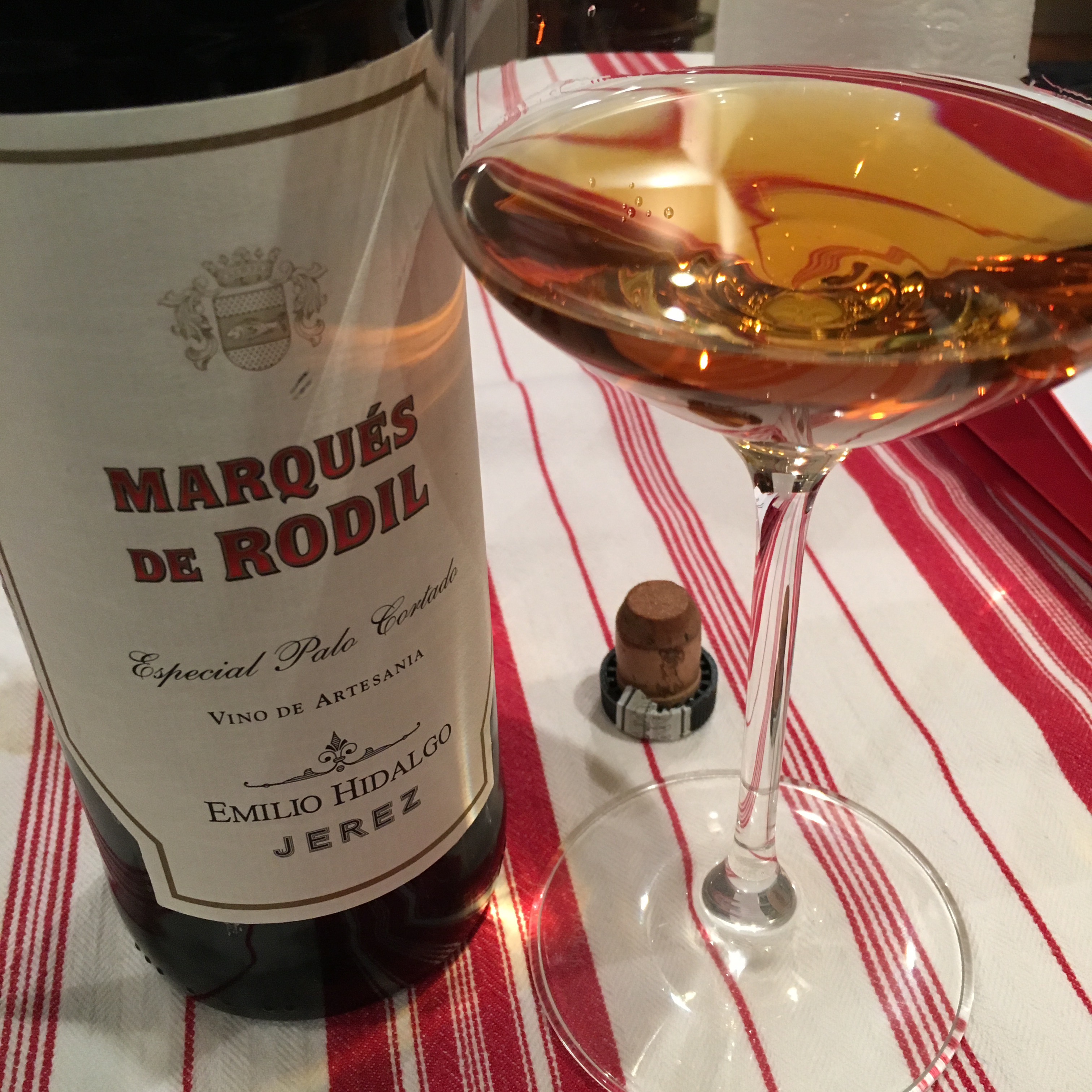
So here is a wine you don’t see around a lot. Emilio Hidalgo is probably my favourite single label – as if La Panesa were not enough on its own they also make El Tresillo and El Tresillo 1874, not to mention El Privilegio 1860 and the ethereal Santa Ana PX. In fact the only wine I hadn’t tried before from this bodega is this Marques de Rodil “especial” palo cortado, which had an average age of anywhere between 15-20 years when it was bottled in 2013.

As you can see, it is beautifully clear. (I like to take pictures against this table cloth – the straight lines help give an impression of turbidity – as you can see above this wine is as clear as a bell. It is also a relatively pale amber colour – at least a shade lighter than you might expect from a palo cortado. The nose is also different – there is a kind of semi-volatile aroma there, not as sharp as in the amontillados, with saltiness and caramel in the background and to be honest the lack of definition is off putting: it smells reductive for all the world, as if it were a red wine with poorly integrated sulphur. (Maybe it is just my bottle – I am going to double check.)

On the palate it doesn’t suffer as badly and has a lovely combination of caramel, bite and salinity, with a long finish that seems to suggest fruit. The zingy salinity, in particular, is very noticeable for a palo cortado, but if anything it seems elegant and maybe lacking the structure of the racier palo cortados.

A typically elegant wine this one but I must admit I find the nose difficult.


Fino Inocente 

Macharnudo power in Surtopia today. I have had this many times in the past (here is one) but I really look at this in a different way after my day on the pagos. Not looking for acetaldehide here – the haybales don’t come out even when the glass is empty – but rather the muscle of the albariza and the sapidity and those two qualities are certainly there. It is incredibly compact and austere, elegant/horizontal in profile and leaves a mouthwatering tingle that lasts and lasts (I am reliably informed that this is the effect of the caliza), giving it an incredibly fresh and refreshing finish.

I see that back in the day I was ahead of my time and compared this one with the Bota de Fino 54 “Macharnudo Alto” (which does after all come from the same neighbourhood). Reassuring to see that those notes and those of the day before correspond roughly to my thoughts now, so I am not imagining these qualities. More interestingly, a clear demonstration of the different profiles of fino that can be produced from the same grape and on the same pago (and by the same chap now I think about it) using different techniques in the solera: this stark, compact, sapid style or the big, expansive, almost fruity 54.

Delicious, classic, and illuminating. I have since been told by none other than Alvaro Giron that this (and other macharnudos) is a prime candidate for cellar ageing – “at least” five years. See you in 2021 for that one!


Vino de España una pasión 2016

Pasion 2016

Wanted to give a bit of publicity to this absolutely cracking event coming up in May. Previous editions have been in Jerez and were excellent – really top class bodegas and atmosphere – and although it will be in Seville this year I don’t expect any less.

I love the emphasis – excellent sherries and manzanillias alongside top class wines from every region and style, and looking at that list there are some really exciting bodegas, old and new. Some favourites of this blog both from the sherry region – Emilio Hidalgo, Barbadillo, Forlong, Gutierrez Colosia, José Estevez (owner of Valdespino and La Guita) and Bodegas Luis Perez – and beyond.

But don’t take my word for it, here is Juan Manuel Martin Hidalgo, the organizer and founder of the tradition explaining last year’s event in person (in Spanish).

All the details are on the web. See you there!

Jefford on Sherry again: The coming of Jesus

Coming of JesusAndrew Jefford wrote for me one of the great books about French wine and it is thus incredibly heartening to see him coming round to the one true faith.

Following on from his piece on Jerez and the terroir challenge a few weeks ago he has now penned a really nice piece on Equipo Navazos (they of the Magic Numbers and equally Magic Wines) and, in particular, Jesus Barquin, with the topical Easter monday title: “The Coming of Jesus”. (I know some of the guys down there may bridle at the use of the word “saviour” in this context but anyway.) Fantastic stuff.

Manzanilla Sacristia AB – 2a saca 2012


I have had mixed experiences wih these (the 1a saca de 2013 (preblog), the 2a saca de 2013, the 1a saca de 2014, the 2a saca de 2014, and the 1a saca de 2015) but it was only recently that I found out that the these sacas are from different bodegas. According to this piece by Spanishwinelover, the first few (the first sacas were 2010) are from Sanchez Ayala, the more recent from Bodegas Francisco Yuste (a new bodega but one that acquired the historic solera of Conde de Aldama).

Wherever it comes from (and I am assuming Sanchez Ayala) this is a real beauty. The colour is a dark, dark gold, on the nose it is very aromatic and yeasty (lot of hay bales for a manzanilla), then on the palate baked apple-like fruit, zingy salinity, and a long, long tail of those fading apple, yeast and mineral flavours.

A really tasty, almost explosive, wine. I have found some of the others shy, refined or restrained but this is none of those things. Wonderful stuff.

Fino Tradicion Saca de Octubre 2013 


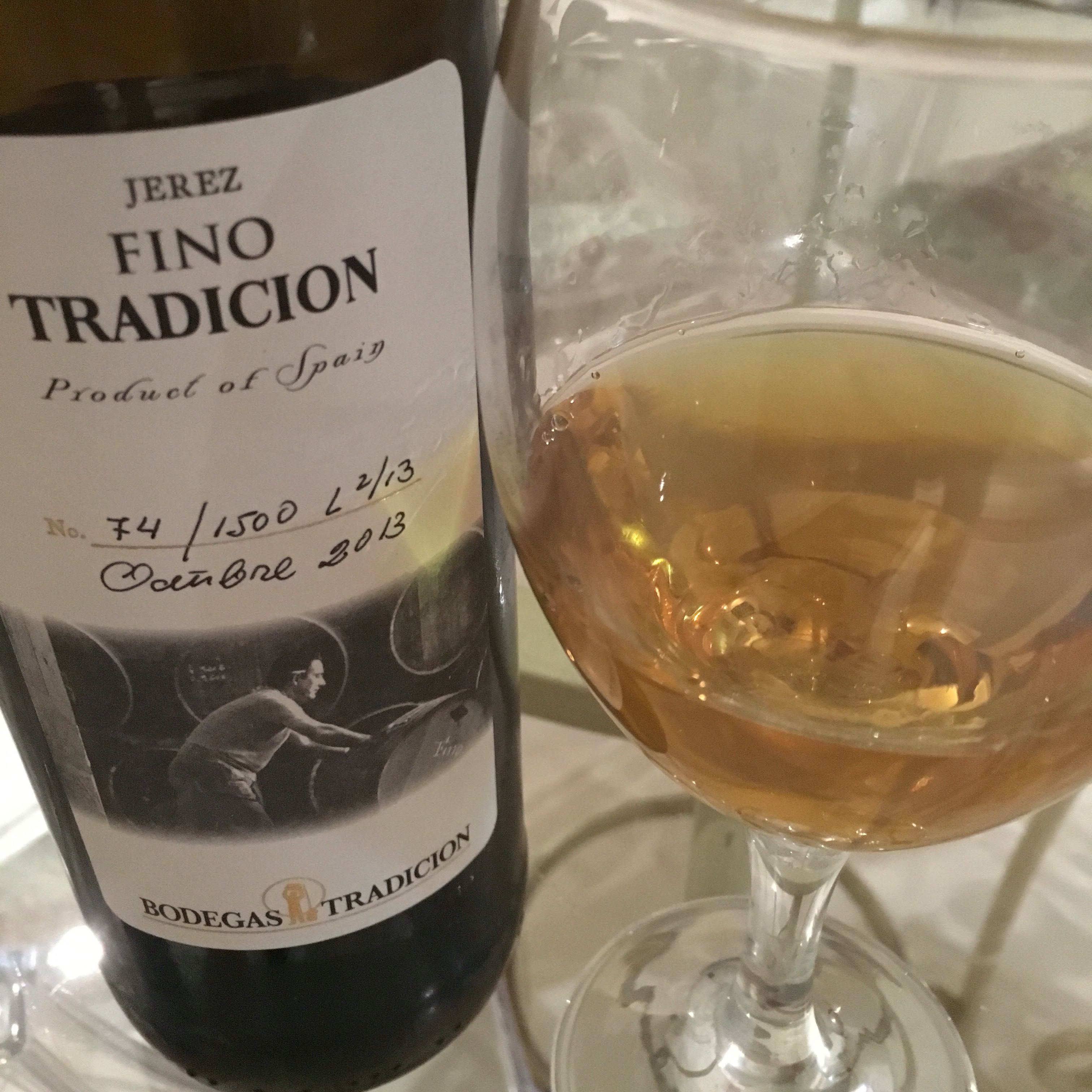
So here we have bottle number 74 of the second saca of 2013 from this fantastic bodega. On the blog I have previously tried the May 2013 saca, the May 2015 Saca (not once but twice) and the November 2015, and pre-blog I had also had the October 2014 and my impression is that for whatever reason these are getting better as the years go by.

This one looks a shade darker in colour to me, and although this stemware is not quite the best it also doesn’t look quite right in terms of brilliance – maybe not cloudy but slightly dull. The nose is quiet and jura like but not all that cheesy, and on the palate it doesn’t seem to have the nutty, umami solidity of some of the later versions. As a result, the grapefruit flavours I noticed in the May 2013 come across as almost sour in this one. There are nice minerals, it makes the mouth water and there is a long, bready aftertaste, but just not enough on the front end.

Chalk it up to the old ones not necessarily being the best I guess.

One year under the flor

A year ago during a long weekend here on the coast I decided to start sharing my blather on this blog. Fittingly, a year later I have returned to the same spot and again have time on my hands to reflect on this year gone.

The Internet is an amazing thing: the blog has had over 16,600 hits and 5,500 daily visitors, from exactly 80 countries (and nearly half of those hits and visitors in 2016). Now judging by my spam filters a number of these are bots that want to sell me pills that will transform my lovelife or generous chaps in Africa offering me an inheritance in return for some modest lawyers fees, but even so I am pleased with those 80 countries (it would be fascinating to know what you guys make of my ramblings in Algeria, Azerbaijan, Bangladesh, Bosnia-Herzegovinia, the Ivory Coast, Greenland, and Sri Lanka – drop us a comment!).

Not that I haven’t worked at it. This is my 350th entry, just shy of a post a day (and add in the pages etc), and I have made a proper nuisance of myself on twitter, 3,386 tweets, or nearly 10 a day. To be fair the posts are generally pretty short and sweet – generally just my thoughts on a wine, a link I have seen or a bit of general blather.

Looking at the stats though I see that the top posts in terms of hits are the ones that get worked on a little bit:

  1. Jerez and Terroir by Jefford and Others. A collection of writings on a subject that deserves some study.
  2. Taberna der Guerrita – my tribute to a legendary spot with a big fan club (apparently)
  3. You win somm, you lose somm – my tribute to the geniuses that make wine and food taste better
  4. The magic numbers: the big one – a follow up tribute to the marketing genius of Equipo Navazos
  5. Vintage Chic – a heartfelt plea for more vintage sherries 

Anyway, it really hasn’t felt like an effort to write. As I noted early on, it becomes a bit of a virtuous circle: the blog encourages me to try more different wines, and when I try them to focus on them more, which increases the enjoyment and makes me want to try more wines, etc etc. While it is a lot of wine from one region, the variety of styles and characteristics keeps it interesting and the sheer number of tastings has clear benefits: these wines can have such an impact on first tasting that a second dip a little while later can produce a much clearer analysis of the wine; and comparing a lot of different wines of the same style in quick succession can be instructive.

In addition to the general improvement in appreciation there have been some highlights:

  1. Pagos, Albariza, Palomino and the wines they can produce – took the absolute cake. A mind enlarging day that changed the way I look at these wines.
  2. The night of the Pitijopos (and six days later) – was a real privilege to try this fantastic experiment in terroir with the boys.
  3. The sherryTT: a twitter tasting of palo cortados with Sherrynotes – was a really fun way of tasting and swapping notes on some wonderful wines (my tweets here)
  4. Lustau Almacenistas in Taberna Palo Cortado – another brilliant night and a great tasting
  5. A fantastic dinner  with my Madrid crew with some special wines (admittedly not sherries)

In fact it has been a great year. The blog has helped me get in touch with and even get to know other bloggers, bulletin boarders, tweeters, sommeliers, distributors and, best of all, winemakers. Really top quality people from whom I have learned (and with whom I have drunk) a lot. In particular, I have received a lot of restaurant recommendations: I started writing down a few of my favourite haunts for sherry drinking but thanks to comments and messages received since it first went up the list has now morphed into a list of 57 restaurants around Madrid, Spain, Europe, the US, and the Pacific. The recommendations that have come in have been cracking, and the page with list is the most visited and most commented on part of the blog.

More importantly, the blog has lead me to try different styles of wines and broaden my horizons in general. This time last year I had never heard of los Sobrinos de Haurie (or even Haurie), I hadn’t begun to discover the new horizons those two blokes are striking out towards (from Carrascal to Carrascal and beyond) and I had never set foot on an albariza pago, let alone all the great pagos. Neither had I even started to look at any of the great writing that is out there (to be honest I have still only scratched the surface – this is only a hobby blog after all).

On balance I just wish I had started this blog years ago. Anyway, a massive thankyou to all of the folk out there who have contributed to a fun first year and let’s see how we get on in year 2 …


Cuatrogatos Wine Club

Fede

“Cuatrogatos”, or “four cats”, comes from a joyous Spanish expression meaning “very few people”. I am pretty sure the name was chosen in reference to the very few people that drink the adventurous, indy wines that the club is focussed on but it is also true that there are very few guys around like Federico Ferrer, the fantastic bloke behind the Cuatrogatos Wine Club (for some reason pictured above with something foamy).

My first contact with the Cuatrogatos was last September when looking for one of the most exciting wines of the last year: the Callejuela Manzanilla de Añada. I remember seeing a picture of this revolutionary liquid on twitter and tweeting to find out where I could get it. Within seconds I was directed to the Cuatrogatos – making that my most important tweet of the year by a distance.

Because that amazing wine was the first of many gems I have discovered via the club – other highlights include the El Cerro oloroso, an old vine PX from Callejuela, the spectacular Fino by Alexander Jules (and the Manzanilla which isn’t too shabby either), the Maruja Manzanilla Pasada, the Encrucijado and the Pandorga. And all that was before I managed to persuade the Cuatrogatos to send me the full catalogue and discovered more than a distributor of exciting sherries. The catalogue reads, in fact, like an A-Z of up and coming winemakers in Spain, with names like Zarate, Albamar, Coto de Gomariz, Zorzal, Tentenublo, Barco del Corneta, Charlotte Allen, Silice, Losada, Mengoba, Quinta Milu, Altos de San Esteban, and Bernabé Navarro alongside Alexander Jules, Juan Piñero, Primitivo Collantes, Callejuela and Cota 45.

It is a fantastic selection of stuff that is both interesting in itself and hard to get elsewhere, and a testament to the passion of the guy behind it all. I will never forget meeting Federico earlier this month – not only did he introduce me to one of the most exciting winemaking talents around and help organize an inspirational visit to the vineyards of Jerez and Sanlucar, he brought more than his share of good humour to the party – even as we were pillageing his 100 year old birthday-present amontillado (no greater love hath any wine lover, etc.).

The great Marx (G) was famed for not caring to be member of any club that would have him as a member, but even old Groucho would have approved of the Cuatrogatos. As the web says: no membership card is necessary, only the desire to have fun.

Carnet