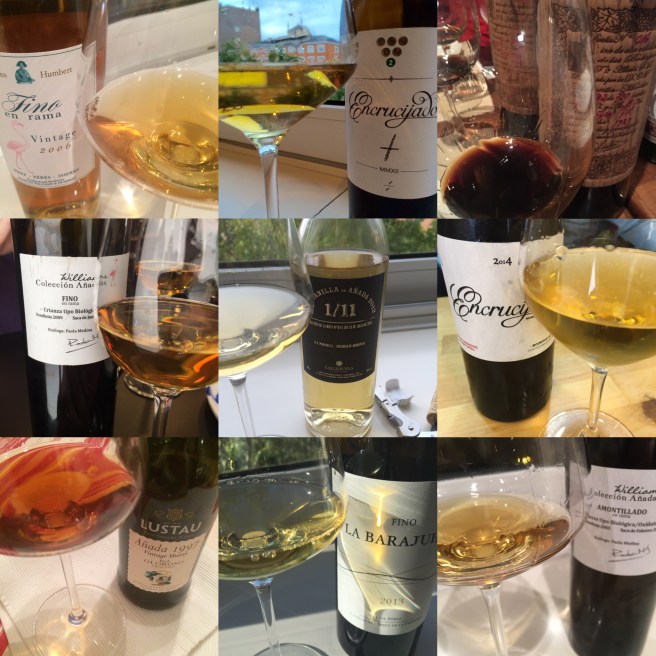
Equipo Navazos


A fella has a pretty decent supply here: 16 bottles and 11 different wines from this brilliant team. A fair few more have come and gone too.

I have written before about the contribution these guys have made to marketing these wines with their magic numbers and the resulting scarcity.

But more importantly, the wines are of a very high quality indeed. Even in the three years I have known about them I have had the pleasure of 23 different botas:

Between them they cover every category and style of wine: some classic and elegant, some extreme, museum pieces, some innovative wines and some pushing the technical boundaries. And to these you can add bubbles by Colet Navazos, table wine under the label Niepoort Navazos, brandies and who knows what next?

It really is a fantastic body of work.

Manifesto 119

Manifiesto-119

Been meaning to post a link to this excellent article (in Spanish) by Pepe Monforte on his blog http://www.cosasdecome.es concerning an interesting movement called Manifiesto 119.

There are a lot of manifestos floating around at the moment in the world of Spanish wine (some in favour of unique vineyards, some in favour of bag in box), but I think this one is particularly interesting. It is now several months since it was reported (and live tweeted by some of the protagonists ) but I was reminded of it recently in an exchange on a forum with a fellow enthusiast .

The “119” is a reference to the large number of varieties of grape that were recorded by the eminent 19th Century botanist Simon Rojas Clemente as autoctonous to Andalucia, of which 40 or so were found in the region of Cadiz. 200 years on, a passionate group of winemakers are setting out to bring some of these varieties back, replanting the varieties and making some interesting stuff with them.

I have taken the liberty of borrowing the above picture from the blog post – because it is a cracking round up of the usual suspects (who also happen to be among my favourite wine makers):  Ramiro Ibañez, Willy Perez, Armando Guerra, Primitivo Collantes, the guys from Forlong and the guys from Callejuela.

To be honest I haven’t really had a chance to try many of the actual wines: off the top of my head the Encrucijado (which has a coupage of palomino and five others), tintilla de rota in various forms and maybe at a pinch the three strains of palomino in the UBE (although they may only count as 1 of the 40, not sure).

The article though talks about a few interesting projects: 1700 vines of “uva Rey” or mantúo planted by Primitivo Collantes; wines from gateta made by a bodega in Chiclana called el Sanatorio; a bodega called Ambrosio de Olvera working with perruno; and an outfit called Mostolé with plans to plant mantua castellana and alarije dorada.

I certainly hope to try some before I get too much older. For the time being, all power to the 119.

Ask not what Jerez can do for you …

After a fantastic visit of Emilio Hidalgo a couple of years ago in Jerez, and struck by what a tragedy it was that I had only just found about these amazing wines, I asked our host what I could do to repay him. His answer was simple: “you seem to eat in the right places, do me a favour and ask for my wines”. I have not stopped doing so ever since.

The best places do indeed have his wines (even if some of them don’t know as much about them as they think), and even if they don’t, it is a technique that has paid dividends. For a start, mortified sommeliers around the world have been too embarassed to charge me for the fino that was not La Panesa, and even if you don’t get a consolation invitation, there is nothing wrong with letting the sommelier know that you know about these wines: I have yet to meet a really good sommelier that didn’t know her or his sherries.

Now, my standard routine has a couple of additional steps. “Esker vous avez la Panesa?”, if not, “would you have a fino or a manzanilla?” and, if so, “which do you have?”. Don´t stop at finos and manzanillas either. One of my biggest successes in terms of introducing friends to sherry is generally the callos and oloroso pairing. A group of friends and I are in the process of exploring the callos of Madrid, with score sheets and a ranking system tracking the best callos around town, and since I introduced them to oloroso restaurants are severely marked down if they don’t have it. (Even if you can’t get callos, oloroso, palo cortado or amontillado can be a cracking pair for almost anything tasty, so should be asked for at every opportunity.)

You will be surprized at how many places have sherry and even good sherry. I have had some very pleasant surprises along the way: the little gem of a sherry list at Punto MX would be one; my hotel bar in Vienna was another; and probably the best of all was a flight with Iberia enlived by Tio Pepe and his mate Alfonso.  Even if they don’t these wines on the list they may have some excellent bottles hidden under the bar or about the premises. I remember one fantastic mystery oloroso, label on the bottle completely obliterated, that was produced from heaven knows where in one place.

And if the restaurant in question doesn’t have these amazing wines (for shame), it is amazing the effect that we can have just by asking: in this day and age of instant reviews on twitter, facebook, tripadvisor and their ilk most places seem keen to keep us consumers smiling. If we all keep asking they will eventually get the message, and if they were to stop and look at the prices of these wines surely it shouldn’t take long to realize that for a small investment they can keep some of their more knowledgeable consumers happier.

And while we are at it – let’s all please insist on quality stemware!

Vintage chic

992ae23a-d032-4d31-94af-1902d89eaec2

The issue of vintages has been on my mind a great deal lately. First, a couple of weeks ago I was lucky enough to take part in a brilliant tasting of vintage port organized by Vila Viniteca here in Madrid – including four examples of the fantastic 1994 vintage and a wonderful Niepoort from 1970 (thanks David). After that tasting, a few of us went for dinner which we washed down with a couple of vintage champagnes (what else would you drink after port?), including an amazing Pascual Doquet 1995 (thanks Guille). After all those vintages from those two splendid regions, this blogger was left musing on why he so rarely saw vintage sherries.

Not that there are none. The half dozen or so avid readers of this blog will recall brushes with vintage wines by Cota 45 (the Encrucijado MMXII, and again), Willams & Humbert (2006 fino en rama), Lustau (1997 Oloroso), la Callejuela 2012 Manzanilla de Añada (not once but twice), Ximenez Spinola (2014 Pedro Ximenez) and, most recently, Cota 45 again(the 2014 Pandorga), and although not blogged I have been lucky enough to imbibe several vintage palo cortados (the 1974, 1983 and 1987) by the great Gonzalez Byass (my favourite, the 1974, I haven’t seen around much).

Nevertheless, in percentage terms we are not talking a great deal of wine – eight posts of a total of 287 to date – which is surprising. I bet if you looked at a blog specialized in Port or Champagne it would be a different story and it is a situation I have lamented in the past.

I am not saying do away with soleras – you certainly should maintain miraculous creations like La Panesa, Inocente and others. I also appreciate that soleras do more than merely blend wines: the wines of different average ages contain different nutrients that interact with the different strains of flor and produce different effects (which is why it is frustrating that more producers don’t specify how many criaderas they use).

But it would be great to see how much can be achieved by the fruit of an individual year’s harvest. Anyone involved in cultivation will tell you that harvests can vary widely from year to year – I remember a cracking chat in a cider bar in Gijon where the lads were worrying about that year’s apples – and while it is mathematically impossible for every year to be above average, the same laws tell us that quite a few of them will be.

Indeed, although at this level anecdotal and not very scientific, I once carried out a comparison of vintage vs solera (the 2006 Fino en Rama and the Fino Tradicion may 2015). On that occasion, although the wines were different to start with, they would have been of approximately the same age at the time of consumption and the benefit of the solera was clear – the lovely umami fullness from the action of the flor – but so was the individuality of the vintage wine (which I slightly preferred).

This is why I am increasingly of the mind that a sytem similar to the one used in the Douro – where at the sobretablas stage, say, makers and Consejo Regulador determine whether to declare a vintage or not – would be an excellent way forward. (Particularly if allied with a bit of self restraint by the makers, say 2 or 3 vintages a decade like the best Port houses.) At the same time, they could of course continue solera production.

So it is great to see stuff like the piece this week by Paz Ivison in elmundovino (which has also been transcribed into English by the excellent sherrynotes) and even more exciting to see the first sections of the book being written by Ramiro Ibañez and Willy Perez (“Las Añadas en el marco de Jerez” or “Vintages in the Jerez Region”).

I really hope that it is just the beginning. I believe vintages are more interesting and provide scope for greater expression and differentiation and must be worth exploring further. In fact, winemakers: I promise that if you make them, I will buy them.

The Magic Numbers: the big one

01p

I was reminded this week of my piece on the magic numbers when I saw on a UK wine-merchant’s price list a bottle of La Bota de Amontillado Nº1, “Navazos”, December 2005, at a price of £480 (€630) (including VAT).  This wine – of which 600 bottles were released – was not initially put on open sale, but as you can see from the comment below the line, some bottles were available for €25,80. Indeed, when I caught up with Equipo Navazos their releases of the descendants of this wine were selling in the low €30s and I am told that a few years ago Clan Tabernario got their hands on a bottle of this for around that.

Of course a wine bottled in December 2005 is bound to appreciate in value, and recently there has been a surge in interest in bottle conditioned sherries (a topic to which I really need to give some thought) but it is a pretty good markup by any standards. Even more interestingly, La Bota de Amontillado Nº26, “Cinco Años Despues”, December 2010, which again was never released to the public, and of which only 150 were bottled, is the most expensive sherry on the list at £1200 (€1578).

26p

This average to poor blogger has never tried any of these wines, which are no doubt excellent to great. However, I don’t need to try them to be able to tell you where the gained value of the Navazos wines comes from: their unique character and scarcity (and I was going to suggest also their historic value).

Let’s put this in context, though: that £1200 (€1578) wouldn’t get this wine into the top 300 prices on this list – in fact it is equal 345th price on this (pretty awesome) list (although looking back some of those prices are for “assortments” of DRC, for those keen on multi bottle packs)  and less than a tenth of the £12,000 stickers on some of those very big beasts.

The wines of Jerez are still a very long way from their rightful place at the top of the pile, but I really believe that Equipo Navazos are showing the way forward. All hail to them and enjoy those 26s if you still have them fellas!

What’s new in Jerez and Sanlucar?

Wanted to link to my latest post on the sherry.wine site – no surprises here for any followers of my scrawlings.

In fact I wrote it before Christmas and it was published early January, but with a number of typos and embarassing errors (Coto, not Cota ffs) that I have only just managed to correct (although there is still a bit of misdirection in there by special request).

Having corrected it, I then tweeted a link which didn’t work, although this one seems to. Anyway, would be fascinated to know what people think.

Are the children really our future?

280px-Cripta_Cappuccini

With apologies to the late, great, Whitney Houston, I am taking a liberty in an attempt to harness the famous first line of the Greatest Love of All to my own ends. Namely, in response to an interesting piece that was posted by winesearcher about the decline of fortified wines under the provocative title “Fortified wine’s final generation?”

It is a piece that starts brightly enough, noting that “The magnificent fortified wines of Port, Sherry and Madeira are undoubtedly some of the greatest and longest-lived fine wines available in the market today.” But soon it takes a more pessimistic turn, noting that, the occasional green shoot aside, the image is all wrong, sales are down since 2003, people don’t drink much port or sherry any more etc. It is a pretty impressive piece full of statistics and quotes from influential sommeliers and the like, many of them full of doom and gloom.

The piece gives particular prominence to the reported fact that “the majority of fortified wine drinkers are males older than 45” while, by contrast, “only” 22% of people aged 18-34 are drinking sherry (and only 25% are drink port).  The piece then poses the worrying question of whether “fortified wine [is] heading for a slow death as Generation Y continues to shun the style?” Even more apocalyptically, the piece then worries about the impending extinction of the over 45s: “… as that generation eventually dies out, is there any evidence that younger drinkers will take their place?”

While the evidence looks solid enough and, it has to be said, sounds plausible too, the “angle” seems to miss the point. You see, what our younger colleagues may not yet appreciate is that, as the plaque in the capuchin monks famous ossary (you may have been wondering about the picture) points out, “what you are now, we used to be. What we are now, you will be“. Incredible as it may now seem, a mere 8 years ago I was myself part of that 18-34 demographic. On the other hand, the majority of people in that 18-34 demographic today will one day literally grow out of it. In fact, barring really apocalyptic Hollywood blockbuster style developments or zombies, there will always be people (including males) over 45.

And the point is that at different times of our life our relationship with wine changes. Did I drink wine in my youth? Only occasionally, it must be said. I really started taking an interest in my mid-20s when I fell in with the right crowd in Brussels. As for sherry, it really only got hold of me much later – I would say at age 36 and I have certainly made up for lost time since then. For a start, it just wasn’t available to me before that – it is no secret that for the last 20 years sherry sales haven’t been as buoyant as in the past. I also think that sherry, in particular, is a grown up wine – challenging and complex, intimidating even. In fact, to me 22% seems a pretty healthy percentage- of course it could be higher, but unless that percentage has itself declined it doesn’t on its own look like cause to worry.

So I really don’t think it is a problem that the youngsters aren’t hitting these particular bottles right now. From where I am sitting the outlook for fortified wines – and particularly, dry sherries, is bright. As the piece itself recognizes, “Both Sherry and Port are growing in value and volume” and that growth in value is almost tangible in the market.  Pioneers like Equipo Navazos and Tradicion have forced open the cellar door and an ever larger number of historic bodegas and classic wines are emerging, blinking, into the light. There are sherry bars opening all over the place. And  even more exciting things are happening as experimental mavericks are taking on the rulebook and questioning everything.

And the best thing about this renaissance is that it isn’t purely based on clever marketing (although there is some really clever marketing involved) but on quality, and in today’s world quality will win the argument. Going back to my spell in that 18-34 demographic, we didn’t have the internet, apps (we didn’t even have smart phones – imagine that), points scores, winetrackers or winesearchers to help us find the right wines and we didn’t have the million and one blogs by enthusiasts telling us what to drink. Today, all these innovations make it much easier for anyone with a bit of interest to find quality wines. It is no surprise to me that sherry has been a major winner as a result.

So please, let’s not worry about marketing to the kids – let’s just keep making the best wines we can. If you build it, they will come.

The mistake I make when tasting wine


Going back a good few years I used to play snooker with a mate in a smoke filled cafe in downtown Brussels. We would rock up after work and play a few frames with several nice Belgian beers, of which our favourite at the time was Duvel, a masterpiece of brewing that is incredibly dry and an impressive 8.5% proof. Anyway, there was a waiter there who was also an excellent player and one night, frustrated by our poor play, we asked him if he had any words of advice to improve our snooker. He shook his head and said: “don’t drink Duvel”

We didn’t take his advice of course – without the soothing liquid I could never have borne the outrageous fortune and underhand tactics of my competitor, but years later I can see that that anonymous guru was onto something. There are several clues. First, there are recent incidents when at the end of a long night I just don’t have sufficient recollection to write a report worth the name. Second, when I look back at some tasting notes I have written I sometimes wonder “what was I on when I wrote this?” (the answer, generally, is about 8-10 units). In fact, on the many occasions I was fortunate to have had great nights dining with great friends and lovely wines (this in particular, but you can see evidence of another here), I can’t honestly remember the details of the wines involved with any precision.

On the other hand, when asked to name my favourite wines of 2015 it was really noticeable to me that the wines that stood out most in the memory (aside from the stellar sherries on here) were generally wines I tasted in either a formal setting in which I even used a spittoon (or, appropriately enough, around the snooker table).

I suppose it is a paradox of wine blogging – the more you enjoy your wine the more your ability to appreciate it, or at least to remember what you thought of it, diminishes.

Bottle shape rant 

Am upgrading my rant to post status.

On the left above we have the Regente Palo Cortado in its new packaging, bottled in a stockier, you could say dumpier, “old school” bottle. To be fair, they look original, interesting and even attractive on the shelf – all very minimal and elegant. And they are not the only brand to be making use of original and attractive packaging: off the top of my head the most extreme examples include the Barbadillo Reliquias, Manzanilla la Kika, and the Old and Plus range (again from Sanchez Romate).

But on the other hand, I do find all these different shaped bottles a bit taxing – a fella only has so much storage capacity in his wine fridge and wines that depart from the standard bordelais are as easy to store as square pegs in round holes. I also think there are problems from the point of view of the image of the wine. I believe sherries are wines that need to be packaged as such – by chosing random bottle shapes labels are reinforcing the alarming idea that sherry is some sort of exotic liqueur.

What is more, the cork/stopper on this is also an attractive rounded shape, but when I took the plastic seal off the top there was moisture/stickiness there: if the wine is escaping we need to talk about our priorities here guys.

OK, rant over.

Will sherry be the next “new gin tonic”? (Hopefully not)

The title isn’t my own invention – it is the title of a piece from El Comidista, published a little while ago.

It is a hopeful piece in that it picks up on some of the signs of optimism surrounding sherry at the moment: the Mystery of Palo Cortado movie; the prominence of sherry on the wine lists of top restaurants; the apparent success of sherry in tapas bars in the US and the growing number of sherry bars opening up. It also identifies two of the most important labels behind this new momentum – Equipo Navazos and Bodegas Tradicion.

Nevertheless the title of the piece is disconcerting and the reasoning seems incomplete. Despite a lot of good input, the overall impression is that the author started off with a bad idea and never really joins the dots.

It is true that gin and tonics are dry, as are some sherries, and that for the price of 2 or 3 gin and tonics you could have a cracking bottle of sherry, but the same is true of champagne or, come to that, a lot of quality wines. Why should sherry be a competitor of gin and tonic or vermouth and not of champagne, claret or burgundy (of either colour)?

I frankly am no expert, but whatever anyone tells you about their preferred brand of gin or tonic, their choice of salad accompaniment and goldfish bowl/chalice/goblet to put it in, by comparison to the wines of Jerez and Manzanilla these are standardised products that will cool you down, get you drunk, and maybe (depending on the tonic) protect you from malaria. Gins may not all be made in bathtubs and served in coffee cups these days, but they are products produced on an industrial scale and their success is based on differentiation, branding and marketing more than on uniqueness or complexity.

The same concepts have a role to play alright (the magic numbers again) but the wines made in the sherry triangle can be so much more than marketing. These are some of the most wonderful, complex wines being made and with every advance in terms of terroir and vintage more singular, exciting wines will be available.I really believe there is so much potential in the region for making great wines that it would be a tragedy if they fell back into the bad old ways of chasing the mass market.