Primitivo Collantes in Enoteca Barolo

Primitivo Collantes is one of the true unsung heroes of the so called sherry revolution. He and his wines are from the Southernmost tip of el marco in Chiclana – outside the traditional centres of Jerez, Sanlucar and el Puerto – but the wines are as good as any that you will find from El Marco and on Monday Primitivo himself gave a masterclass on the new wine making in the region to a packed house in Enoteca Barolo.

A really excellent tasting in fact. As you can see above, we had explanations of the geography and climate, sobretablas from different soils, samples of the soils themselves (including from the famous Finca Matalian), wines of different styles and at different stages of ageing, explanations of the major choices made in making the wines and some really neat nuggets of technical wisdom.

Most importantly, the wines were cracking – Socaire, the Arroyuelo Fino en Rama and Amontillado Fossi you may have already heard of, but we also had the chance to try a Socaire with a touch of oxidation from an additional 8 months ageing and a frankly beautiful, elegant, light and spritely fifty year old moscatel.

As always, will take me sometime to write up my notes – for the time being my congratulations to Enoteca Barolo and the man himself. Bravo!


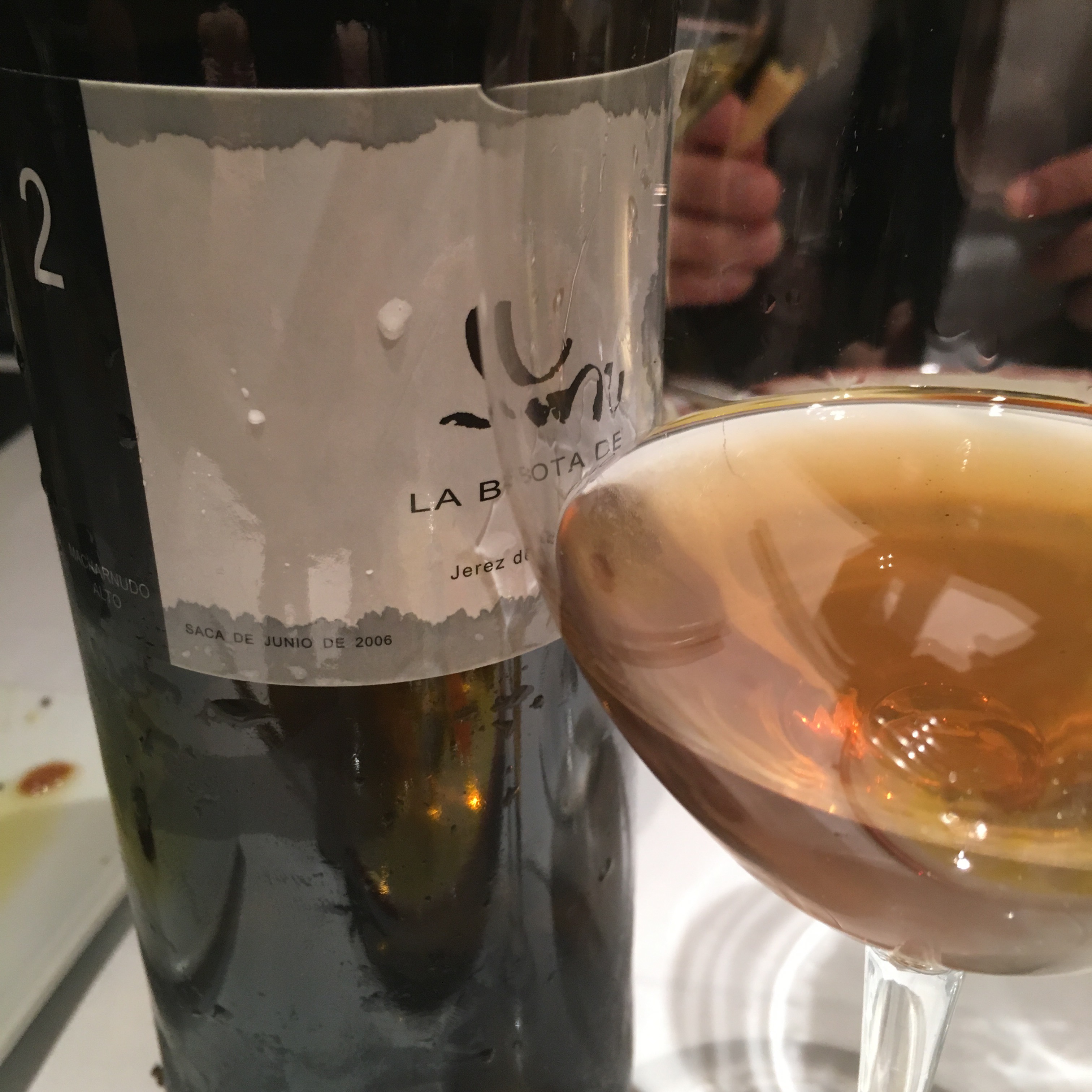
La Bota de Fino 2 – Jerez de la Frontera 

The first of the epic series of finos released by the guys at Equipo Navazos, of which I have had the good fortune to taste several (including the Nº35, the Nº54 and, my favourite so far, the Nº 68). This was bottled way back in June 2006 and as you can see from the ficha even back then the makers were thinking in terms of its evolution in the bottle.

As you can see, ten years later it is no longer gold with a greenish hue: a lovely rich amber instead. The nose is all hay bales and crusty bread – a real rustic bakery nose -, it has a nice profile of zingy/salinity and mouth watering finish and the flavours in between are savoury and rich in umami. A really class fino, even ten years later.

And yet there is a but here, because I can’t help comparing this refined, elegant old wine with the swashbuckling, punchy Nº68 that I enjoyed a few weeks ago. I may be in the minority, but not for the first time I find this glory (and there is no doubt it is delicious wine) to be a little faded. (Of course it may be confirmation bias: the excuse I am looking for to stop worrying about cellaring and drink up these cracking wines as soon as I can.)

I look forward to the debate on that. In the meantime, I want to take a moment to show my appreciation to Fernando at Cuenllas, who made it possible for me to try this and some other special wines during what was an absolutely phenomenal meal yesterday. Absolutely top drawer.

Pitijopos: Lessons in the terroir of Jerez and Sanlucar


This week I finally got around to tasting Volume II of the “Pitijopos”.

Pitijopos is literally the Jerez/Sanlucar word for mayflies but here it is the name given to a boxed set of six “mostos”, or palomino wines (even if, confusingly it is also a term given to unfermented grape juice elsewhere in Spain ) from different vineyards in the Jerez region.

The vines are all tended and harvested, by hand, by Ramiro Ibañez of Cota 45. Then each of the six wines is fermented at ambient temperature in wooden “butts”, where they stay for a good few months (unless I am mistaken 9 or 10) before being released as part of a set of six. The whole exercise is designed to show the influence that the terroir can have on the wines, and in doing so also demonstrate that far from being “neutral” as many suppose, palomino can be as expressive as any other great white grape.

It really is a fantastic project and just a small part of the work that Ramiro Ibañez is doing on behalf of winemaking in Jerez and, his hometown, Sanlucar (amongst other things, he is writing a winemakers history of the wines of Jerez and Sanlucar, which looks like being a fascinating retake on the traditional, bodega centric vision).

The first Volume of the Pitijopos, “From North to South”, was produced in 2015 and involved mostos from six different locations right across the Jerez region, from Northwest to Southeast: Trebujena, Sanlúcar, Rota, Jerez (Añina and Macharnudo) and Chiclana. The wines were strikingly different and fascinatingly so (you can see my reports on the initial tasting in this note – and then on the same wines after further study in this one).

In fact, even without the chance to taste six at a time there is a clear benefit to tasting these mostos, since it can give you a look at characteristics of the base wines that the biological and other ageing processes obscure – the difference between Añina and Macharnudo, two pagos (vineyard clusters) that face each other across the Sanlucar road – is memorable.

So I was really looking forward to Volume II. “Atlantico vs Guadalquivir”, and it didn’t disappoint. This time all six wines are from pagos around Sanlucar. As a result there was a more evident unifying style to the wines, and if I had to choose I would say Volume II had the edge on Volume I in overall quality, but again the differences, even between wines from only a few kilometres apart, were striking. I posted a full note of this week’s tasting (from my heavily hungover state) on Thursday (although I still have a little bit left and don’t rule out writing a bit more at a later date).

Overall it really is a fantastic effort by the winemaker (and the word here is effort, just think of the work involved in making six different wines like this) and two of the most educational, instructive tastings of my life (can you imagine having the opportunity to taste something similar from Pomerol or the Còte D’Or?).

I am told that Volume III is in the works (in the botas even), and I can’t wait to see what Ramiro has in store, but for me the key argument has already been settled conclusively. Namely, if Jerez and Sanlucar are to regain the prominence they had, the historic soleras will not be enough on their own: the traditional virtues of terroir and winemaking have an important role to play. And if and when it does happen, we will all owe a big debt to Ramiro Ibañez.

The Night of the Pitijopos – Volume II

It has taken a little while to organize but, at long last, here it is, a chance to open the second Volume of the Pitijopos. Whereas Volume I covered the entire Jerez region, from Trebujena in the North to Chiclana in the South (via Sanlucar, Rota, and Añina and Macharnudo), Volume II is all about Sanlucar and sets up a contrast between the vineyards near the Atlantic and those inland, influenced by the Guadalquivir river.

Yet again, it is a quite fantastic piece of work: a case of six “mostos” from 100% palomino grown in six specific sites in Sanlucar, fermented without temperature controls in bota at Cota 45, and released as a boxed set together with the above fact sheet. (Just behold that magnificent diagram indicating the relative distances from the sea and altitudes of the different sites.)

  1. El Carrascal (“the austerity of the Atlantic extreme”) – not to be confused with Carrascal de Jerez, this is the closest pago to the atlantic (7,4 km) billed as having the “purest and most homogeneous” area of “antehojuela” albariza, said to produce the freshest, most vertical wines. And it certainly was fresh – had a metallic, mineral and almost smokey and lemon juice nose, and a really sharp, fine profile, with metallic flavours and what seemed like a fair whack of volatile acid upfront (lacquer) and behind (esparto grass).
  2. Miraflores Alta (“balance and precision”), further inland (7,9 km) where the antehojuelas give way to the tosca cerrada, making for wines with more structure but maintaining some of that Atlantic freshness – considered amongst the finest pagos and associated with some historic names. This was frankly superb, with a lovely elegant profile, juicy, jammy citrus flavours and saline zing. Powerful but silky/slippy. Again the volatile was evident but much better integrated.
  3. Cuadradillos/Charruado (“structured but fluid”), the furthest of the three from the Atlantic (9,45 km) characterized by tosca cerrada in the higher areas and albariza of lesser purity lower down. That distance from the sea, its orientation and the types of soils are said to make for wines of greater weight and fruit. Again, it certainly lived up to its billing. Had the most extraordinary fruity, doughy nose- for all the world like a chardonnay that had been under the veil – and a big fat fruitiness to it first up, but then it disappeared a little on the palate and didn’t hold together with the same finesse as the Miraflores Alta.
  4. La Atalaya (“diagnosos bipolar”), said to be a fascinating “hybrid” pago halfway between the river and atlantic pagos, 10,75km from the sea and characterized by albariza antehojuela which makes for direct, fresh wines, albeit tempered by the inland location and climate. Again top class, with a very aromatic nose of lemon and seaside air, a fresh start, nice juicy volume and a long, mouthwatering saline, seafood shell finish. A little bit more potent than 2 and elegant but maybe not quite as silky.
  5. Maína (“the sapid empire”), or “Mahína” is found on the flood plains of the Guadalquivir, 12,75km from the sea and in an area said to be characterized by albariza de barajuela and the largest quantity of silicate fossils anywhere in the Jerez region, the famous “diatoms” said in turn to produce wines of incredible sapidity (the “diatom bombs”). It did indeed have a big stewy, rockpool nose and lots of concentrated, slightly more vegetable and peppery flavour, with a metallic, almost rusty finish. The tastiest of the six but maybe not as balanced as two and four.
  6. Cabeza Gordo (the gates of hell),  the Sanlucar pago that is furthest from the sea (14,25 km) and closest to the Guadalquivir. It is characterized by tosca cerrada with lower levels of diatoms that offers wines that are structured but more “docile” and “unctious”. Another big bodied wine, with a nose of ripe apples, almost pineapples, but only just a hint of shape – and like three a little diffuse at the back end (where the volatile is noticeable again).

Overall the wines were cracking good – in particular Miraflores Alta and the Atalaya – and the general level was excellent. More importantly, yet again a fantastic demonstration of the kind of expression of terroir that is possible in these wines. Bravo!

And really a brilliant night, thanks in no small part to our hosts for the evening, David and Diego at Territorio Era, which quite apart from the absolutely top class cuisine on offer, has in a short time come to be almost a second home to this blogger and a sort of day care centre for those passionate about the wines of the Jerez region. 102 wines by the glass of which 72 are fortified wines, including some of the most sought after wines you will ever read about. If you haven’t been yet, you really ought to.


Precede Miraflores 2013 

This is a collaboration between Cota 45 and Taberna Der Guerrita. For a few years now Cota 45 has supplied unfortified mosto from pago Miraflores to Der Guerrita but for this wine these guys have taken one of the butts and stored it away “tocadedos” style with no flor for three years before its release. It is the kind of wine that would have been common in Sanlucar going back a couple of centuries before the process of biological ageing and the solera system were widespread. As the label shows, it was harvested in 2013 and a total of 700 bottles were produced when it was bottled in October 2016. I tried it first in Territorio Era, but picked up this bottle for further study in Reserva y Cata.

You would guess it was a pretty old bota because despite those three years you wouldn’t say there was a lot of “wood effect”. On the other hand, you would also guess that it wasn’t a bota that had been used for fino or oloroso because neither is there “bota effect” (you don’t get the same character you might find in Socaire, for example).

Rather, what you get is a dark gold wine with a citrus and slightly ripe pineapple nose, not much acidity but a nice freshness and pineapple on the front of the tongue and then a lasting aftertaste of nicely concentrated, almost jammy citrus fruit – strong and sticky but at the end but not bitter either. There is no noticeable sharpness or zing but the mouth waters as the minerals freshen the wine up around the edges, letting that jammy aftertaste linger a good while.

This is a proper wine, and very enjoyable too. More please!

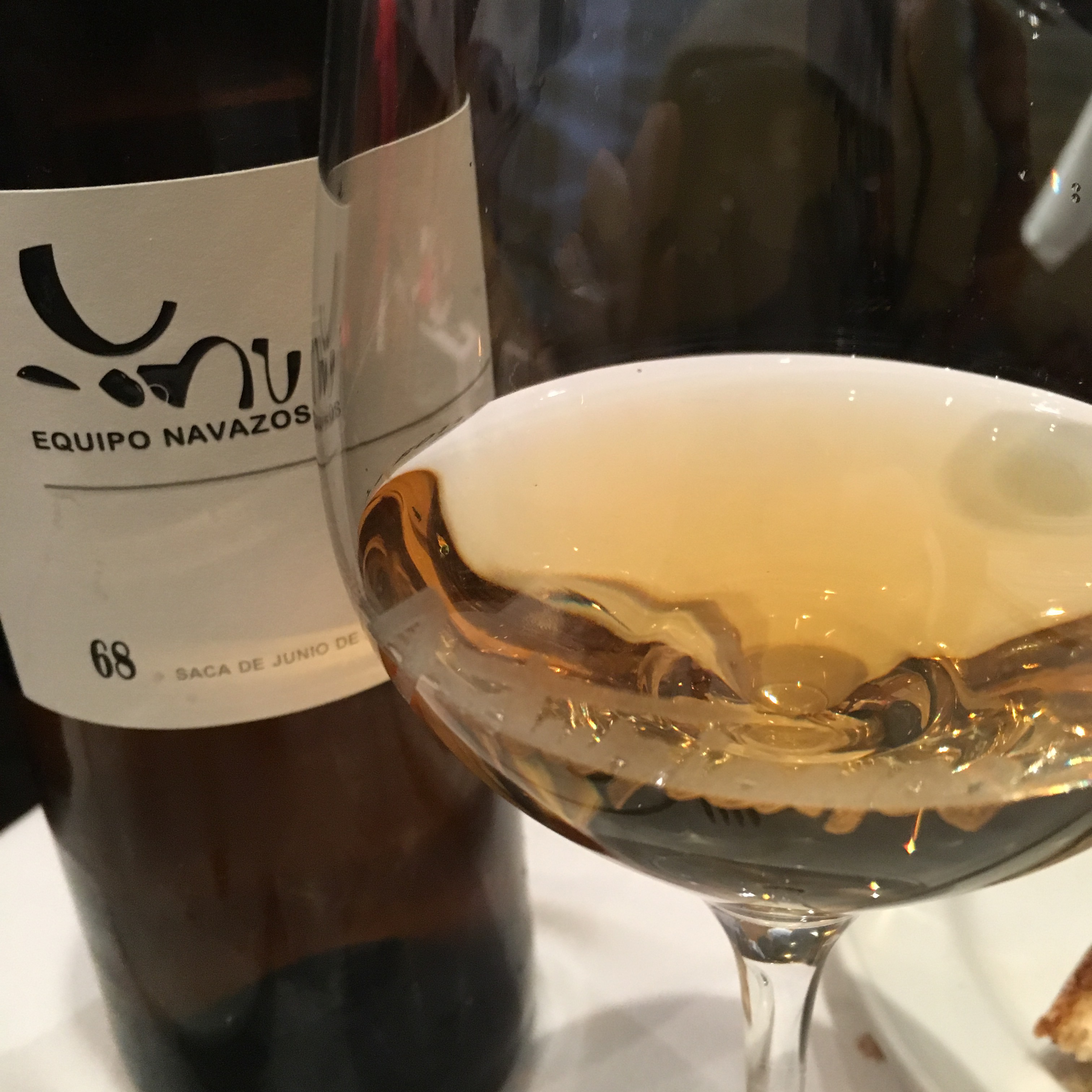
La Bota de Fino 68 – Macharnudo Alto 

Lunch with an old friend in Asturianosthe new saca of the fantastic macharnudo alto fino by Equipo Navazos. They have produced no fewer than seven of these but I don’t remember a better edition than this. 

Absolutely spectacular, classy with a huge  atomatic nose and flavour profile. A cider vat in a hay barn on the nose. Zingy to the point of stingy, with a lush feel on the palate and big, spicey roast almonds to roast apple flavours. The salinity is beautifully integrated and the finish is long and savoury. 

World class fino – a real belter. 

Amontillado Muy Viejo Don Paco 

After a week of relative sobriety the wheel nuts are unwinding pretty fast. The magnificent old Sanlucar palo cortado (pictured on the left) that I just had a generous glass of put me in mind of this old, old Sanlucar amontillado that I first tried in Surtopia this year and I couldn’t resist. As I mentioned back then it is a single pago  wine – fruit sourced from Pago Balbaina (Viña las Cañas) it would have spent some several years under flor and is a total of around 50 to 60 years old.

In age and concentration we are comparing very similar animals and as you can see there isn’t much in it in colour terms (although the Gaspar Florido wine possibly has a touch more brilliance). On the nose the Don Paco has that salty sea air and really does have the “full ozone”, with maybe just a hint of spices to it. (The comparison may exaggerate the difference, but it doesn’t have as much “extra” as the palo cortado.)

On the palate it is salty and direct – salinity that goes beyond zingy to stingy – and then there are roasted, almost burn nut flavours and just a touch of sweet, winelike flavour from somewhere. It is long and dry, and the flavours that stay with you are the ozone, the iodine and maybe sweet cedar wood or cigar tobacco.

Absolutely cracking wine.

Manzanilla de Añada 2012 Callejuela 2/11

I have been mulling in my head a post on the effects of bottle ageing for a while now and have even sneakily created a related category, but I am still not really sure what to talk about. And maybe because those thoughts were already in the old noggin over the last couple of days I have been struck by how different two wines have seemed thanks to, or at least so I imagine, the time they have had in the bottle.

The first was a little bottle of Pastora that I opened on Friday – a little gem that seemed to have gone from green apple to golden apple and to have gained as a result (and indeed was gone in 60 seconds).

The second was this little bottle above – an absolute star of a wine that I thought was good before – as recently as a month ago – but seems way better now. More potent on the nose and palate, sharper, a little bit spicier.  I am looking back at my notes of other tastings (here and here) and I am convinced it has really come of age only now – just more of that awesome sapidity.


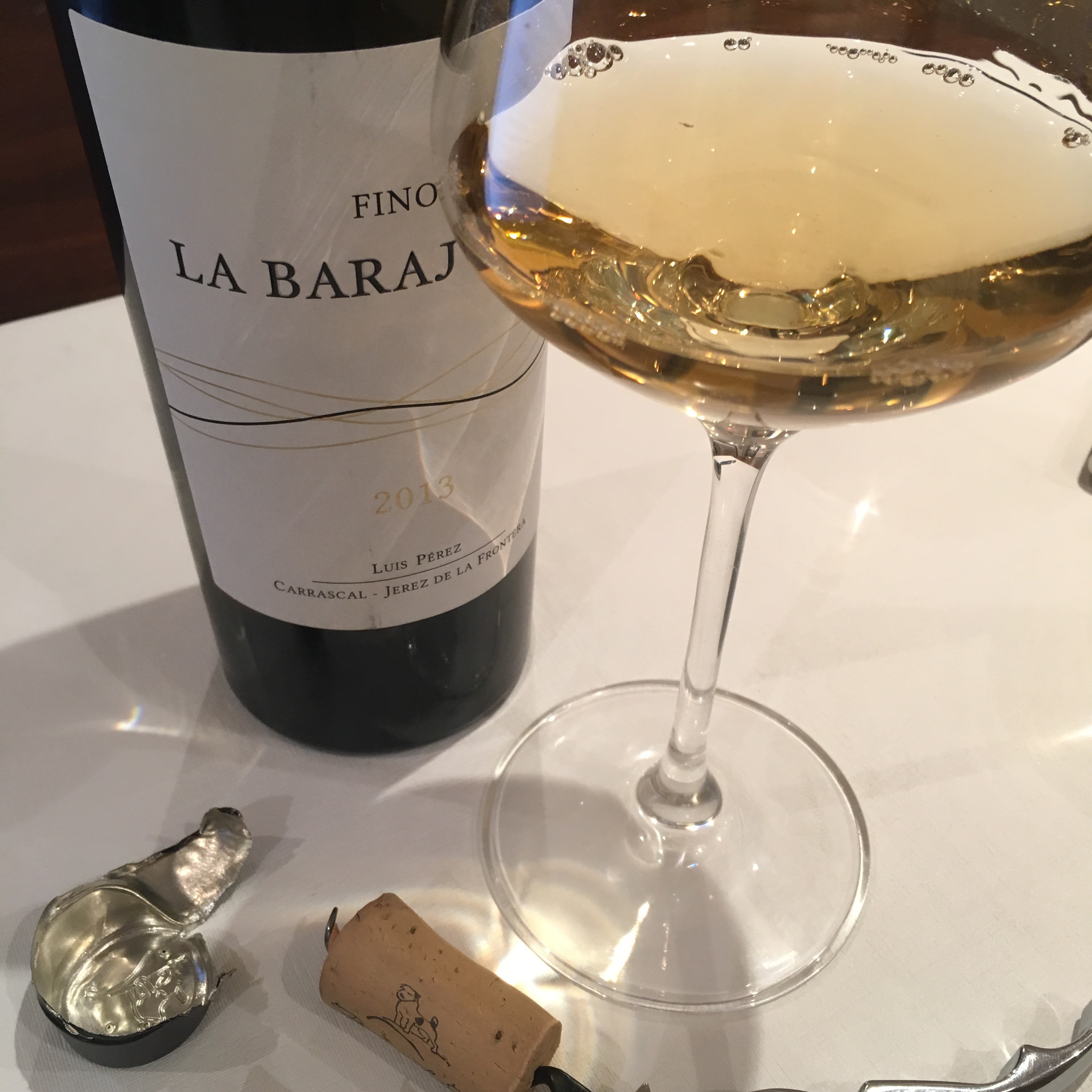
Fino La Barajuela 2013 again

Have been writing a piece on what to look for on a sherry label, which is just another way of saying what to look for in a sherry bottle and apart from working up a thirst it dawned on me that what I am looking for is this. A vintage, terroir specific fino built to express both dimensions, and more importantly, a cracking wine.

I have written about it several times already – the first time I really tried it in June it was superb, so much so that I felt the need to taste it against a Chassagne Montrachet, and then in August I was lucky enough to take part in a fantastic tasting with the maker himself.

This time what strikes me is the potency of the fruit – a kind of super intense melon flavour, and how it complements the zingy salinity and crisp minerals to make a potent wine that is piercing, sleek and elegant at the same time.

Really top class.


Socaire 2014

You guessed it, I forgot to take a picture of this one while still live so have had to edit the skyline shot (not for the first time). Anyway, it is another wine I have tried before – the Socaire 2014 – a 100% palomino fino from my favourite corner of Chiclana that has spent a full 24 months in an old bota that had been used for the Fino Arroyuelo. Apparently the name Socaire means a shelter from the wind, and refers to the breezy conditions up on Finca Matalian, which is near to the sea but a good 100 metres above sea level.

This one was brought to dinner at Territorio ERA by the maker himself and it was a rare chance to try it alongside a couple of other palominos (including its sibling, the Viña Matalian), as well as some wines from Jura, Arbois and the like.

And it must be said it stood up pretty well against all comers on the night, with loads of fino like character on the nose, the fruit/herb of the palomino added to a bit of almond and a more pronounced minerality on the palate and a nice fresh finish.

A really nice wine by any standards.