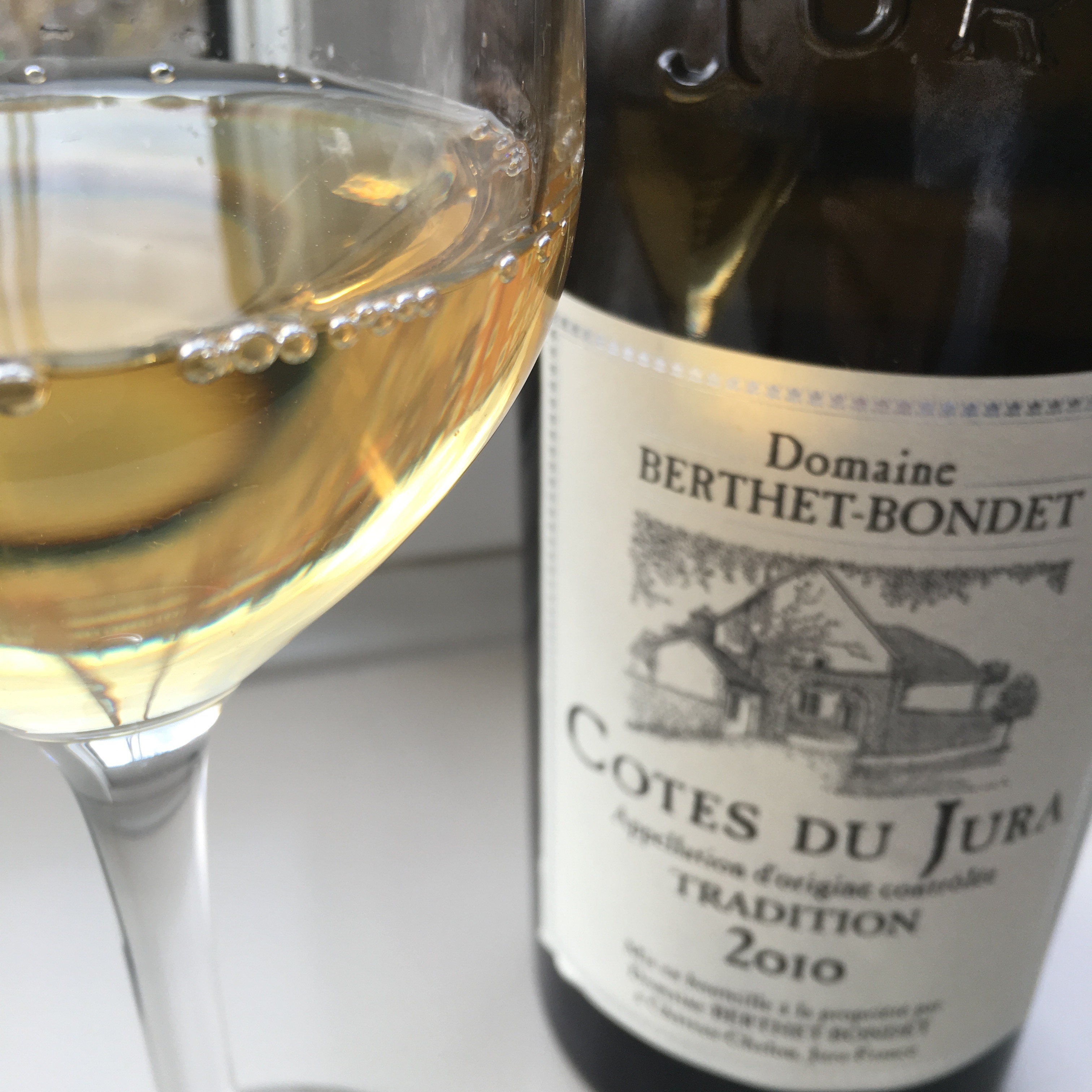
Domaine Berthet-Bondet, Cotes du Jura Tradition 2010  

Not a sherry but delicious and one to learn from. This is a Chardonnay/Savignin that has been two years in botas under flor and around four years in the bottle and is really expressive. Picked it up in Enoteca Barolo recently because I wanted to try it with some palomino white wines but couldn’t wait.

The colour is a lively gold, the nose has cheeses, citrus and and alpine meadows with the accompanying flowers. The wine has proper acidity – the difference with a palomino is striking – but has a lot of the fruit-to-herb characteristics you would expect of a palomino with a similar time in the bottle. It has that umami sweet cheese-and-herb flavour and maybe a bit of a clingy finish, although some salinity seems to come through to clean the palate eventually.

Really good – actually one of the nicer Cotes du Jura I have had lately.


Oloroso Tradicion 

This is a 2014 saca from this magnificent bodega’s oloroso and it is brilliant. Seen here in action at a lunch where we were partaking of a few callos and it absolutely excelled.

In colour it is orange/yellow/brown and a lovely shine to it. On the nose a very nice caramel and a touch of citrus – maybe the contrast with the callos we had on the table but it just had a touch of freshness to it.

Then on the palate I find it really excellent – lively and zingy, nice caramel flavour and enough punch. I remember more baked citrus notes in this but this one is neither sour nor astringent – really elegant in fact. Ever since I recommended the pairing so heavily I worry about whether these wines may be like pouring water on a fat fire where callos are concerned but this had that acidic effect of cutting through the fattiness and enough overall structure, even if at the end it does seem to leave a burning tingle. (Today’s callos were particularly spicey.)

A brilliant, elegant wine (and let’s face it, a cracking lunch).


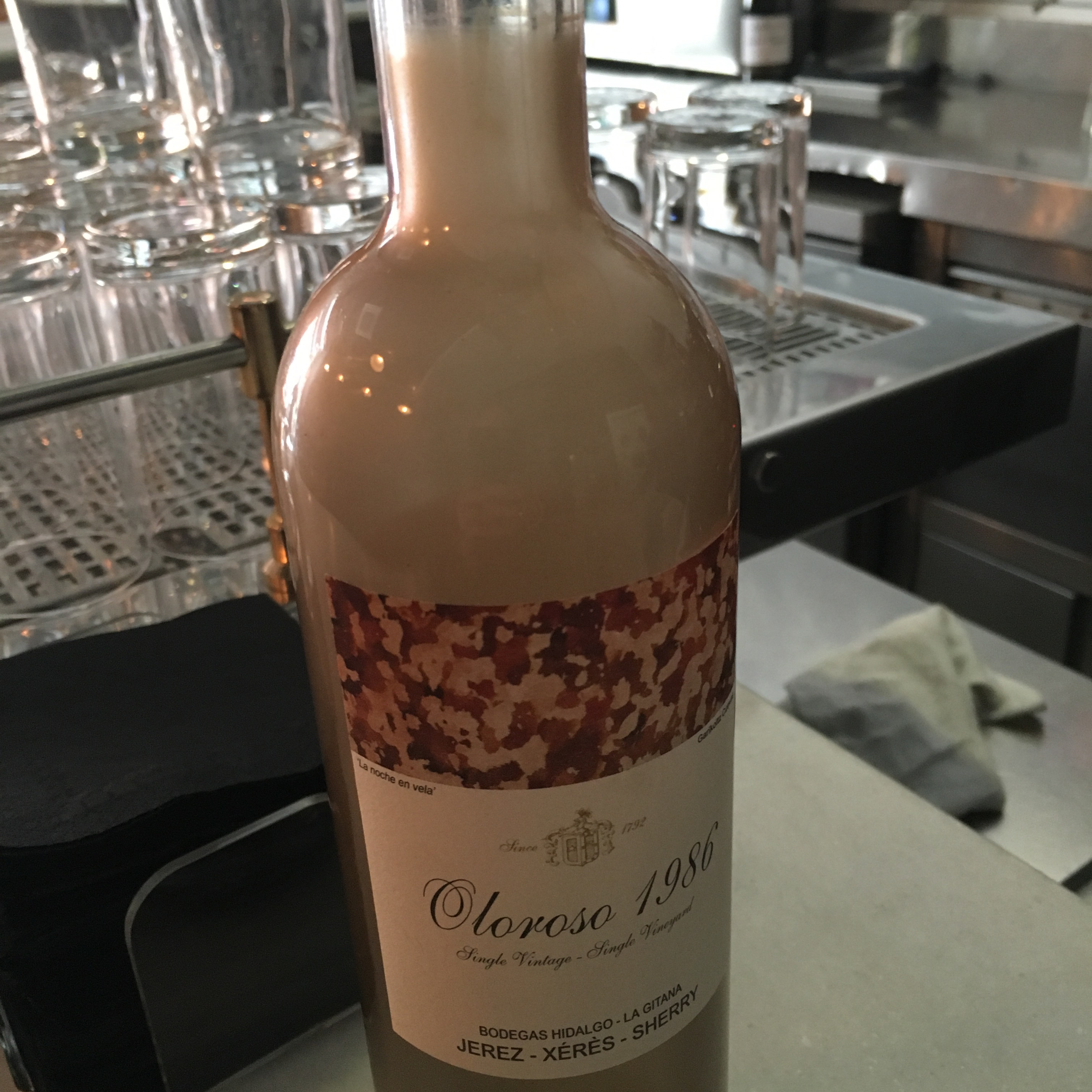
Oloroso 1986, Bodegas Hidalgo – La Gitana

Ana in the Chula de Chamberi very kindly saved the last glass of this for me and I am extremely grateful. It is a beautiful wine.

This is a single vineyard, vintage wine from the legendary Jerez pago “El Cuadrado” (see here for an idea of its location – at the West end of the Barbaina pago, the most sea-influenced of the Jerez pagos). It is by Hidalgo la Gitana and has been twenty years in botas in the San Francisco bodega in the centre of Sanlucar: according to the label 12 botas to start with, but a barely believable 3 by the end. If my maths serve me right it has since spent 10 years in its bottle.

The time has been well spent because it is epic.

First, it has a curious look to it – very black, smokey and murky. Not all that much sediment in the glass – could be a result of having been shaken up but just look at what it has done to the bottle (easiest to see looking at the neck). It really looks like it has been through some sort of trauma (but it still really excellent) – if anyone knows what might have caused this I would be most interested.

On the nose there are relatively muted aromas of old barrels and gingerish spices, black treacle, and Christmas cake. Really none of those polish or solvent, volatile type aromas and maybe that was why it seemed muted (it was also a little cold). Nonetheless a very appetising nose.

Then on the palate it is downright lovely – has the elegance of a Sanlucar wine but a beautifully rich, Christmas-cake body to it. Concentrated but class – a wine where you only need a merest sip and sip after tiny sip give you black treacle flavours fading to toffee, coffee/black chocolate like bitterness and then cloves and woody spices. It is savoury rather than saline – maybe a tingle on the tip and top of the tongue – not at all astringent and just that little bit of acidic bite. Really unbelievably rich, flavourful and smooth and the spices at the end are perfect.

Wonderful. More please!
Fino la Janda


This is fino La Janda by Bodegas Alvaro Domecq. I tried their very pleasant manzanilla La Jaca a while ago and the equally decent 1730 Amontillado too – seem to be a pretty solid little producer.

Not much detail on the ficha although they do make a point of mentioning that they harvest in September (one of the issues that comes up in learned debates is the issue of the Jerez harvest taking place in August in search of less mature, less concentrated fruit).

I like it. Nice gold colour (this was served in a chilled glass, would you believe, but you still get the drift) and quite a fragrant, almond and mineral nose. Then on the palate it is fresh and saline but with a bit of bite and a nice bitter almond flavour. Quite a character and not bad at all.

Solear en rama spring 2016

Another little cracker from this magic production line. Really intense and zingy and with a lot of greenery in it.

The colour is a greener yellow than appears above (no filter used – have no idea what happens to these photos), the nose is salty sea air and shrubs, and those salty shrubs are all over the palate too.

This really has bite – intensely zingy – leaves a burn on the tongue – and full of vitamins. Maybe a bit more mineral than previous editions and it even has a tingly aftertaste (I wonder where they source the palomino from that goes in this).

Really warms the passages as they say.

Solear en rama: the flock

img_7217

The Solear series was one of the pioneers of the “en rama” trend – with Barbadillo releasing for each of the four seasons every year since 1999 – and not only was it the first but it is a reliable favourite of mine.

I include above the now traditional family photo of my budding collection of these brilliant manzanillas. Had I known back in 2012 I was going to start this blog it would be bigger, but careless consumption intervened (although the guys at Barbadillo very generously found me a couple of back issues to complete the sequence (only one of each though so haven’t been able to crack them open)).

In any event, the flock currently includes:

These really are brilliant manzanillas: full bodied and tasty as they come, and although not precisely the same wine each time, they provide a great opportunity to contrast sacas from the different seasons (and against other manzanillas and other wines). They are also quite a distinct style of manzanilla en rama – I would call them a full bodied, full flavoured style.

I reckon my favourite of the above was the Dormouse – just a little more oxidation and a little less flor influence – but the Teal/Garganey has caused a very good impression first up. I wish I had a case (of magnums) of each and every one but my limited storage infrastructure will not allow. If anyone does organize a decent vertical I fervently wish to be invited!

Palo Cortado Añada 1975, Bodegas Tradicion 

Another vintage specific wine, again during a terrific lunch at Restaurante Vinoteca Garcia de la Navarra (you can just see the great Luis in the background there), but this time a 41 year old Palo Cortado (although only 39 years oxidative ageing, from a saca in 2014) – number 39 of the 50 magnums produced. Intriguingly it says Bota Nº1 – wonder how many more of these they have waiting for release?

Again the photo strikes me as deceptive (I didn’t notice dim lighting at the time but it may be the light behind). Nevertheless, it was a deep reddish brown – maybe a touch darker than usual – then on the nose the overwhelming memory is of elegance, a nice salty caramel, fresh citrus, and maybe just a hint of polish.

The palate is even more refined and elegant – a really clean, fresh and delicately structured mouthful. Nice caramel flavours with a delicate citrus flavour, then a pleasingly integrated salinity and acidity, then a slightly more burnt caramel and bitter citrus aftertaste – and a pleasant finish that fades out. What is most notable is that cleanliness and definition. It doesn’t have any of the astringency or old barrel flavours I associate with a 40 year old palo cortado (not having been in a solera it doesn’t have that famous teaspoon of “infinitely old” wine), although perhaps if you were being very critical (and maybe for the same reason) neither does it perhaps reach the very heights of intensity either.

I am often bemused when people call the real brutally intense dinosaurs of the cellar “delights”, but for this extremely youthful forty one year old, that description is absolutely spot on – a delightfully elegant wine.


Fino en rama 2009, saca de febrero 2016, Williams Coleccion Añadas

This is the second of these vinos de añada that I have tried “in the wild” (as opposed to the box I have captive at home) and another very interesting experience. (In fact in addition to being of interest due to its static ageing it also from an interesting spot of terroir: although it doesn’t have any indication on the bottle, a knowledgeable source tells me it is made with fruit from the oldest vines in Añina and Carrascal (Jerez).)

Anyway, whereas the previous example I had tried was an oloroso that had been statically aged – i.e., not included in a solera, but in a butt on its own – this is a fino and thus has been under its very own veil of flor for seven years (which is pretty good going without being refreshed). As such it would be comparable to other statically aged biological wines like the Williams Fiño de Añada, in particular, but also the Callejuela Añada, the Barajuela, and the Encrucijado on this blog (although they have had much less time under flor), or like a vin jaune, if you want to look further afield.

Had this at lunch in Restaurante Vinoteca Garcia de la Navarra with a good mate and the speed of conversation didn’t leave much room for note taking. However, as you can see it is a dark, evolved colour (although I think my pictures exaggerate the share a little) but then has a fruitful, sweet but “sherryfied” nose. On the palate it is rich and full bodied in texture – I had the sense that there was more glycerine than you would expect for a wine with seven years under flor (certainly more than I remember from the 2006 Vintage)- and again gave an impression of fruity sweetness, like the flesh of the grape, while the minerals were very refined.

Quite a delicate structure to it overall and in addition to being fascinating extremely easy to drink.


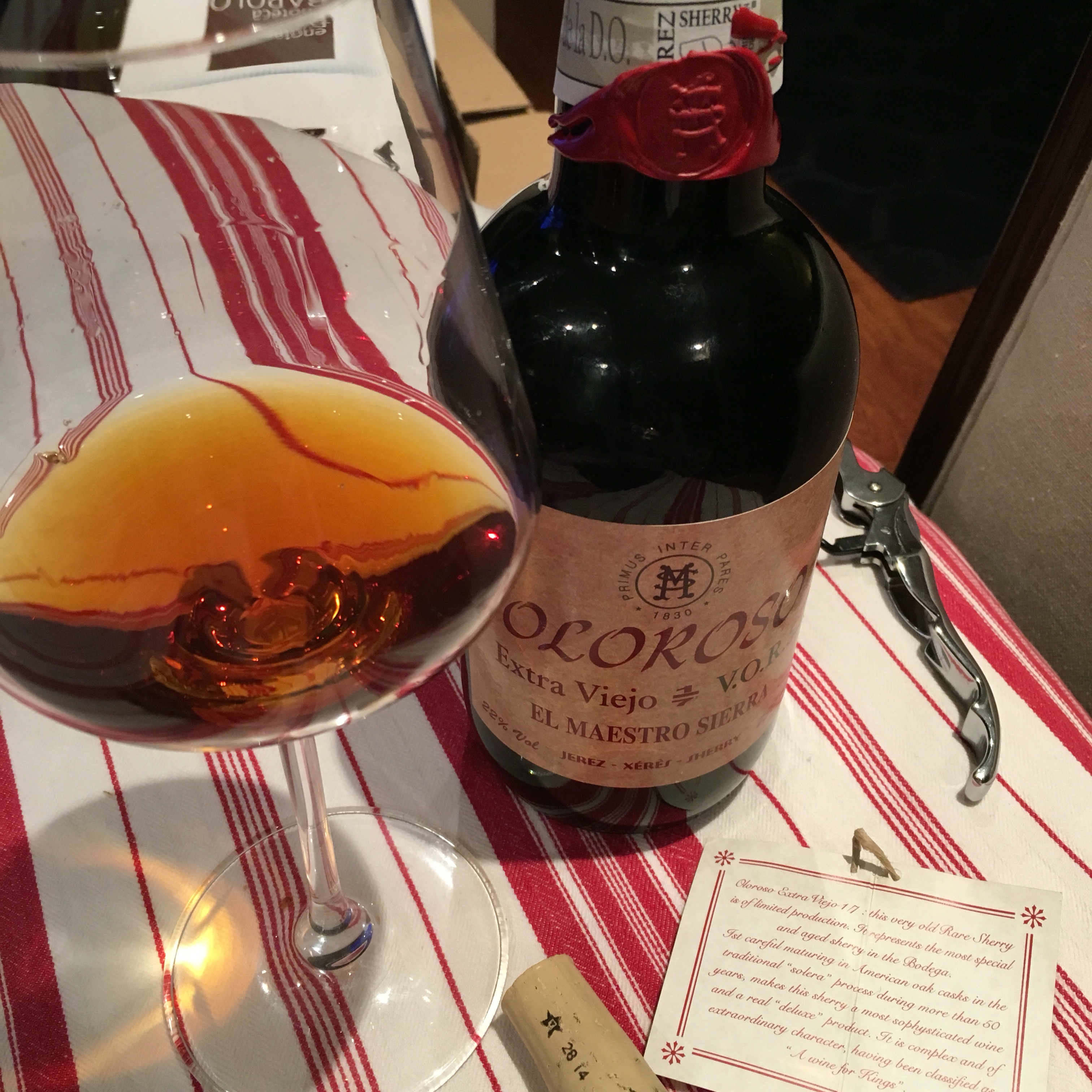
Oloroso Extraviejo 1/7 El Maestro Sierra

When they say “extra old” they really mean it. According to the ficha this has an average age of 80 years of oxidative ageing from a solera of only 7 botas (hence the 1/7) although fed in turn by 1/14 solera – which produces wines of  50 years old. They don’t make much of it: 100 bottles a year – this is 70/100 from 2014 (they also release 300 of the 50 year old). I love the recommended pairing – a good book.

The colour is a beautiful rich chestnut brown and there is real singe on the nose – furniture polish or extremely concentrated walnut. Sweetness in the nose too – real burnt butter caramel.  As the glass warms and empties there are more aromas – pine wood chips/cedar cigar matches and old tobacco. (My grandad was a pipe smoker and this took me back a bit to his attic.)

On tasting there is sweetness on the tip of the tongue but then a spike of acidity and those walnutskin, wood and tobacco flavours. It doesn’t seem astringent or harsh but there are highly concentrated flavours, that walnut again, then really dry dusty flavours and a long caramel finish but one that dries the mouth a little.

An elegant and spicey drink – all you need is the good book because it has the cigar incorporated!

La Bota de Amontillado 61 – “Bota NO”

Acquired this little beauty from Coalla Gourmet and have been enjoying it little by little (started at Easter and finishing at the final round of the Masters).

No ficha for this one but based on the information on the Coalla site this is from one of a number of soleras in the La Guita bodega that have been untouched since the 1980s – Manzanilla Pasada, Manzanilla Pasada Vieja and Manzanilla Pasada Viejísima. Specifically, this is from the Solera 1/10 of Manzanilla Pasada Vieja but is in reality a very old amontillado. It is the second time they have released a wine from this solera – the first one being Number 31.

Don´t be deceived by the photo above – this is a lovely crystal clear dark orange amber. On the nose there are quite remarkable cigar box, tobacco, and woody aromas, some honey and burnt butter, and curry type flavours.

On the palate it has a beautiful zingy feel. The woody, cigar box flavours are there but so are those sweet flavours that hold them together and it doesn’t seem acidic or astringent. There is a tobacco like singe at the back end and it leaves you with those woody flavours for a long time.

Another really unique wine from Equipo Navazos – they really are remarkable.