Amontillado Viña AB

Talk about classics – one I haven’t had in a long time but this is cracking. It is one of the wines that was always around back in the bad old days but it isn’t seen nearly as much in Madrid lately: funnily enough the lads I was having dinner with had never heard of it. 

The entry level amontillado by Gonzalez Byass with an average age of 12 years, of which 4 under the flor. It is a punchy, vertical wine with a sharp, dry, slightly salty/nutty nose and a fresh, bitter saline nutty palate. Longish finish despite its youth. 

Not bad at all and a top pairing with the (thai style) callos at Territorio ERA: old classic meets new funk.

Manzanilla pasada Blanquito

A classic manzanilla pasada and one that seems different every time I try it (and there have been a few already. At times I find it full of green apples, other times ripe, almost overripe apples,  other times the apples are under haybales. This was from the August 2016 saca (I really need to start taking better note of these things).

Anyway, this time the apples are deep in bitter spices and spikey salinity. It has a much more vertical, Sanlucar feel to it than sometimes, but still has that fruit underneath. Really long and almost stinging finish, leaving your mouth smarting and watering in equal measure.

Oloroso Tradicion, Trafalgar Bicentenary Edition, 2007

Enjoyed with a terrific lunch at Taberna Verdejo with Bodegas Tradicion and what Englishman could begrudge this – a beautiful label to start with, as Nelson’s ships traverse the hispano-french line prior to sharing them out (only for the storm to carry away the prizes).

A magnificent start – you can see the colour and the nose was as bright as brandy, a lovely fine nose. Then on the palate an acid, buzzy swell of distilled, brandy like caramel and bitter flavours and a long finish. The time in the bottle was evident a touch of bitterness on the nose and maybe half an ounce less of lift on the palate,  but a top class oloroso no doubt.

England expects that every man will do their duty.

Michelangelo’s second law

Michelangelo was a genius in many ways, but I must admit I have struggled to come to terms with his second law: “no anchovies, dude” (it is to Michelangelo the mutant ninja turtle that I refer, not to be confused with Michelangelo di Lodovico Buonarroti Simoni, the sculptor, painter, architect, and poet).

He was referring, of course, to pizza (the first law being “never pay full price for late pizza”) and for years I have tried to find sense in this. I love anchovies, and I find it hard to believe that a sophisticated and fun loving reptilian oriental assassin such as Michelangelo did not. So what did he mean?

It may of course have been a reverse homage to the supreme pizza ingredient, pepperoni sausage, and an ackowledgment that adding any other source of protein when you might have pepperoni would be a grievous error, but why not say that directly? And why pick out anchovies? Why would Michelangelo’s laws stay silent on the numerous other deranged and inappropriate ingredients being used on pizzas, from onions (never, never) to frankfurter sausaes, merguez or kebab, or even leafy salads? Or was his opposition to the delicious anchovy founded on his concerns about the possible pairing issues for which anchovies are famous? Was it that he had been lead to believe that your only realistic pairing was a mediterranean white or rosé?

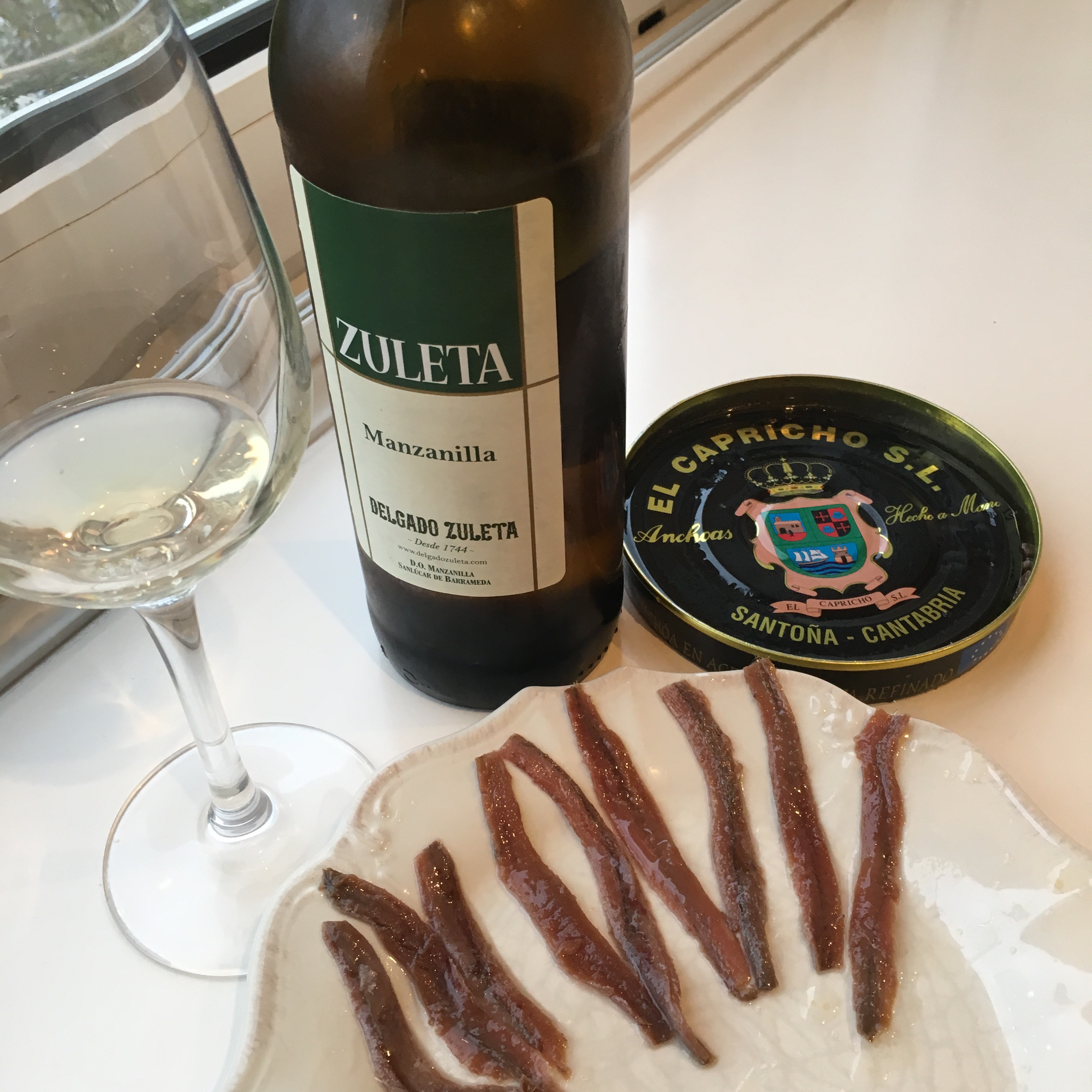
I suppose we will never know the answer, but my preferred interpretation is that what he meant was that we shouldn’t misuse anchovies by letting them roast in a sea of cheese, but that rather we should enjoy them as nature intended, preferably with a nice glass of chilled manzanilla, like this lovely Manzanilla Zuleta.


The Acid Test

It is funny how the world works – last week there was a tasting at the UEC of natural wines marked by their volatile acid content and for a while all anyone tweeted or wassaped about here in Madrid was volatile – the new cool. Then the next thing I know I am at the bar of Angelita for a light and liquid lunch and by coincidence I hit a rich stream of the new cool.

Three extraordinary wines here – Irakere is a macabeo and garnacha wine made in the North by some guys from Valencia and, as you probably gathered from the introduction, the volatile is just extraordinary (makes the wine seem lighter than air, if a bit stingy). Then the Las Moradas Albillo Real “Bajo Velo” (not much velo, it was only six months in the barrel and velo of what, you might ask) and, while not as extreme as the Irakere, that also had a solventish edge to it – slight lift at the edges on the nose and palate.

And then finally the Santa Petronila oloroso.  Now the first time I tried this back in October I found it lighter and finer than your regular oloroso and to be honest even on that occasion there were mutterings about volatile, but today it really seemed to come across very clearly  – even compared to the Irakere. It was also pretty turbid and it was pretty interesting to see if from this natural wine angle.

Very interesting indeed. Fortunately the other thing that Angelita does exceptionally well is cheese, which helped take the razor edge off the liquid!

Giving Thanks

Restaurants

I envy our american cousins and their thanksgiving holiday, and not just because I would like the Thursday off and enjoy roast turkey. I like the idea of taking a moment to acknowledge how much we have to be thankful for, and thought I would share my own thanks for those who have helped me and this blog over the last year and a half.

So here we go, in an approximate chronological order:

  • Cesar Saldaña at the DO, who first gave me the idea, and Ana Losada, who encouraged me to get on with it and make it a reality;
  • WordPress for their cracking app which is easy enough to use that even I can manage it with moderate proficiency;
  • My wine drinking buddies here in Madrid, including David at Vila Viniteca, Guillermo, Manuel, Raul and Jason, all legends that have humoured me, generously broadened my education with wonderful wines from all over the world in the face of my obsession with a single corner of Andalucia and now to be honest drink more sherry than I do;
  • My fellow sherry bloggers, including the international crowd – Ruben, Helen, Paddy, Erik, and Seanna (a friendlier, more welcoming bunch you could not imagine), and also the Spanish guys and in particular the Enoarquia and Spanishwinelover, both of which have been a source of ideas and an inspiration;
  • The guys off the wineberserkers bulletin board and in particular David Coffey – it has been fascinating getting the perspective of fans of other wines in the US and elsewhere (after all, what do they know of sherry, who only sherry know?) ;
  • The other characters on twitter for all their retweets, likes, comments and such, in particular Lori and Michael at Dracaena Wines for giving me an excuse to retweet blog posts as part of #sundaysips;
  • The restauranteurs and barpersons of Madrid and elsewhere, for giving me the opportunity to try so many wines by the glass, including Jose and Ruth at Surtopia, Ana Losada (again) when she was at the Chula, David and the guys at Angelita, Paqui at Taberna Palo Cortado and David and Diego at Territorio Era;
  • My dealers, and in particular Federico Ferrer of the Cuatrogatos Wine Club, Ezequiel at Reserva y Cata,  Santiago at Coalla Gourmet and Armando Guerra of the legend that is Der Guerrita;
  • The bodegas that have been generous with their time and in so many ways: in particular Carlos and the guys at Lustau, but also Manuel and Lorenzo from Tradición, Adela and José from Perez Barquero, Rocío from Urium, and Cristina from Williams & Humbert; and
  • The real experts, from whom I have learned a lot, including Alvaro Giron, Juancho Asenjo and Paco del Castillo, but in particular Victor de la Serna, who from the start has been a big support retweeting, commenting and on one memorable evening coming along to show us how to taste wines.

Most of all I am grateful to all the winemakers who have taken time to chat and share their knowledge, and of course for making the wines that give the whole thing meaning. In particular I would pick out Ramiro Ibañez, one of the most passionate and knowledgeable winemakers I have ever met, who has been a true inspiration and a fount of wisdom, but also thanks and kudos to Luis “Willy” Perez and his Barajuela Project, Primitivo Collantes and Finca Matalian, Paola Medina for her Colección Añadas and the many others that are creating exciting wines for me to taste and blog about.

Now begins the worry about who I have left out. If I have forgotten you don’t be dismayed – it is the way of this particular beast, and I guarantee as soon as I see you again I will remember and attempt to hastily amend this page with my mobile!


Manzanilla Zuleta, Spring 2010

A gift from my good friend Guille – one of the most generous guys around, whether with his wine or his time – this is a bit of a treat during a week of hard labour. And it is a lovely sup too – has that chalky/metallic, citrussy flavour that seems to be accentuated and broadened out by a slight oxidation.

Of course I now realize I should have lined up a new bottle of the same so I could tell the differences – must see if I can rectify that in the next couple of days. For the time being there is certainly nothing wrong with this – very nice indeed.

Oloroso Juan Piñero 

An oloroso from the same Sanlucar stable as the Camborio, the Maruja, and the Palo Cortado of recent days and another smooth, enjoyable wine.

Whereas the Palo Cortado traces its lineage from Pago de Hornillos and Maruja, this is, like Camborio, from Añina and Macharnudo, although presumably without any biological ageing. It has spent around 12-14 years in a solera with three criaderas and one saca a year.

As you can see the colour is lighter than for many olorosos, a lightish chestnut, and the nose too is relatively fine, with a little bit of strawdust. It is very refined on the palate too – an easy drinking wine with nice nutty flavours and very mellow salinity. A bit more laid back than the palo cortado but with just a touch more concentration.

Another lovely example of a Sanlucar oloroso – really like the style.

Manzanilla la Kika

Not entirely by accident things are coming along in bunches. Here we have la Kika, the manzanilla flagship of the Yuste fleet, with its touching homage to the owner’s mother and it’s outrageously unrackable bottle – not to mention the stopper!

More importantly this is a cracking wine – and a close relation of the Manzanilla Sacristia AB of recent releases (of which I had a glass of the Spring 2016 just last week and the Spring 2015 yesterday), which I believe are taken from the first or second criaderas.

A manzanilla from palomino sourced in Balbaina that has passed through nine classes located in the bodegas of the group in Miraflores, Los Angeles, and Santa Ana. At the end the average age under flor is about 10 years and it is bottled unfiltered and by hand .

I am a bit surprised at how bright and fresh it is compared to my memories of other bottles. It is a bright, sharp gold and has more green apple fruit than I recall. Nice seaside and esparto grass aromas and raw almonds, then similar richness on the palate – very smooth and creamy, punchy yeastiness and a bittersweet, mineral finish: really zingy and fresh. Really quite different to what I expected – I remembered it as more evolved and cheesy – maybe a variation due to spring and winter sacas or time in the bottle? (Wish I had taken better notes.)

Anyway, available by the glass at Territorio Era but hurry – the bottles are small weeny and I am not sure how many they have.

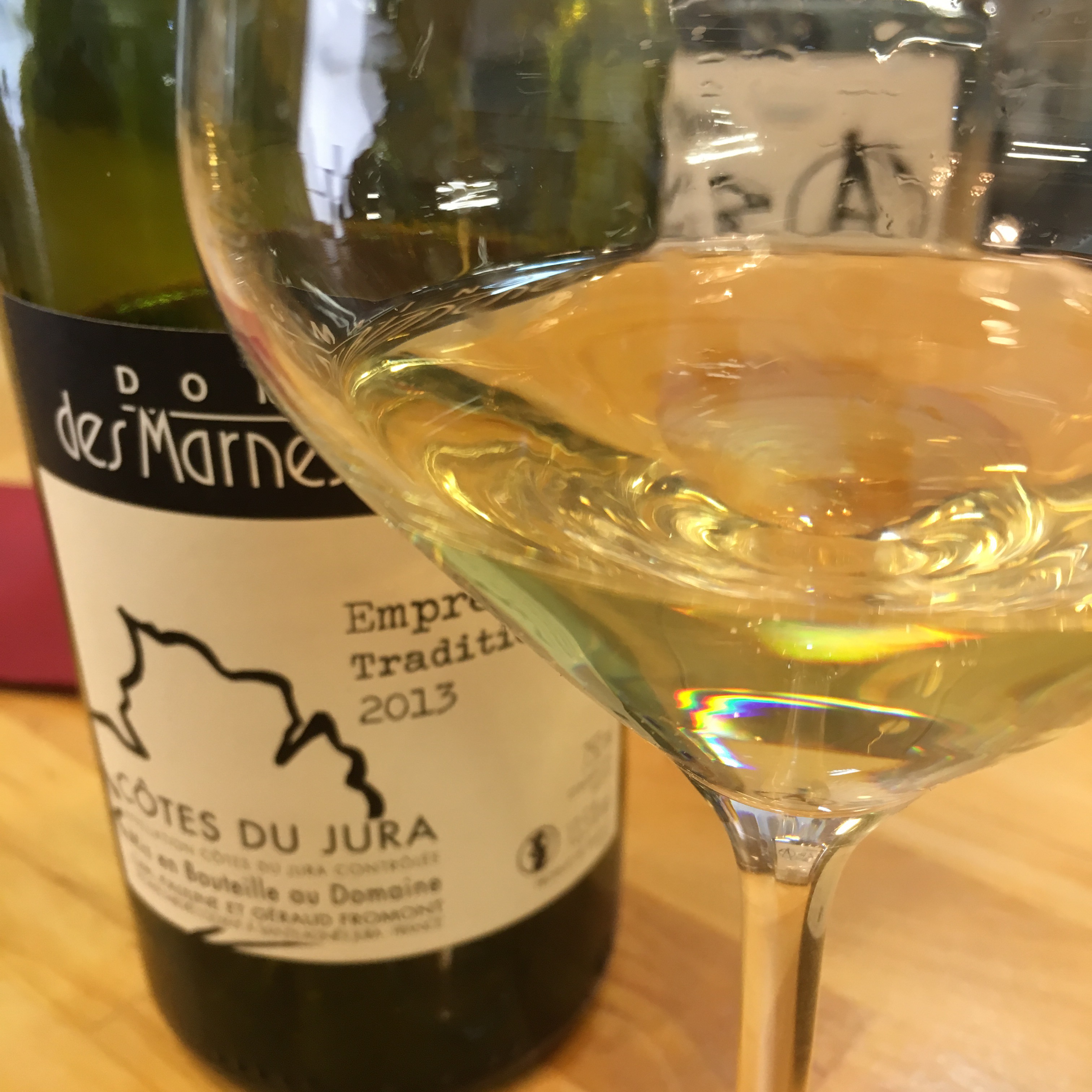
Empreinte Tradition 2013

One of the interesting wines on offer at Territorio Era and one I have been back to a couple of times, this is a 2013 “Tradition” Cotes du Jura – 60% savagnin (minerals and acidity) and 40% chardonnay (body) with three years under flor.

It has a nice freshness to it – the fresh yeastiness of raw almonds, green apples and unbaked bread, a slightly mineral palate and finish. Doesn’t have the mineral power of its palomino cousins from Sanlucar and Jerez but I like the freshness and the fruit. Very drinkable indeed.