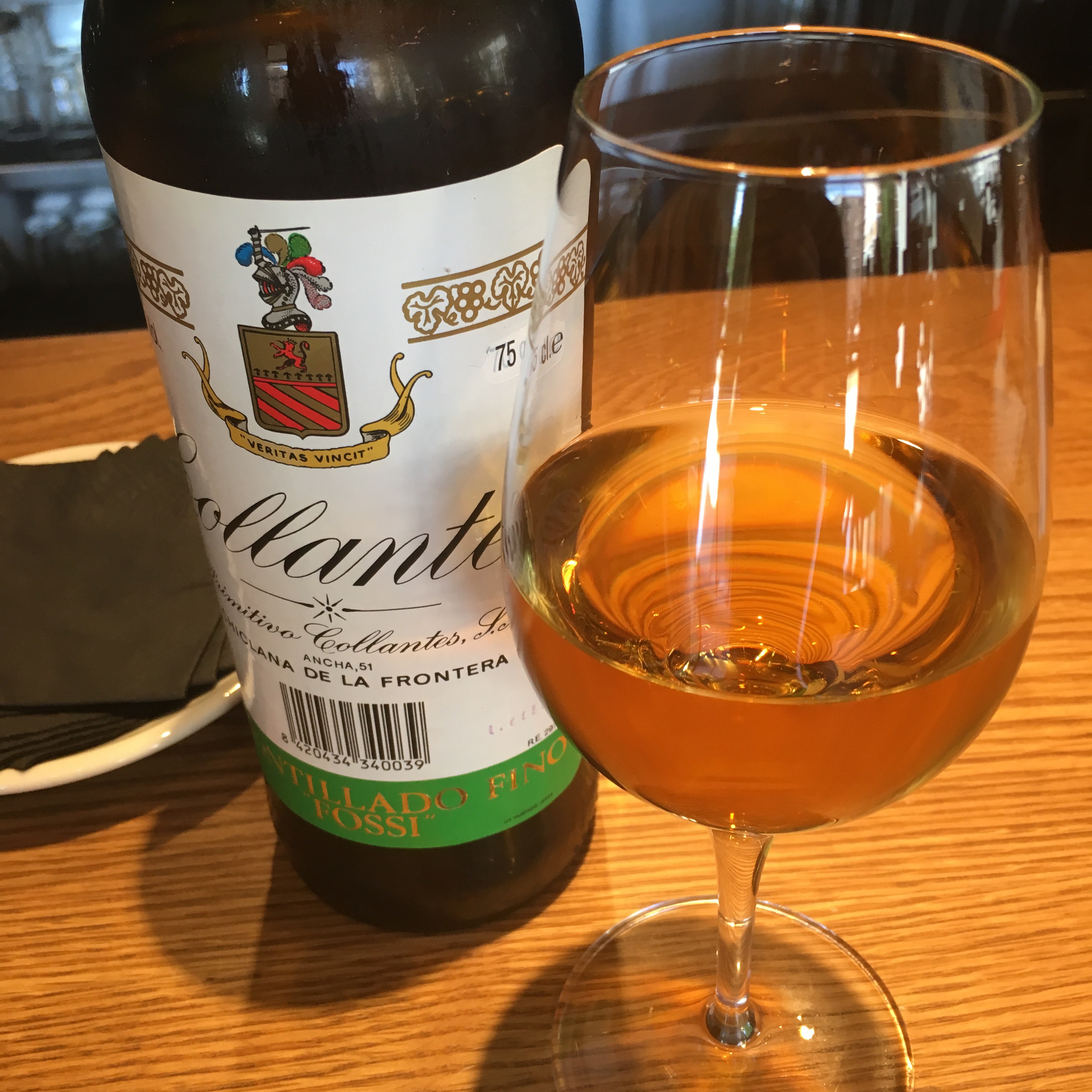
 Lovely. Have just finished lunch around the corner but thought I would call into Lakasa and this little beauty, by Primitivo Collantes and the famous Finca Matalian, is pure pleasure. If there is a more drinkable, enjoyable sherry I know not what it is. Brilliant lush toffee and spikey minerals in balance. Lovely.
Author: sharquillo
Navazos Niepoort 2014

For me this is now a classic in its category – the first unfortified palomino I read about and tried (and didn’t understand at the time, to be quite honest). Now there are plenty such wines around – I took it to dinner a week ago to be tasted blind and it was remarkable how many other wines people mistook it for. I enjoyed it that night and am lucky enough to have another crack thanks to the marvellous wine list at Taberna Averias.
Very nicely integrated, mineral but juicy palomino fino – this one is a deeper colour than I expected and the bottle may have been open a while. On the nose it has a slight metallic aroma and sweet herbal notes – bit of white fruit maybe. Then on the palate there is just a suggestion of herbal sweetness turning to bitterness and gentle, nicely integrated minerals – not zingy or salty but earthy and pebbly – with a touch more cool metal at the end.
Really good stuff – you can’t beat the classics.
Pride in your roots

Yesterday I had a nice little manzanilla Orleans Borbon and was delighted to see a reference on the label to Pago Balbaina. There has recently been something of a reawakening in interest in terroir in el Marco de Jerez, but it is still relatively rare to see the Pagos (and even less the vineyards) identified on the labels of the wines.
With one exception: Macharnudo and, particularly, Macharnudo Alto. That particular Pago has built a mystique and brand to the point where I have seen it referred to as the “DRC” of Jerez. It owes that mystique in large part to the wines: Inocente, Coliseo and the other Valdespino wines, the Macharnudo Alto finos from Equipo Navazos, and at the other end of the scale, Pitijopo Number 5. And those are just the recent wines: the fame of the pago is not a recent phenomenon. It owes a lot to historic brands like Agustin Blazquez and de la Riva and, most of all, the legendary Domecq.
Neither is it a coincidence that some of the finest wine makers in the history of the region chose to acquire vineyards in Macharnudo Alto. Indeed, Macharnudo looks absolutely splendid from a distance – hills of pure white albariza – and in fact if you go and spend time in Jerez with the guys that are keen on terroir and ask them where they would like to have a vineyard there is a good chance they will tell you Macharnudo. There is every indication that it really is top class real estate and an ideal place to make wine.
But there is another issue at play here, which is that Macharnudo has become famous not just because the finest winemakers had vineyards there, or because they made very famous wines there, but because they also put the name of the pago on the labels of those very fine wines. Nothing controversial about that: because the wines from the pago were good, the name of the pago was used to market the wines. What strikes me, though, is the number of great wines from Jerez that don’t make any attempt to capitalize in the same way.
The Solear en rama series are an example that springs to mind: these outstanding wines come from Santa Lucia and Gibalbin, but it doesn’t say so on the label. Those particular vineyards are not in a fashionable neighbourhood – they are far inland – indeed they are not even on the map of the famous pagos (like the champagnes of Cote de l’Aube or the burgundies from up around Auxerre) but they are the source of some of the most distinctive wines in the region, with perhaps the spikey Mirabras as the clearest exponent of the qualities of the terroir. They are also, I am told, interesting properties due to the location and their positioning between hills and marshland.
There are of course a number of issues related to the structure and recent history of the region, the fact that many bodegas do not own their own vineyards or have changed hands, and the compounding difficulty of the solera system (with many soleras having been refreshed, over the years, with wines from a number of sources) that mean many bodegas cannot guarantee that their wines are sourced from a single pago. (On the other hand, even if a bodegas has always sourced from a particular pago, if they don’t own that land they may be wary of becoming hostage to the names on their labels.)
Nevertheless, where it is possible to do so, as in the case of Solear and some others, it strikes me as a great shame – and a missed opportunity – not to give the vineyards the recognition they deserve.
Manzanilla fina Orleans Borbon

I can be grumpy at times about packaging but there is a lot to like about this little bottle. It is a regular size, the label is a thing of beauty, the colours seem lively and appropriate and the magic words “Pago Balbaina” are proudly displayed. I couldn’t resist picking this up on my last visit to Der Guerrita.
I am very pleased to have done so too because there is also a lot to like about the contents. It is quite a pale lemony yellow and has aromas of straw and sea air, maybe some lemon and almonds. Then on the palate it has a nice punchy, zingy salinity, nice yeastiness and bitter almonds.
Very nice little wine: nicely presented, zingy and tasty.
Palo Cortado De la Cruz de 1767
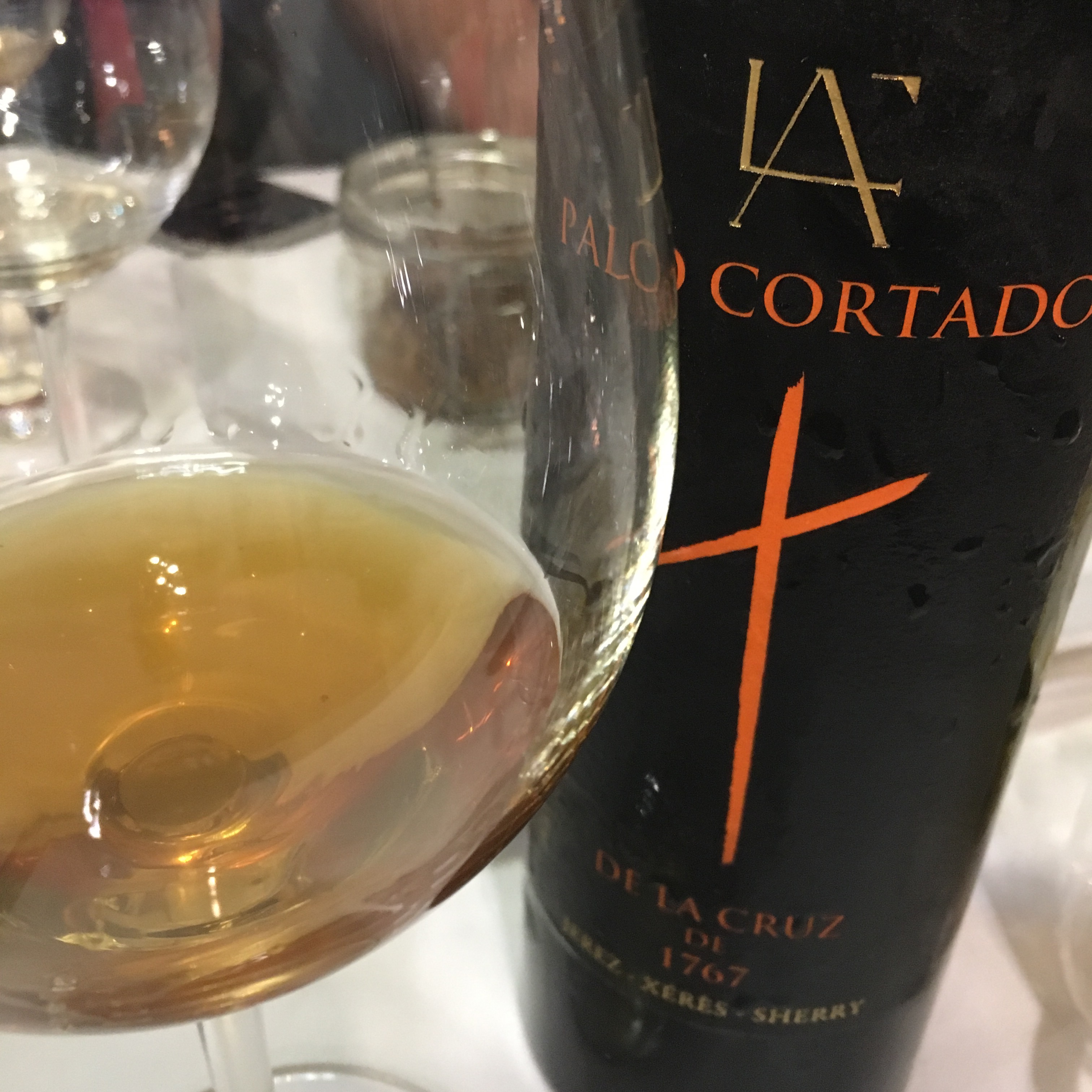
I have never had a bottle of this to myself or really had time to study it but having encountered it twice before (at the Feria de vinos and the Salon de los Vinos Generosos) last night it was brought to a cracking dinner in La Piperna. Third time lucky I thought and I even took a couple of notes. It is a relatively new release and the only wine, as far as I know, from Bodegas Arfe, an old old building (the 1767) but under the brand new management of the former enologo of Garveys, Luis Arroyo. I think they literally released their first wines this year.
As you can see it is a brown-yellow amber colour and at least this bottle last night wasn’t entirely crystalline – just slightly cloudy. On the nose it has nuts and sawdust, and the spicey, gingery and tobacco aromas I associate with old barrels. More a bundle of aromas than a strong, punchy nose.
A very similar story on the palate. It is not over concentrated or astringent and by no means overpowering – almost light, and maybe a bit lacking in body. Has a nice caramel and nuts at the beginning, buzzy salinity and acidity and spicey, gingery flavours, with sawdust and tobacco flavours on the finish but overall gives the impression of a new wine in an old barrel.
A nice, distinctive wine but lacking in power and uniformity.
Equipo Navazos old and new by Victor de la Serna

If you want to know what is what when it comes to the latest Equipo Navazos releases then look no further than these cracking notes of a blind tasting by Victor de la Serna. Normally these elmundovino tastings are by a panel but this one looks like a solo effort and what an effort it is: 13 wines, some of them pretty potent, and a whisky, rum and brandy. It is the sort of tasting where you might not start blind but you will almost certainly finish that way.
It also once again gives an impression of the amazingly varied output of Equipo Navazos – wines and spirits of every feather and fur. I have only tasted a few of these wines, and it seems I am a bit behind the curve with the recent releases in particular, but the notes of the ones I have tried certainly ring true. I am just disappointed to read that the Bottle of Number 6 I have been hoarding all these years may have been better pre hoarding …
Angelita Madrid revisited
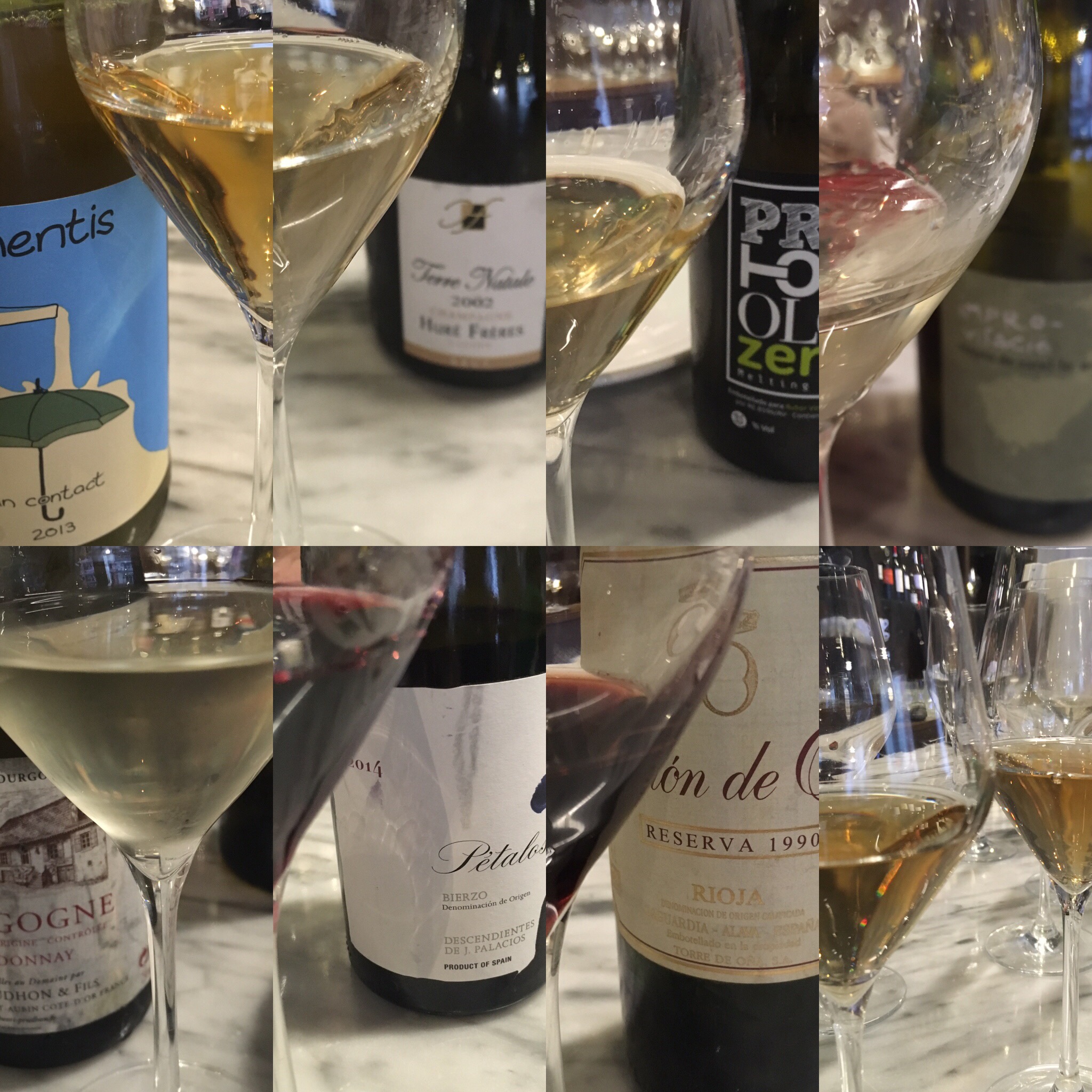
Brilliantly long lunch yesterday in Angelita Madrid – the headquarters for wine lovers in the capital.
The great attraction of Angelita is its ever changing selection of wines by the glass – including a list of a dozen or so wines from Jerez and Sanlucar (and a few more from Chiclana) – together with hard to find wines by the bottle (including UBE and the Manzanilla de Añada, to name just two) and classic wines from all over with a few years in their legs (yesterday we had a 26 year old Rioja, for example).
It makes it a great place to come and try new things and also to try out your blind tasting skills. Just look at the outstanding, original wines we tasted blind yesterday (the record shows that I got one of them dead right and got the regions and varieties right for two others, although I whiffed in humiliating fashion on the only manzanilla we tried). It is also a great place to run into fellow wine lovers – yesterday was no exception on that score either.
Finally, it is also tomato season and there may not be better tomatoes on sale anywhere in Madrid. Just look at these absolute beauties before and after, not to mention the delicious pez mantequilla and sirloin with migas. It is hard to believe they have only been open five months – what on earth did we do before Angelita opened?

Kabuki Wellington

Last night a fella was lucky enough to have a quite outstanding dinner in Kabuki Wellington, one of the very best restaurants in Madrid or indeed anywhere.
The cuisine is japanese with and mediterranean influences and is of superb quality. I really am not qualified to describe it in detail – all I can say is that if you have not been already you really have to go. I did not at any stage take any photographs of the dishes: I was too busy eating, drinking and generally making merry. Neither did I, and this is perhaps less forgiveable given the theme of this blog, have a very detailed look at the winelist and the list of sherries.
Fortunately, I have since been able to get my hands on a copy and I can confirm that they have everything a sherrylover could reasonably ask for. In fact there really is a lot to like about this outstanding sherrylist:
- I count a total of 54 bottles, including some very fine and rare wines, including vintages and limited releases, and although some are understandably expensive, there are also some absolute bargains.
- The sherries come first, and under the header “Our special wines”. No doubt about the importance they attach to sherries on this list at all.
- The wines are classified not just by style but also by centre – Jerez, Sanlucar, el Puerto and Montilla Moriles, a distinction I think is really helpful and which should be emphasized more.
- The coverage of styles and centres is first class. If you wanted to be hyper demanding you would ask for a couple of finos del puerto and a couple of amontillados de Sanlucar, but there is plenty to choose from as it is.
The wines of Jerez and Sanlucar are of course perfect matches for the cuisine, although they compete here with an equally superb selection of champagnes, rieslings, burgundies and other chardonnays and, well, wines of every colour and stripe, from vinho verde to pinot noir.
And maybe most importantly, in Silvia Garcia Guijarro they have a fantastic sommelier – a real star and the main reason I didn’t bother studying the wine list (which in retrospect, is a shame, since I would have been even more impressed). The first time I visited Kabuki I remember having a chat about pairings with her and was bowled over by how friendly, disarming but knowledgeable she was – a real pleasure to be advised and the pairings suggested were superb. Since then we simply put ourselves in her hands and the pairings this time were, as always, absolutely faultless, even brilliant.
Sugoi, as they say.
Quo Vadis, NPU and the traditionally aged wines of Sanlucar and Jerez
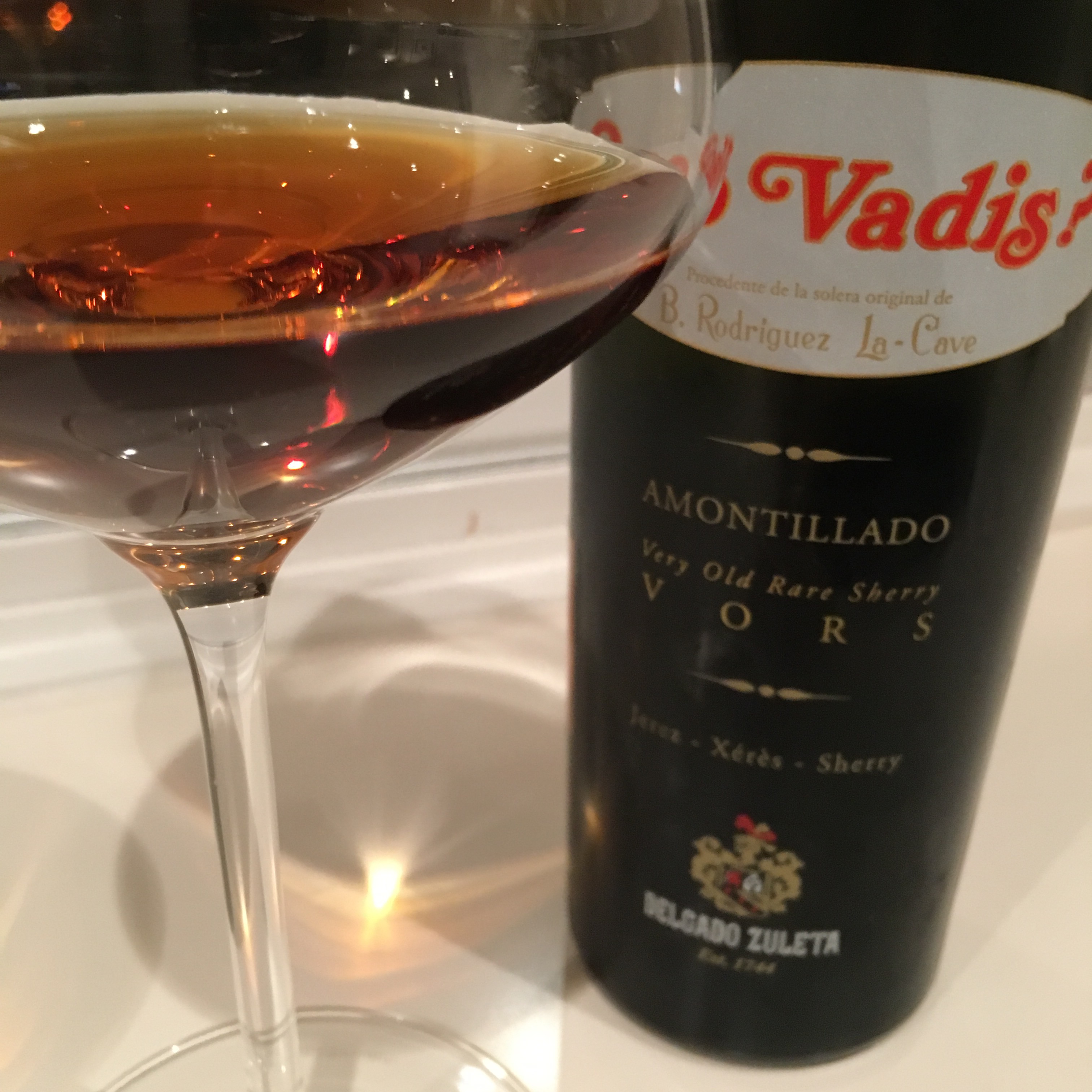
I have had this bottle open at home since before the summer and it has really grown and grown on me since I opened it about six weeks ago. It is a very fine old wine – more than 40 years old – and almost the epitome of what a Sanlucar amontillado is all about. It has a very dry, very stark profile, with only the bare minimum of nuts and caramel, a very saline, savoury flavour and really sharp zinginess.
It is also an interesting contrast to the NPU amontillado from Jerez that I tried this week. That seemed to me to be typical of a Jerez amontillado and was very rich by comparison – really pronounced hazelnut on the nose and a sensation of sweet juiciness to it.
The differences are revealing and to a certain extent mysterious: while it is easy to see why a veil of flor would develop differently in one or the other location, it is less obvious to me why the oxidatively aged wines are so different. The fruit used in each case may even be the same (there is no obligation to use mosto from Sanlucar in Sanlucar or mosto from Jerez in Jerez) and although the amontillados may of course differ due to the biological ageing in practice these days many finos have characteristics that are very similar to manzanillas. Evidently there is a slight difference in terms of climate and it may well be that there are big differences in the techniques used in the cellar – it is something I would like to learn more about.
For the time being, all I can say is that they are different and recommend anyone seeking to learn about these wines to compare and contrast. In fact I would go further: all preferences aside to really understand the wines of the region I think you need to have a handle on both styles.
Fino (de Sanlucar) in Bar la Manzanilla (in Jerez)

Ask for a manzanilla in Jerez and you are likely to get given a cup of chamomile tea, unless, of course, you visit Bar la Manzanilla – a modest establishment bang in the centre which stands as a lone monument to the other place on the coast. In fact a few of the chaps were joking that the order de rigeur in this place would be a fino, and, what is more a “fino de Sanlucar”.
“A fino de Sanlucar? “, you ask, “Has he been on the bottle all day?”, you wonder. But no, a fella is in full possession of both faculties and indeed facts. You see while the biologically aged wines of Sanlucar are, as a rule (and possibly as a legal obligation), known as manzanillas, in origin this is due to the aromatics imprinted on them by the healthy levels of flor prevailing at the seaside. As a result, in Sanlucar itself wine from botas that don’t develop that vigorous veil of flor – that develop a veil of flor more typical of the inland cellars of Jerez, in fact – is traditionally known, legally or not, as “Fino de Sanlucar”.
So on a flying visit to Jerez last week I made a beeline for the locus in quo and confidently asked, in a rich baritone with no hint of (Spanish) accent, “Un fino de Sanlucar, por favor”. Unfortunately the barman, who clearly was not in the market for sherry geekery or similar. He patiently explained to me – in Spanish but slowly – that in Sanlucar they made “manzanilla”.
So I had a manzanilla, obviously.
 undertheflor.com