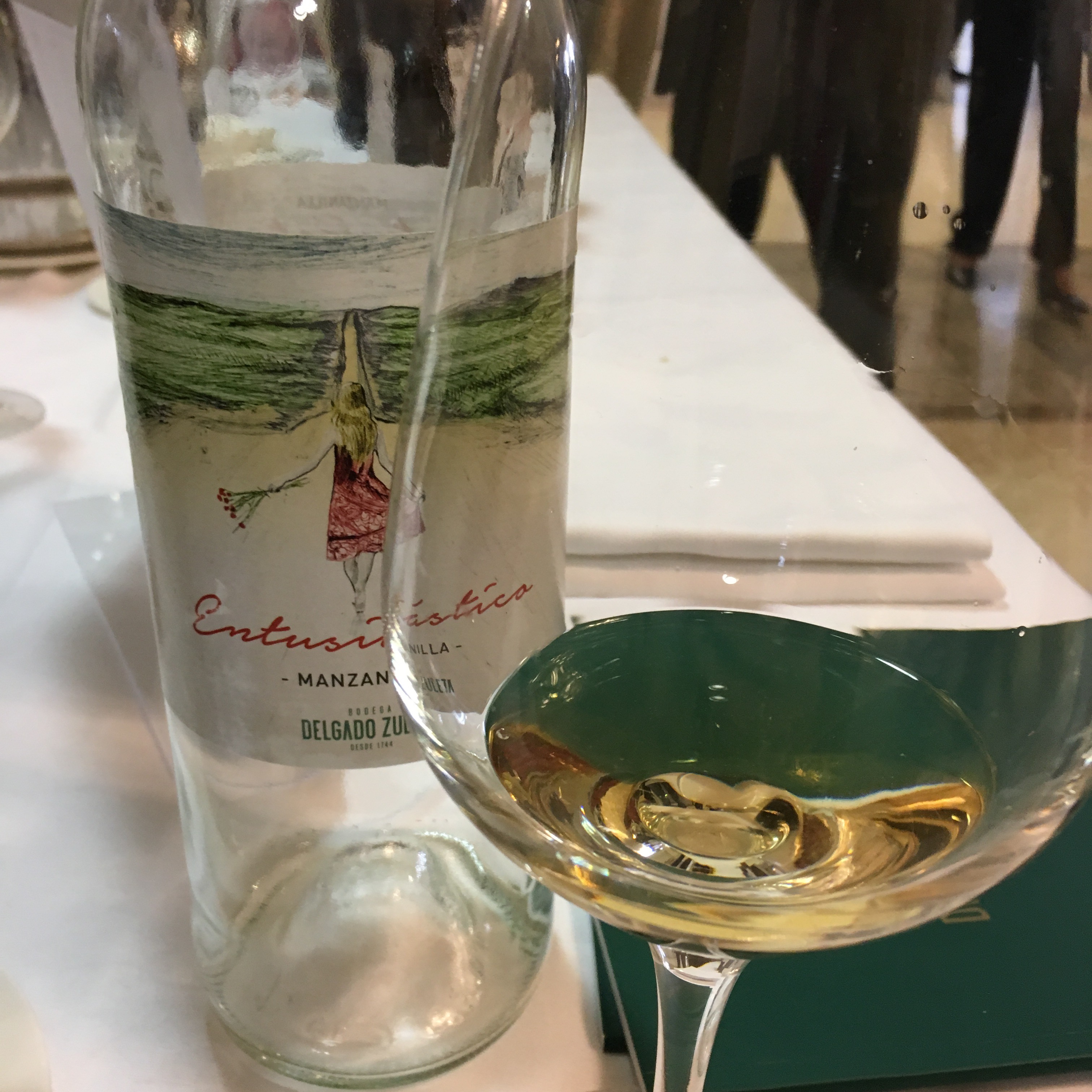
Manzanilla Entusiastico 

One of the more interesting projects around is the Entusiastico manzanilla by Delgado Zuleta – which aside from being “bio” and all the rest is one of the only examples I can think of of a brand new solera. You have to say that the label has improved out of sight. 

My impression was that the second saca seems to hold together a touch better than the first while maintaining a little bit of that softer-than-apple fruit on nose and palate. On the other hand, still a bit short of zing and real profile.

A work in progress, but a fascinating work in progress. 

Ramiro Ibañez and the History of Palo Cortados 

3682b0b9-b89a-4940-a2b4-608eae56c654-1

A quite outstanding masterclass, by the Master himself, appropriately enough in Taberna Palo Cortado. Many of the points were not new, but it was an excellent presentation bringing some much needed factual clarity to an area too often given to folklore while at the same time deftly comparing the industrial present to a past that was more respectful of the vines and the wines. My own retelling is going to be painfully inadequate by comparison, but I feel compelled to try.

History, not mystery

I particularly like the asymmetry in the title: “History” contrasting with the “Mystery” you get told about in 9 out of 10 tastings of palo cortados. With Ramiro the story usually begins back in the mists of time with the formation of the continents – or at least the Iberian peninsular – but here we pick up the story a mere 250 years ago at the back end of the 18th Century.

Until then the guilds in Jerez had prohibited the ageing of wines in el marco and the wines produced were young wines differentiated by style. The wines were not monovarietal: although palomino fino was largely dominant in Sanlucar, in Jerez less than fifty percent of vines were palomino, and many of them later ripening varieties that gave heavier wines. In practice, the growers would ferment the wine in botas fed with all the varieties in their vineyards, harvesting in several passes to account for the differing maturities of the distinct varieties, but the varieties were not kept separate. The wines produced in this way were then classified according to their characteristics – palma for the finest wines, and palo and raya for the heavier wines.

Ageing and classification

As the Century drew to a close the great Juan Haurie brought and won a historic lawsuit against the prohibition of storage and ageing, making possible the development of all manner of cellaring. Bodegas that previously had classified young wines by style also started selling wines that were a year, two years and three or more years old using classifications, adapted to reflect how the wines had developed in bota with “cortados” (palma cortado and palo cortado). (Confusingly, at first there were in fact different classifications corresponding to different stages of the wines: raya, raya/dot and two rayas at fermentation and then as the wine developed palma and cortado (for the finest wines, destined for biological ageing) and raya.)

Plurivarietal, vintage specific, and unfortified

But the wines of Jerez would have been fundamentally different to those we know today. First, they were vintage specific “añada” wines. Second, there was no fortification. Third, the wines were not monovarietal.

We were treated to three examples of wines from this “pre-industrial” age: a Palma from palomino fino on Miraflores Alta, and a Raya, also from palomino fino on Miraflores Baja, that had been harvested later, and a plurivarietal wine, the Encrucijado 2014, 40% uva rey, 40% perruno and 20% palomino fino. There was a notable difference in weight, girth and punch between the palma and the raya – an excellent illustration – and a massive difference between the palomino finos and the other varieties. And the Encrucijado was excellent on the night, with its overripe melon start, delicate structure, sharpness and zip.

The plurivarietal vineyards met their end thanks to the gradual adoption of palomino fino in Jerez and, in particular, tiny little sap suckers: the phylloxera crisis laid waste to the many indigenous varieties of the region. As a result, vineyards that had previously been plurivarietal or of varieties other than palomino were not replaced, and one of the key variations between the wines was lost.

However, wines continued to be statically aged as “añadas” in many cases, and even those wines that were used to refresh soleras were generally only introduced to the solera after three or four (or in some cases even six) years of static ageing. As a result, only a limited percentage of such wines went on to be finos, since nothing but the finest, first press mosto would survive four years of static ageing under flor (finos that incidentally being used to refresh the soleras of the most highly valued wines of them all, the amontillados).

Monovarietal, but still vintage specific

We were once again treated to wines that would have corresponded to those of this early-industrial age (end of the 19th to early 20th Century), specifically the Oloroso la Barajuela 2013 and the Williams & Humbert Oloroso de Añada 2001.

The Oloroso la Barajuela was fantastic. Probably my favourite wine of the night, it had bright acidity and potent fruit with just a hint of nuts and caramel. The Williams & Humbert also had a bright acidity to it, fruity nuts like hazelnuts and a velvety texture (there was a mention of residual sugar), but a lot more concentration as you would expect – a revealing comparison in that respect.

But what was really interesting about these two wines became more obvious as we moved on to the “modern” palo cortados: the Williams & Humbert “Dos Cortados” and the Barbadillo “Obispo Gascon“.

Monovarietal, solera and fortified 

These wines from the modern age of soleras are monovarietal palomino finos subjected to the bare minimum of static ageing: selected and fortified at the sobretablas stage after only a few months, rather than the several years of earlier times. This is one of the less well known but really important changes in the development of dynamic ageing over the years: whereas once wines were classified after several years of static ageing, they are now classified young.

They also offered examples of the two dominant styles of modern palo cortado. Palo Cortados are famously defined by the Consejo Regulador organoleptically  – wines that are as fine as an amontillado in aroma and as structured as an oloroso on the palate. And since there is no definition stipulating how it should be made producers tend to play up the “mystery” of how they make it (is it made, or is it born, etc?)

But with all due respect to the hype, it is all a load of bunk. As figures as illustrious as Jesus Barquin, Alvaro Giron and others have already pointed out, in the modern winemaking of single varieties and temperature controlled inox mystery is in short supply. While the name may derive from wines that once truly were accidental, today’s palo cortados are made by simply producing a slightly lighter oloroso – either selecting a lighter mosto than used for the oloroso (if the house oloroso is made from the second press, the palo cortado would be primera yema), or by subjecting the mosto to a little biological ageing.

Of these methods, the Dos Cortados would be an example of the former, and the Obispo Gascon the latter. They both showed the solidity and power of solera bred wines:  although the añada olorosos were potent and flavourful in their own way, they were noticeably finer and more elegant. The solera wines were impressive though, no doubt (and maybe the Obispo Gascon had a touch more salinity).

And there a great evening came to an end, but not before some delicious tapas and a cheeky glass of Encrucijado – in many ways the star of the evening and a delicious throwback to the time when these wines really were a mystery. I for one hope that it isn’t the last of its kind, and that the history of palo cortados has not yet been fully written.
The Salon de los Vinos Generosos: 2nd Edition

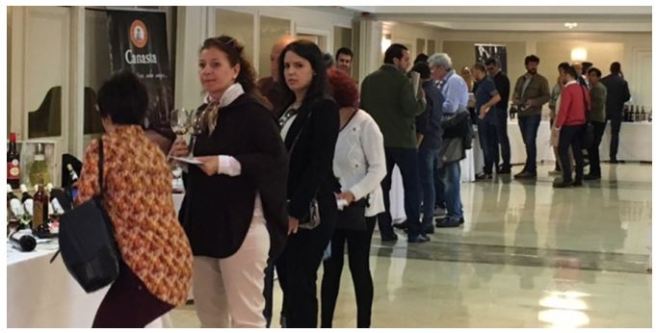
A much more disciplined, if all too brief, visit to this excellent event this year. I had just over an hour and couldn’t spend as much time as I would have liked but still caught up with a lot of of bodegas and sampled a few cracking wines. 

Once again if the salon is anything to go by then the sherry business is in rude health with a lot of bodegas, a lot of wines and a lot of interest. There were even bodegas I didn’t know – specifically Elias Gonzalez, with a pair of pretty handy manzanillas – and bodegas that I haven’t yet seen on the circuit, like Sanchez Ayala and Fundador. There were bodegas from both major DOs,  from el marco but outside the DO (Monge) and from Condado de Huelva.

As to the wines, it was a great chance to try a lot of wines side by side, including the new sacas of the Manzanilla by Sacristia AB, Puerto Fino by Lustau, the En rama by Fernando de Castilla (and the Antique while I was there) (and the vermouth), the Pastora by Barbadillo, the Goya and Goya XL, and the old saca of the La Guita en rama (still October 2015, a new saca expected in October this year). I also had my first chance to try the Fino Harvey’s by Bodegas Fundador – not bad at all – and the Gracia Solera Fina by Perez Barquero, which despite only 6/7 years under flor was saline and beautifully refined. Bodegas Tradicion had some intriguing magnums of fino that I wish I had more time to investigate. 

As I said, I didn’t have a chance to try everything, and was intrigued to learn later that there was a new, February 2017 saca of the Williams & Humbert añadas – definitely will be looking out for that next time. 


Moving on to the bigger guns, it was great to finally meet Fernando Hidalgo of Emilio Hidalgo and try a few of the old friends hw had brought along. Their Marques de Rodil palo cortado in particular was even better than I remembered – real saline edge to it – although they told me there is none left for the moment so will have to search around. 

Other memorable wines would include the 2016 amontillado from Sacristia AB – one of the most elegant around – and the “world champion” VORS amontillado by Harvey’s. Hard to live up to that hype but it is a serious wine, no doubt. I then spent some time getting to know the Capuchino, Sibarita, AOS and BC 200 wines by Osborne. Real classics all of them, and it is just remarkable how well integrated those abocados are – probably the best wines of that style that I know of. 

Again I am aware that I missed out on a few things. Perez Barquero apparently had some bottle aged amontillado that impressed a few of the guys, and a lot of people were excited by the Cigarrera amontillado and oloroso. Again, so many top wines, so little time etc. 

But overall an outstanding salon – kudos once again to the Calduch Comunicacion and I for one hope that a lot of business was done (if only so that I can try a few of these wines at my leisure around Madrid). 

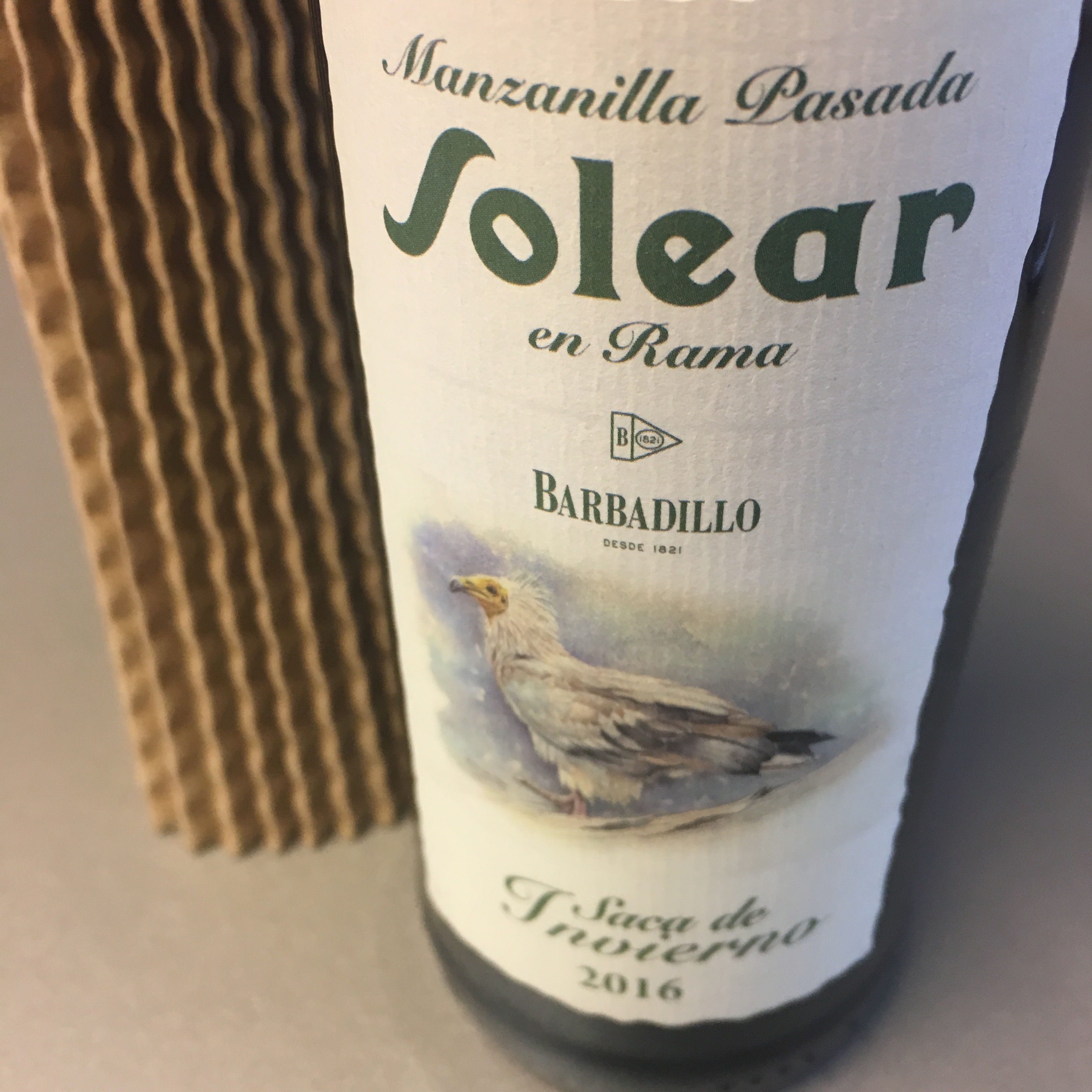
Manzanilla Solear en rama Winter 2016 – the Egyptian Vulture 

The Egyptian vulture has landed – been looking out for this for a while and now two halves of Europe’s smallest vulture are in my possession. 

Am intrigued that it is now labelled “manzanilla pasada” (was also the case in the Autumn but I didn’t notice). May be more accurate but I am not sure I fully agree with that. These marvellous wines have been manzanillas since 1999 and have surely earned the right to the name. They also don’t quite have the full, oxidated richness I associate with the best pasadas.

It certainly has all the flavour and character of the very best manzanillas. One of the most biological of wines, it has a sea air, wet reeds and rockpool nose, and the definition of zingy salinity – it is searing. Then spicey salad flavours that this time Inam finding slightly sweet. 

Vultures are already in grave danger in my apartment and I expect a dramatic fall in the population generally – get them while you can.  

Forlong Rosado 2016 

I am pretty sure this is the first Cabernet Sauvignon on this blog and it is another of the fresh and inventive wines from the guys at Forlong in Cadiz. I first tried it at the Cuatrogatos Wine Fest a while ago and had another chance to have a closer look this week.

As you can see it is  a clear pink/orange or orange/pink – maybe pink/gold. The nose is floral and summery fruit but also has some nice dairy and bakery notes. On the palate it is fresh on entry, maybe even has a bit of zingy salinity, a nice buttery texture, some summery red fruit and a bit of undergrowth. Again a fresh, slightly mineral finish with notes of baked fruit. 

One of the top cabernet sauvignon wines I have tried from Cadiz, no doubt. 

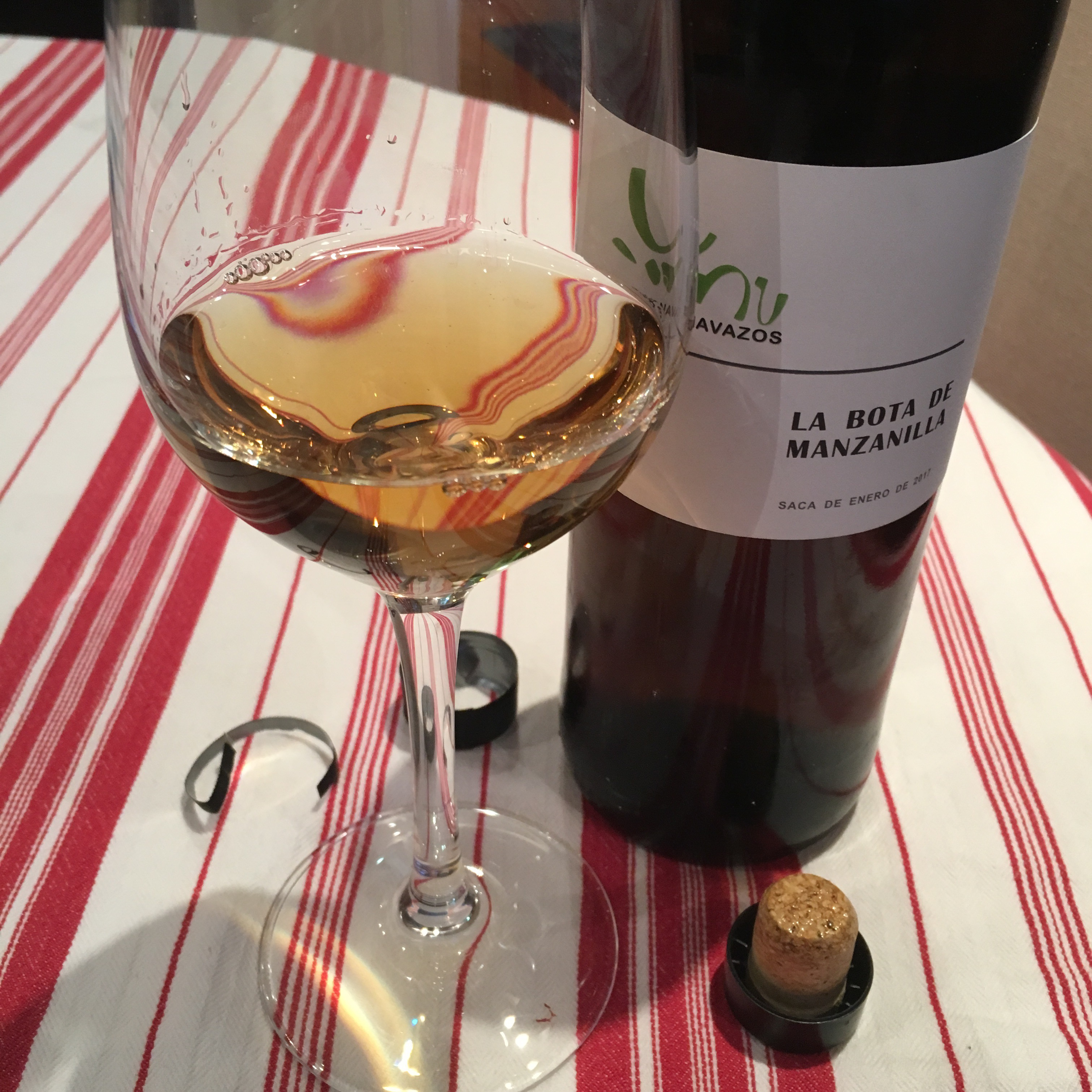
La Bota de Manzanilla 71 

The latest manzanilla from Equipo Navazos (see their ficha here) and once again from the solera of Hijos de Rainera Pérez Marín. 

At least to my mind it seems a shade darker than the last release, but with the same aromatic nose of esparto grass and salty sea air. Then silky in the mouth – light when compared to the manzanilla of course –  very elegant salinity and tasty herb flavours. 

Crying out for some fish and chips! (Or is that me?)

Fino Tradicion, Saca de Noviembre 2016

The latest saca from this excellent and improving series of wines, fresh in at Territorio Era. These winter sacas (they produce two a year in May and November respectively) tend to have more volume, punch and toasted, oxidated notes and this is no exception.

A pure beautiful crystaline brass of gold colour, it has a big punchy nose of salty sea air and esparto grass (natch) with a mix of older yeast, citrus and over-roasted almonds. On the palate it has real zing – a lot of saline action from start to finish – with again nice layers of flavours of nuts/burnt nuts and citrus/bitter citrus. Dry but flavourful and it lasts and lasts, with that sharp, crisp saline edge all the while.

Really excellent. I generally like the May sacas even more so look forward to that one!

The joy of blind tasting 

Was very fortunate to take part in an absolutely top class event organized by Vila Viniteca here in Madrid this weekend – The 10th Premio de Cata por Parejas (Tasting in Pairs competition).

I was blown away by the scale of it – 120 pairs of contestants in the contest itself but on top of that 50 top drawer bodegas showing off their wines to around 2,500 people in total, and all in the stunning surroundings of Madrid’s original Casino (not currently a casino, confusingly).  If you don’t believe me you can see some TV highlights from three of Spain’s national broadcasters and Madrid’ local news (all in Spanish and untainted by my presence) here, here, here and here.

I was also surprised by the quality of the wines – first up was a lovely old Salon, with the tightest, creamiest bubbles you can imagine, followed by a wine given no fewer than the perfect 100 points by you know who – the 1986 Castillo y Gay. (I got the regions, DOs, grapes and approximate ages of both, but never imagined they would be that generous so duffed the makers.) In fact all the way down the line the wines were excellent, and my favourites were in fact a Barbera by Voerzio (I said Sangiovese) and a Malvasia from Tenerife (Sauternes). (Again, accurate details will be available on the Vila Viniteca Blog.)

And it was enjoyable for a lot of other reasons. First, my “pair” was Ana, formerly of the Chula de Chamberi and we spent most of the 90 minutes laughing, teasing and generally enjoying ourselves. Second, there were an awful lot of good friends and big names around the room and the place generally – it was a pleasure to compete against and chat to Jesus Barquin, no less. Third, the wines downstairs were as good as those upstairs – the new Riberas from Dominio del Aguila and the classic Riojas by Finca Allende stood out for me, and Jerez was fantastically represented by Lustau and all their almacenistas, but there was top drawer liquid everywhere to be honest.

But most importantly I have discovered I really enjoy tasting wines blind. Not because I am any good at identifying them (although I was pleased with the effort on the day) but because it strikes me that you focus on and enjoy the wine that little bit more. On the day itself they were top wines, but in the last few weeks people like David at Angelita, David at Era and David at Santceloni (different people) have been trying me out and wines I previously  thought I didn’t like were surprisingly enjoyable. In fact I reckon that from now on I am going to tell sommeliers I am training for next year.

So a great day, and bravo both to Vila Viniteca for an outstanding event, and to the winners – Luis Gutierrez and Ignacio Villalgordo – winning this thing for the second time no less. A brilliant performance from them and the other podium dwellers and I clearly need to drink a lot more Salon in future.


Two years under the flor

img_2376

March 27 around already and another year has flown by. An appropriate moment perhaps to take stock and reflect. The old blog has had a few hits: 49,800 in total now (meaning 33,200 since this time last year) from 17,100 daily visitors in 105 different countries around the world (not including Iceland or Uruguay). It really is rather humbling, and all I can say is many thanks to everyone for your clicks, retweets, comments, likes and messages.  There has been a fair bit to look at too: 326 posts this year, not including this one, or the page updates with lists of restaurants and the like, and just shy of 5,200 tweets, plus all the facebooking etc. Makes me wonder where I find the time.

I am not much cop at deciphering the stats so can’t really tell you with great precision which have been the most visited pages and posts of the year, but I am happy to say that by far the most used page on the blog is the Where To Drink It section, with its list of restaurants of every kind where you can drink the wines of Jerez and Sanlucar, and after that most of the interest appears to be directed at the (proper) Authorities and at the learned writings on topics such as Terroir.

After that, I am also very pleased to say that the wines that arouse most interest are some that are very near to my heart: the Fino la Barajuela 2013, UBE, Encrucijado, the Pitijopos, the Mayeteria Sanluqueña and the Wines of Alba Viticultores. I am convinced that these wines don’t get nearly the attention or respect that they deserve and make no apologies for my numerous posts on them. I only wish that they were more widely available – I have received more than one grumble about my blogging on wines that are made in less than 1,000 bottle batches and I can understand that frustration.

There have once again been a fair few highlights (since March 27 last year):

  • Without question the top day was a visit with Willy Perez and a tasting of the wines of the Barajuela Project down in his cracking bodega in Jerez. I really think these are fantastic, exciting wines and the chance to sit down and taste them altogether was really a treat.
  • The Cuatrogatos Wine Fest, in Puerto de Santa Maria this February, was an absolute blast, with top wines, top people and a lot of laughter in general and in particular a first look at the Mayeteria Sanluqueña.
  • Ramiro Ibañez was involved in many of the highlights of the year, and in particular (and aside from his wines) his two day residency as guest sommelier at Surtopia (Day 1 and Day 2) and an absolutely top drawer masterclass on Palo Cortados in the eponymous taberna (which I am still writing up).
  • Primitivo Collantes gave one of the best tastings of the year, and one of the most disarmingly convincing advertisements for terroir focussed winemaking I have seen, a few weeks ago in Enoteca Barolo, restoring my faith in moscatel in the process.
  • And indeed there were a lot of good tastings, including the Lustau Almacenistas (in Taberna Palo Cortado), the Wines of Alba Viticultores (in La Buena Vida), Toro Albala (in Taberna Palo Cortado again), Mons Urium (in Taberna Palo Cortado again), the Williams Colección Añadas (in Taberna Verdejo), the great Gran Barqueros (in Reserva y Cata) and a fascinating “vertical” of the Tradición Finos (also in Reserva y Cata).

Regrets, as they say, we have had a few, but only a few. The lowlight of the year was the end of an era in one of my erstwhile favourite watering holes some six months ago (although I am told that good news is around the corner), and there were a few tastings, and wines, that to be quite honest were a bit of a let down. More generally, older and, maybe wiser, maybe just grumpier, I find myself getting more irritated these days with wines, and blarney of all kinds (and the acceptance of them by some sommeliers, who ought to know better), that I might have found charming a couple of years ago, and the “everything is awesome” tone of the blog is getting harder to maintain.

Finally, though, I couldn’t write about this last year without talking about Territorio Era. It is without doubt my favourite bar or restaurant in Madrid at the moment and it should be yours too. All available space that is not dedicated to Diego’s fantastic cooking is given over to storing hundreds of wines of every kind, of which over a hundred are available by the glass. I have lost count of the fantastic lunches and dinners, swift and cheeky glasses of wine and general emergency stops that have taken place in there.

So onwards to year three. There is still a long way to go for the wines of Jerez and Sanlucar so time to push on. Many thanks once again to everybody for all your support up to here and I look forward to the next twelve months.


II Salon de los Vinos Generosos

Salon GenerososA really top class event coming up on April 4 here in Madrid – the second edition of the Salon de los Vinos Generosos organized by Calduch Comunicación.

Last year’s event – or what I can remember of it – was excellent: some really top class wines and a chance to meet a lot of names from the bodegas. Happily, it seems as if the majority of the bodegas involved have signed up for the rematch, including:

Alvear – Barbadillo – Bodegas Arfe – Bodegas Fundador – Bodegas La Cigarrera – Bodegas Robles – Bodegas Tradición – Delgado Zuleta – Díez Mérito – Elías González – González Byass – Grupo Estévez – Hidalgo – Lustau – Manzanilla Gabriela – Osborne – Pérez Barquero – Rey Fernando de Castilla – Sacristía AB – Sánchez Romate – Williams & Humbert – Ximénez-Spínola

Throw in some top class ham, cheese and conserves and you have a pretty good day out. Hope to see everyone there!