Fino Especial La Panesa 

Been a while since I had a bottle of this open but it has been on my mind this week.

This is probably my favourite bottle of sherry – a wine suitable for any occasion and the one I would take to a desert island. It comes from a solera where the flor survives – in a layer that can only be microns thick –  on wine with an average age of fifteen years. It has a lovely volume, richness and, at the same time, definition that I find enthralling.

This is a bottle from 2013 and it just has a hint of reduction that almost adds complexity to the nose – from sea air to wet seaweed. Hazelnuts, almonds, salinity and zing, and peppery spices. A long long finish with those warming spices.

A truly world class wine.

Sherry: an apology

A couple of weeks ago I put into words some doubts I had as to the value of “Sherry” as a brand and the question of whether we wouldn’t be better off ditching it in favour of “wines of Jerez and Sanlucar” and other longer, but more precise, terms. I did a couple of polls on twitter and nearly 80% (of not many) agreed – most of the feedback I got was along the same lines (many thanks in particular to Alvaro Giron and Pelayo Delgado Zuleta).

But I had a feeling that mostly I was preaching to the converted/the existing tribe – the not particularly numerous  subset of people that read the blog and follow on twitter, so I thought it would be good to widen the circle and asked the chaps over on winebeserkers.com, where I got a lot of useful feedback (from Drew, Ian, Greg, Sanjay, Paul, Leon, David, Doug, Don and David – I think you can see the thread here) that has turned me around on this.

In my original post my concerns were broadly that the use of “sherry” can be thought of as a category separate to “wines”, that the name had a lot of negative baggage, and that it obscured the great variety of wines and zones from the region.

Noone really touched the first point but there is, of course, a positive side to being your own category. As to the second point on negative associations, it was rightly pointed out that other denominations – Chianti and Riesling are examples – have turned it around, and while Champagne never fell all that low the metamorphosis there has driven a lot of new interest. More importantly, it was interesting to read the perspective from Australia and elsewhere: they would snap up the sherry brand in a heartbeat if they could. And as to the third point, and indeed in general, the overall view was that education was the way forward. That must be right: make nice wines and tell the world, educating while you go. No need to throw the centuries -old baby out with the bathwater .

So look, I take it all back. “Sherry” has its place and its role to play. What can I say? It was an early morning flight and something I  just needed to get out of my system (almost as soon as I had done it struck me I was being a touch precious). But it shouldn’t be the whole story: sherry is not the new G&T, it is the family name applied to some unique wines each of which deserve to be famous in their own right.

But the catavinos, sherry glass or schooner, that I do not forgive.


Amontillado Coliseo 

This Amontillado Coliseo, by Valdespino, was the big beast (in a little bottle) at the end of a memorable dinner at Sacha and one that served as an intense, tasty contrast to the arguable star of the night, the Palo Cortado Reliquia. Like that other wine, this is one of the dinosaurs of the cellar, with an average age of 80 or 90 years, but while the Barbadillo seemed even a little over refined, this was a little brute, full of concentrated flavour.

Dark, mahogany furniture in colour and a punchy, but smooth polish nose. On the palate it was incredibly saline and dense with woody flavours of black treacle, burnt cake and pipe tobacco. Compared to the Reliquia it may have been a little astringent but that salinity and concentration gave it the longest of finishes and I really liked it (I took it after all).

Very very good – may have to taste it again sober!

Manzanilla Deliciosa en Rama, Spring 2016

This is the en rama version of an old favourite and one that I have pursued for over a year – just never seemed to coincide with it until by chance I spotted it on the Coalla Gourmet tweet stream last week.

It is a lovely little bottle of wine, yeasty bakery on the nose, with citrus and sea air in the background. On the palate it is salty citrus fruit – quiet at first then intense and zingy – then salt and pepper that lasts a long time, mouth watering all the while. Really good stuff. Drinking it with salty pecorino cheese the fruitiness comes out.

A class wine full of flavour.


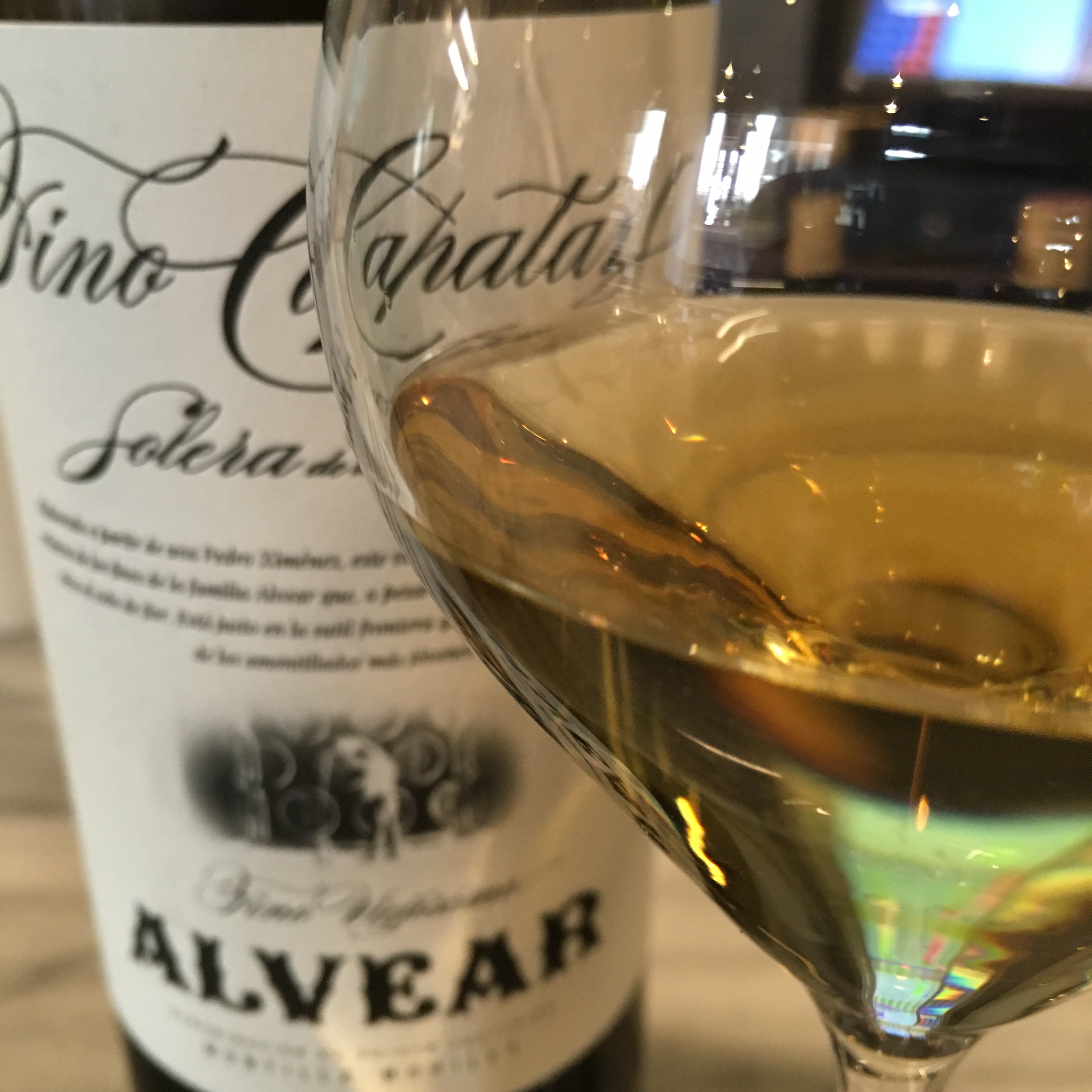
Fino Capataz Solera de la Casa 

Once again at the bar of Angelita and these guys never fail with their wines by the glass. It really is fun coming here.

This is a fino by Alvear, in Montilla Moriles, that is 100% pedro ximenez and has had a long long time under flor – if the original Capataz had over 6 years this has had at least a couple more. (I was told once but I had already had a few at the time.) I am predisposed to like this wine since I learned I shared a surname with the great great grandmother of the current owners, but even without that whiff of nepotism it is a cracker.

The colour is not quite as dark as the picture suggests – it is a straw-coloured gold with a suggestion of black to it. On the nose it is punchy, nutty with hay bales and sweet and herbal tea touches – very nice nose with plenty in it. On the palate it is an intense old liquid: very saline and a real burn on the edges of the tongue, full bodied and oily, and with bitter almond intensity. Long, long salty and bitter finish to it.

Intense but balanced and with plenty in it – a really top class fino worthy of Great Great Grandma Ward.

(And followed with a 2002 late harvest Trimbach – absolutely brilliant contrast, see comment above re coming here.)

Amontillado Gutierrez Colosia Solera Familiar 

Gutierrez Colosia is a former almacenista and now producer from el Puerto de Santa Maria that has released some really nice wines – the fino en rama really stands out (one of the first really good Puerto finos that I had) but down there in March their standard amontillado was the best of a strong field at dinner one night (seeing off Equipo Navazos and Emilio Hidalgo amongst others). So good, in fact, that one of the friends I was at dinner with that night hunted this down and got me a bottle.

This is the kind of wine you treat with respect so I have endeavoured to do a bit of research and, although this wine does not appear on the website, the bodega have been very quick to answer emails and generous with details. The Gutiérrez Colosía family describe themselves as heirs to the long tradition of “criadores de vinos”. In the past all the production was destined for the big houses with exporting operations. This particular amontillado comes from the soleras that over 50 years ago used to supply Williams and Humbert but when Williams changed hands the wine stopped being sold because at that time nobody else was willing to pay what it was worth (with the exception of a small amount that was bottled for the “almacenistas” collection of Lustau under the name Mª Loreto Colosía. The botas of this wine are located in a corner of the bodega blessed with “special” climatic conditions and only small quantities are bottled each year. In total it is estimated to have an average age of above 60 years.

The wine itself is not quite crystal clear – even a little turbid – but is a lovely deep chestnut colour. The nose has that solvent like, ethereal volatile start, but is full of hazelnuts, toasted almond and burnt butter.  On the palate it has a nice bite of alcohol and zingy acidity, and is refined, drying and fresh but tasty and salty. Not as intense as I expected given its age but very pleasant wood, nut and even tobacco flavours and a long, dry finish that is not astringent.

A rare old wine with the woody character to prove it.

Vintages past, present, and future

IMG_4513

My latest post for the sherry.wine site went up this week and, having eliminated the typos, it is my pleasure to share the link here.

This is one of my obsessions – the more I drink and read about these wines the more I am convinced of the value of this kind of differentiation (and if you don’t believe me just see my posts from September and February, amongst others). More importantly, it is apparently a historic reality – here the experts are the so called “Sobrinos de Haurie“, who are working on an exciting new history of the vintage wines of the region.

The making of these vintage wines is, however, more limiting than I had previously thought. I had the great fortune recently to attend a wine tasting of some really spectacular vintage Montilla Moriles wines in Taberna Palo Cortado and one of the issues that came up that night was that the Montilla Moriles wines had been “moved”, i.e., the barrels had been refreshed from other barrels of the same vintage. This is apparently something I understand would not be permitted in a “vintage” sherry, where a seal is attached to the barrels, and only broken on bottling (or something along those lines). In fact, the “movement” caused some consternation among those present.

All I can say is that the results were first class, and on discussing it with Antonio Barbadillo (whose Sacristia AB series is synonymous with some little gems) he also appeared to be convinced of the need to “move” wines for a number of reasons. Of course it was a tiny sample of 60 year old wines and we only tasted one side of the argument, but it struck me as an interesting issue that might usefully be reconsidered.

For now, though, I repeat my promise of February: make me a vintage sherry and trust me, I will buy it!


Ancestral Alegrías del Carrascal 2015

This wine got “left behind” at our recent tasting of the wines of Alba Viticultores in La Buena Vida and lived to see another day – or specifically a night in Sacha. It didn’t see much of it though – it was gone so quick I didn’t even get a picture of the liquid itself (and although it now strikes me as unappetising, the above picture shows just how natural these wines are – boy was that last gulp a tasty one!).

It is an ancestral method wine from the Las Alegrías vineyard (Pago Carrascal de Sanlucar) fermented in a 1,000 litre tank for two weeks before bottling with some residual yeasts and sugars. They disgorge these by hand to order – so this one has around 8 months on the rack before disgorging.

This was a more serious proposition than the other ancestral that we tried the first time around, with less residual sweetness and more marked aromatics and flavours. Really noticeable carbonic and a metallic nose to it at first, but then creamy, herbal and grassy aromas came through, and although it didn’t have big acidity it had a nice saline bite and a bitter herb finish giving it a nice structured trip across the tastebuds. Another fascinating wine alright.

Tintilla 2013, Bodegas Luis Perez 

A 100% Tintilla de Rota dry red wine by Bodegas Luis Perez (and the big brother of the Garum and Samaruco, both of which I also enjoyed).

Tintilla is one of the traditional grapes from the region that until recently had all but disappeared but is now making a strong comeback. It is said to be an Andalucian cousin of Graciano, but while I am not that familiar with Graciano whenever I have come across Tintilla in dry wines it has reminded me of shiraz/syrah (indeed once I tried an unoaked Tintilla blind and thought it was a shiraz).

This is from vines planted on one of the great pagos of Jerez, Balbaina, and specifically from a vineyard named Calderin del Obispo (one of the two “Calderin” on this plan I guess) and has had 16 months in oak.

The resulting wine is a refined, elegant but tasty animal. It has the mineral quality – salinity even – of the other wines, but also beefy, peppery aromas (in the interest of full disclosure I was roasting a joint of beef as we drank this, so my mind may have one tracked a little). On the palate if has very refined blackberry fruit – maybe just a hint of bitterness – and again that salt and pepper and meatiness on the palate, a nice texture with a nice touch of acidity and a lovely fresh finish.

Like this very much – and it was brilliant with that beef too.

Manzanilla Sacristia AB, 1a saca de 2015


A fella thought he had picked up the latest release – the 1a saca 2016 – but failed to read the smallprint and here we are with an old favourite.

In my defense, having tried the 2016 recently I knew immediately that this wasn’t it. This one is tasty though: it has opened up a little and I am enjoying it a lot more than I remember – there are some hay bales in the nose, the yeast is seeming more citrus and the vegetable flavours are seeming fruitier, with that zingy salinity in the background and a long, long finish. (A day later it is really singing in fact – lovely fruitful character to it.)

Really good, even if it wasn’t the wine I thought I was buying.