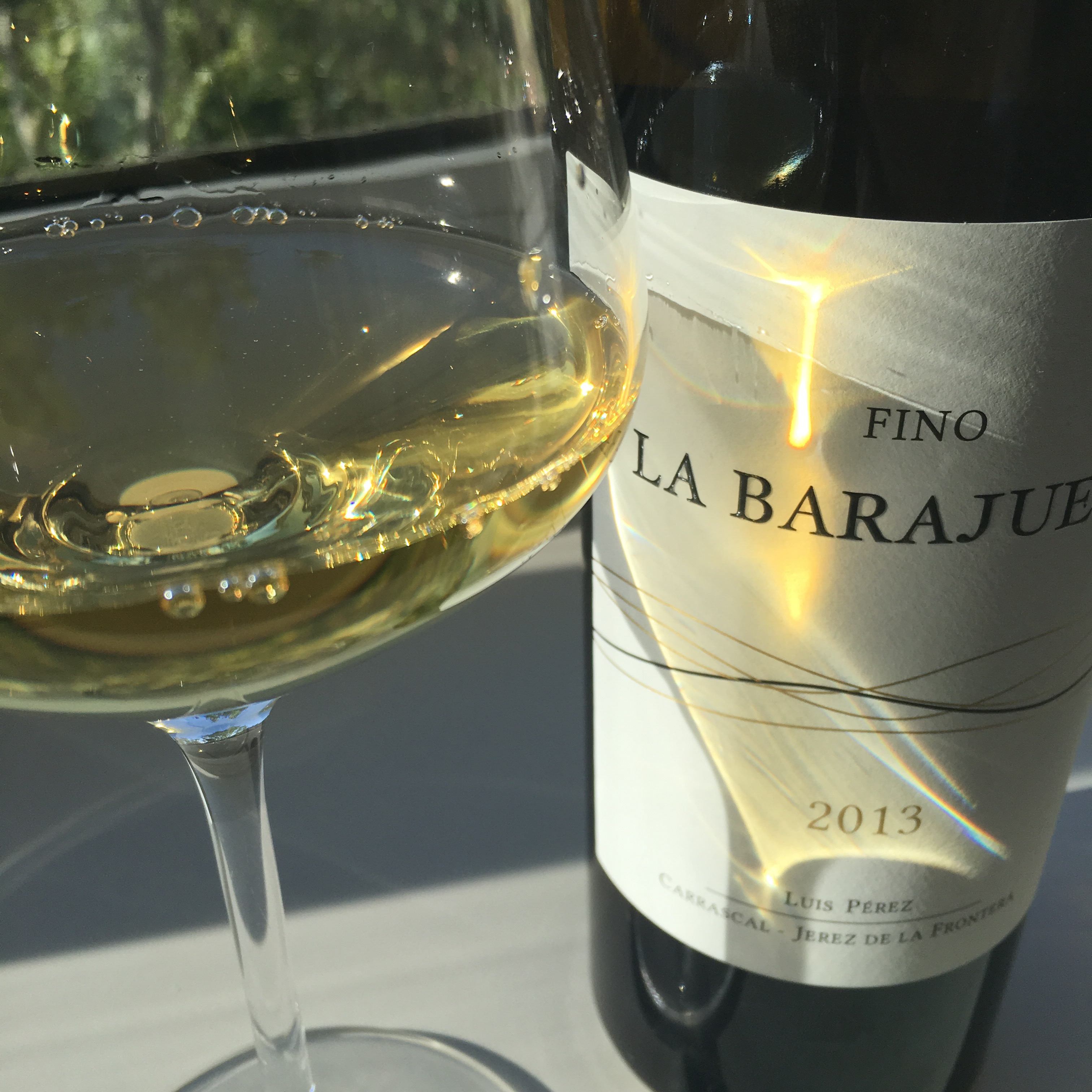
Fino la Barajuela 2013

Happy Father’s Day to me. What a wine this is.

It is a famous wine and one that lives up to its reputation. I first heard about it many moons ago, tried it in March on an overwhelming day in many ways, and have since heard its praises sung from the rooftops. And rightly so.

It may not be what you expect from a fino but it is a very fine wine. In fact, it is the expression of terroir and fruit in Jerez, and of winemaking, that I and many others have been waiting for. I thought it was impressive in March but found it heavy – now it is light on its feet and has the presence and personality of a great wine. I just can’t believe how good it is. It is outrageous.

If anyone tells you palomino is a “neutral vessel” let them taste this (or its Sanlucar cousin, the UBE, when it comes to that). When I first opened it it had that meaty nose of fresh grilled tuna, with a little lemon and coriander. Then as it opened later the nose was all fruit and sweet herbs. On the palate it has those same flavours fruit, sweet herbs, and meatiness, and the profile is horizontal: a long, long flavour that persists. All the while there is spicey saltiness in the background, and the balance of salinity and fruit is perfect – tasty but not clingy, full but not heavy.

Just really delicious. A fantastic wine.

Surtopia – Cota 45 – Atún – Langostino

The sherry event of the summer here in Madrid – five dishes and five wines, with José Calleja of Surtopia providing the food and Ramiro Ibañez of Cota 45 providing the wines. In fact ten dishes and ten wines, with tuna on July 13 and langostinos on July 14 (lunch and dinner).

No clues yet about the wines involved but I have been told that I haven’t tried most of them (I find it hard to believe) and that they include some “massive cucumbers” (pepinazos gordos): you will have to take my word for it but this is a good thing.

I know I will be there – will be absolutely cracking. 

Fino Tradicion October 2014

Another classic fino from Bodegas Tradicion, and when I say another, I mean it follows in the tradition of the May 2013, October 2013, May 2015 and November 2015.

I love these – right up there with the very best finos on the market and this was a cracking “saca”. Nice rich gold in colour. On the nose it has a kind of mineral, haybale, citrus quality – like old lemon energy sweets – then it has a nice full body and just classic yeasty, nutty fino flavours, with mineral zing and a bready, salty finish – clinging but mouthwatering.

Just what a fellow needs.


Mons Urium in Taberna Palo Cortado

Another great night yesterday in Taberna Palo Cortado, this time to taste the wines of Bodegas Urium, a small, family run bodega that is one of the newest faces in Jerez but to judge from last night one of the most passionate.

The bodega has been around for “centuries”, formerly, as an almacenista (one of the “faceless”  winemakers of Jerez, as one of the guys put it last night) and is located on Calle Muro, aka “Wall Street”. The bodega is run by Alonso and Rocio Ruiz, a father and daughter team from a family from the town of Moguer, in Huelva (known to the Romans as “Mons Urium”, from whence the name). Alonso fulfilled a lifelong dream – learnt in turn from his own father – when they acquired the bodega in 2009, acquiring not only a historic bodega but, more importantly, its contents. In total around 500 botas of wines, many of them very old and, to judge by last night, very fine.

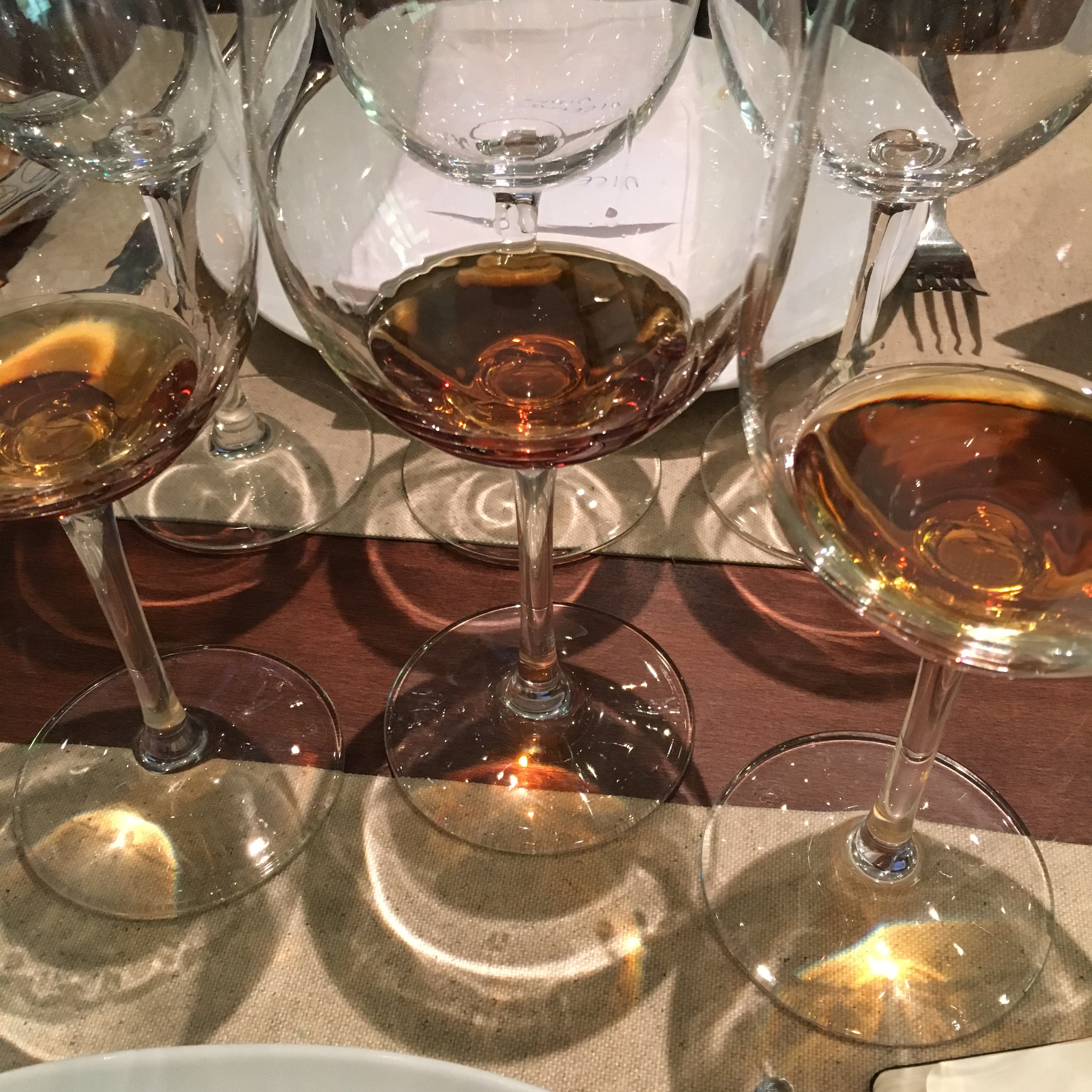
Last night we had five wines: a very nice fino en rama – fruitful, yeasty and juicy – with around eight years under flor, and four VORS wines with an average age of 45 years – the amontillado, oloroso and palo cortado, pictured above, and a very youthful tasting 45 year old Pedro Ximenez.  Five excellent wines – I particularly liked the fino and the punchy, saline oloroso, but the amontillado was elegant and smokey and the palo cortado had a bit of spirit to it.

More importantly, we also had the chance to meet Rocio and one got a clear impression of a project that was moving in the right direction. Having trained with none other than Luis Perez she has a very uncluttered, balanced approach to winemaking that was as free from blarney as it was from unnecessary formalism: wine making with wine at its center, with the goal of making wine that people can drink. It was fascinating to hear her talk about the gradual progress in tasting, assessing and classifying mostos and wines, and the efforts to imprint their own style on the old “jewels” they had inherited. It all sounded like hard work, but despite that there was a lot of laughter and enthusiasm that was captivating.

All in all, another terrific evening in Taberna Palo Cortado and a real pleasure to meet one of the young winemakers pushing the region forward.


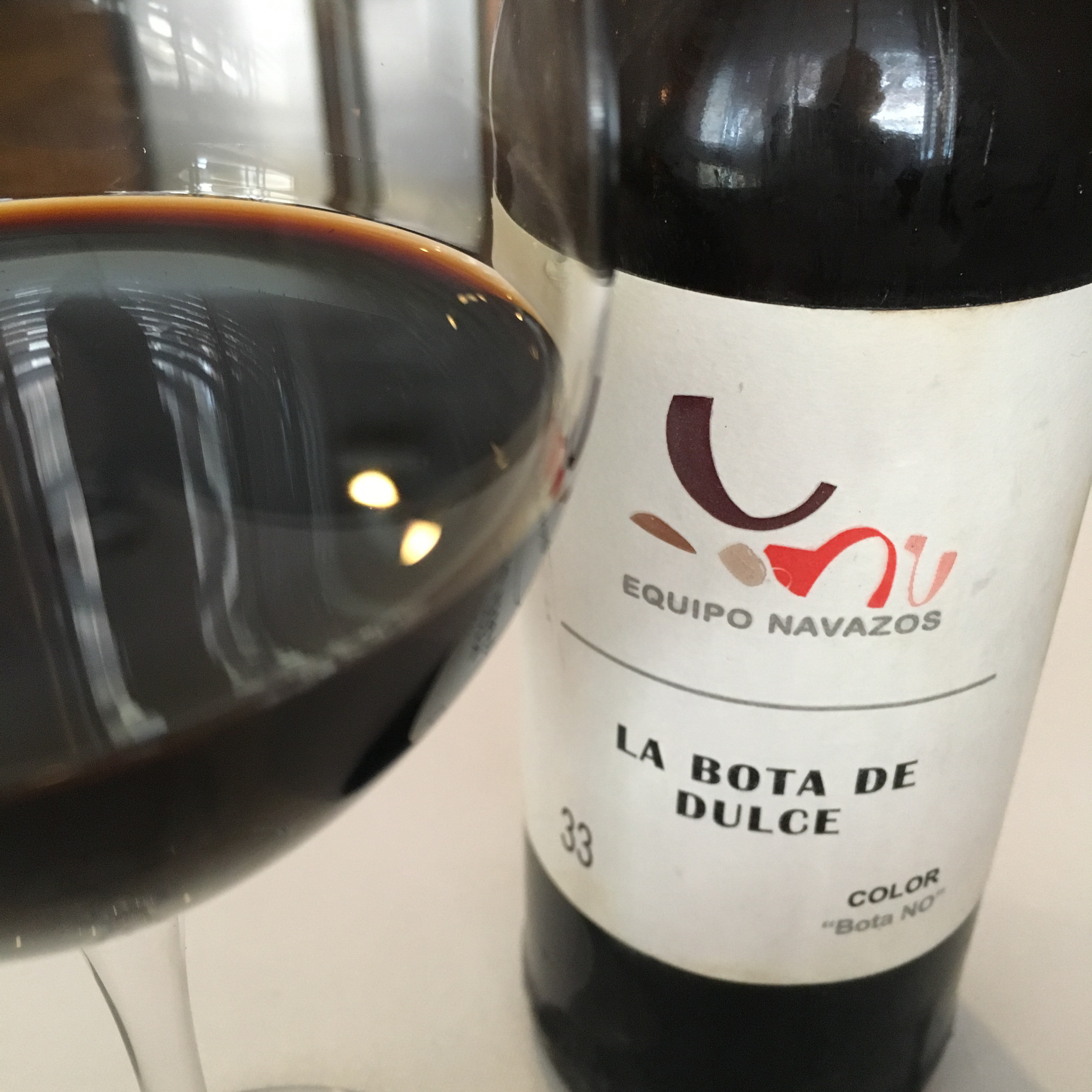
La Bota de Dulce Color 33 – “Bota No”


I have been planning to come back and try this ever since my last visit to Sudestada and have had the chance to read up on it ahead of time.

This is Equipo Navazos in their element. As their excellent (as always) ficha points out, this is really a historic artefact, an example of the “colour” wine that used to be added to wine to – I think you can guess – give it colour and aromatic complexity. I recommend reading the ficha for all the details but this is a wine of about 80 years old that was obtained from the cellar of almacenista Juan Garcia Jarana (a happy hunting ground for these guys).

The “color” in question is black with a reddish brown edge to it, and the tear on the glass is that red brown. On the nose it is surprisingly quiet – I expected my eyes to water – but while all that aromatic there is a nose of distilled barrel with some eucalyptus.

On the palate again it is nowhere near as acidic or potent as I expected. (In all seriousness I wonder if it might have lost some of its mojo after a long time open, but then again for an 80 year old wine it isn’t exactly delicate.) Neither does it come across as sweet – despite the 190 grammes of sugar per liter it apparently has. In fact on the whole I find it balanced, tending to bitter. The bitterness and the barrel flavours are dominant – just a little woody spice, tobacco and resin at the end, and it isn’t really astringent either. Sticky length – one word I notice I haven’t used is salinity, and this is a finish that sticks to you rather than making the mouth water.

Really interesting and instructive.

Fino en rama Tio Pepe 2016


Not my first glass of this but my first chance to have a good look at this 2016 edition (here at the bar of Taberna Verdejo) and I like it.

Has a very nice apple/apple sorbet nose and a fine, delicate almond profile – fresh almonds rather than bitter or toasted – tingling salinity in the background that comes through at the end for a fresh finish. Not overpowering, but elegant, and that apple is very attractive.

A fresh, zesty edition of this classic wine.

Fino Especial La Panesa 

Been a while since I had a bottle of this open but it has been on my mind this week.

This is probably my favourite bottle of sherry – a wine suitable for any occasion and the one I would take to a desert island. It comes from a solera where the flor survives – in a layer that can only be microns thick –  on wine with an average age of fifteen years. It has a lovely volume, richness and, at the same time, definition that I find enthralling.

This is a bottle from 2013 and it just has a hint of reduction that almost adds complexity to the nose – from sea air to wet seaweed. Hazelnuts, almonds, salinity and zing, and peppery spices. A long long finish with those warming spices.

A truly world class wine.

Sherry: an apology

A couple of weeks ago I put into words some doubts I had as to the value of “Sherry” as a brand and the question of whether we wouldn’t be better off ditching it in favour of “wines of Jerez and Sanlucar” and other longer, but more precise, terms. I did a couple of polls on twitter and nearly 80% (of not many) agreed – most of the feedback I got was along the same lines (many thanks in particular to Alvaro Giron and Pelayo Delgado Zuleta).

But I had a feeling that mostly I was preaching to the converted/the existing tribe – the not particularly numerous  subset of people that read the blog and follow on twitter, so I thought it would be good to widen the circle and asked the chaps over on winebeserkers.com, where I got a lot of useful feedback (from Drew, Ian, Greg, Sanjay, Paul, Leon, David, Doug, Don and David – I think you can see the thread here) that has turned me around on this.

In my original post my concerns were broadly that the use of “sherry” can be thought of as a category separate to “wines”, that the name had a lot of negative baggage, and that it obscured the great variety of wines and zones from the region.

Noone really touched the first point but there is, of course, a positive side to being your own category. As to the second point on negative associations, it was rightly pointed out that other denominations – Chianti and Riesling are examples – have turned it around, and while Champagne never fell all that low the metamorphosis there has driven a lot of new interest. More importantly, it was interesting to read the perspective from Australia and elsewhere: they would snap up the sherry brand in a heartbeat if they could. And as to the third point, and indeed in general, the overall view was that education was the way forward. That must be right: make nice wines and tell the world, educating while you go. No need to throw the centuries -old baby out with the bathwater .

So look, I take it all back. “Sherry” has its place and its role to play. What can I say? It was an early morning flight and something I  just needed to get out of my system (almost as soon as I had done it struck me I was being a touch precious). But it shouldn’t be the whole story: sherry is not the new G&T, it is the family name applied to some unique wines each of which deserve to be famous in their own right.

But the catavinos, sherry glass or schooner, that I do not forgive.


Amontillado Coliseo 

This Amontillado Coliseo, by Valdespino, was the big beast (in a little bottle) at the end of a memorable dinner at Sacha and one that served as an intense, tasty contrast to the arguable star of the night, the Palo Cortado Reliquia. Like that other wine, this is one of the dinosaurs of the cellar, with an average age of 80 or 90 years, but while the Barbadillo seemed even a little over refined, this was a little brute, full of concentrated flavour.

Dark, mahogany furniture in colour and a punchy, but smooth polish nose. On the palate it was incredibly saline and dense with woody flavours of black treacle, burnt cake and pipe tobacco. Compared to the Reliquia it may have been a little astringent but that salinity and concentration gave it the longest of finishes and I really liked it (I took it after all).

Very very good – may have to taste it again sober!