UBE 2014

Rumour has it that there were a hundred fewer of these produced (out of not many to start with) so if you see one jump on it. (You never know, this could be the “Pingus” moment for this little gem of a wine.) I didn’t get my hands on Ube 2013 (not just once but twice in quick succession) until January this year but I have been waiting for this one ever since, picked it up last week and managed to wait nearly a full week before opening it.

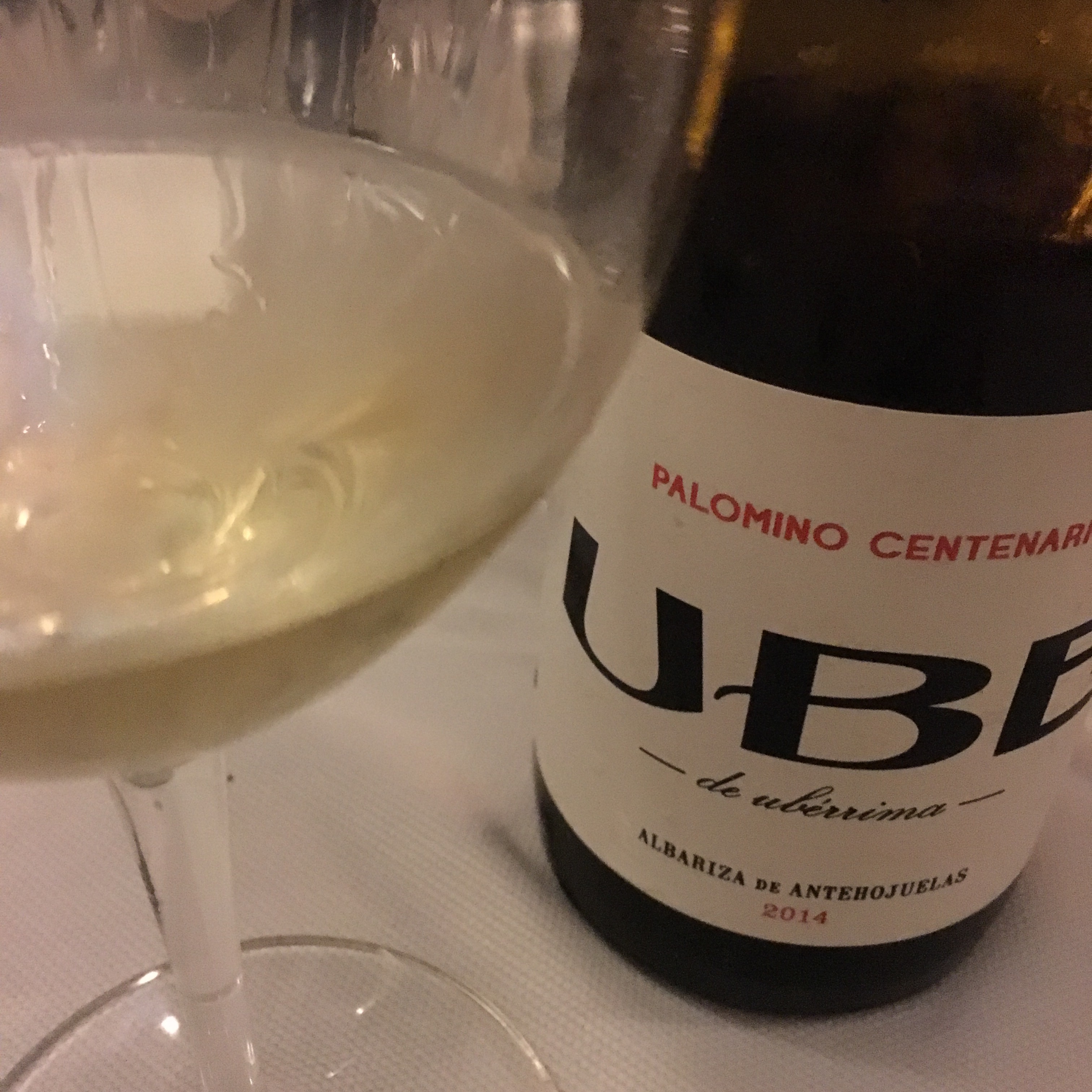
It is by Ramiro Ibañez of Cota 45 and the full name is “Ube de uberrina” (uberrina meaning “utmost”), it is an unfortified white wine labelled “Palomino Centenario” (100 year old palomino) and its label references the kind of albariza soil involved (albariza de antehojuelas), the vineyard (a small finca called Las Vegas), and the cepage (100% palomino but 73% palomino fino, 16% palomino jerezano and 11% palomino peluson). It was fermented and aged for fourteen months in a manzanilla bota – without flor but with a little air – in the tiny microwinery on Bajo de Guia in Sanlucar.

The picture above doesn’t really show the wine off well – in the flesh and with more light it is a lively, crystalline gold with some green tinges, a very appetising sight indeed. The nose was very interesting – at the start it was a little timid and had a little reduction – something I found with the 2013 too-, so I would definitely recommend opening this 30 minutes or so before drinking. Once it got going it had a very interesting nose of  baked apples (one of the guys called toffee apples), chamomile and, as it opened up, more powerful herbal aromas, even savoury and meaty.

On the palate it has a chalky texture and some salinity – not the full zing of a manzanilla but a tingle, mouthwatering and warming on the tongue. In flavour terms it has a quiet, elegant entry but then it is a little flavour bomb. If sapid is the antithesis of insipid then this was sapid squared – in part due to its salinity, but also to the baked apple and then herbal flavours – a mix of chamomile, rosemary and oregano. Not the longest finish in the world but a nice defined, ball of flavour – I must admit I didn’t remember the 2013 being as flavourful.

This really is good – probably the best unfortified palomino I have had yet. I just wish he would make more of it (and I am not referring just to the 100 missing bottles).


Palo Cortado Reliquia 

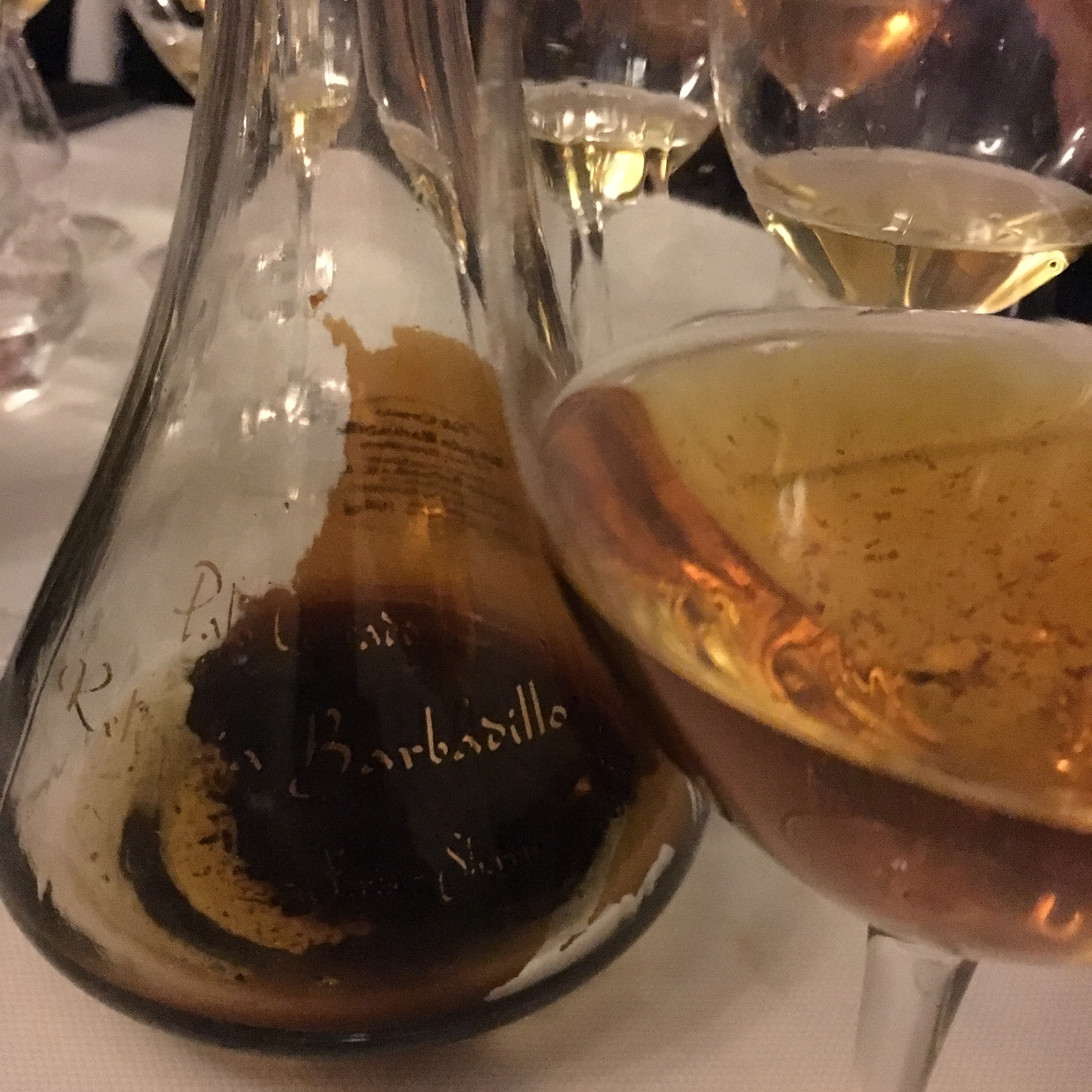
How does one write a tasting note about a wine like this? It is a massively old Palo Cortado by Barbadillo that after a 100 years or so of quiet excellence (the ficha has a nice potted history) was launched to superstardom (and correspondingly astronomic prices) by being awarded 100 points by the Wine Advocate. This one was purchased as a team effort and consumed during a cracking dinner last night.

The colour is paler than I expected – a honey gold as you can see – and it had a lot of sediment. The nose was terrific – a little bit of furniture polish then citric sweetness, toasted nuts, fresh sawdust and chamomile, some salty sea air.

Most importantly, for such an old, concentrated wine it was beautifully elegant and integrated and as a result highly drinkable. Very dry but not at all astringent, with salinity and acidity that warm the tongue without being harsh, and big umami flavours of nuts, toasted nuts and a trace of orange zest bitterness. No edges to it, very silky on the palate and an immensely long, mouth watering finish. 

A beautiful highly drinkable old wine.

Amontillado 2003, Williams Coleccion Añadas

I still haven’t managed to find a moment to open the whole box together but continue to pick off lone bottles of these añadas one by one: so far I have tried the 2009s and now this one (if we are not counting the 2006). Of course they are all similar wines – from the same pagos, made by the same maker in the same bodega – but it is still really remarkable how clear their shared signature is – and indeed I recently had a chance to try the “historic vintage” oloroso and that too was clearly a slightly older brother to these.

And, like those other wines, this is an absolute belter. A beautiful old gold colour (just look at that camerawork), it has a lovely refined nose with hazelnuts baked in granary bread and just a bit of that sweetness in the background. Then on the palate it is wonderfully smooth and elegant, with very refined flavours – nuts, yeast, and minerals. Not all that concentrated but full and seamless – like an opera singer with no vibrato. On the ficha that Williams & Humbert were kind enough to send me they say “rounded” and it certainly has no hard edges.

That tasting note is in fact rather confusing – I had assumed that this was an amontillado on the basis that the flor had given up the ghost in the cask, but according to the ficha it was at some point fortified to 18º (and presumably some time ago, because it finishes up at a hefty 20.5º – which by the way you would never guess in a million years), before being classified as an amontillado in 2016.

However it was made, it is brilliant, and it is absolutely shocking how little of this is available. I am not going to say where I got it just in case I can still get some more.

Don PX Convento Selección 1931

The fourth wine of a quite unbelievable quality tasting at Taberna Palo Cortado was this 1931 Don PX Convento Selección – amazingly, an 85 year old single vintage pedro ximenez. Interestingly, this one was the first one that had the profile I expected – the most stereotypically “super old PX”.

It was black again – maybe a bit blacker than the last one but not that you could tell with the naked eye at that time of night. On the nose though this one was all pepper and spices, raisin of course but now raisin as dry as dust and heading to coffee and leather.

Then on the palate it was no disappointment, all those spices, big sweetness like black treacle, coffee like a coffee liqueur, then those dry wine flavours of wood, tobacco, leather, fading to a black treacle tail for what seems an eternity.

A night of superlatives, what can I say.


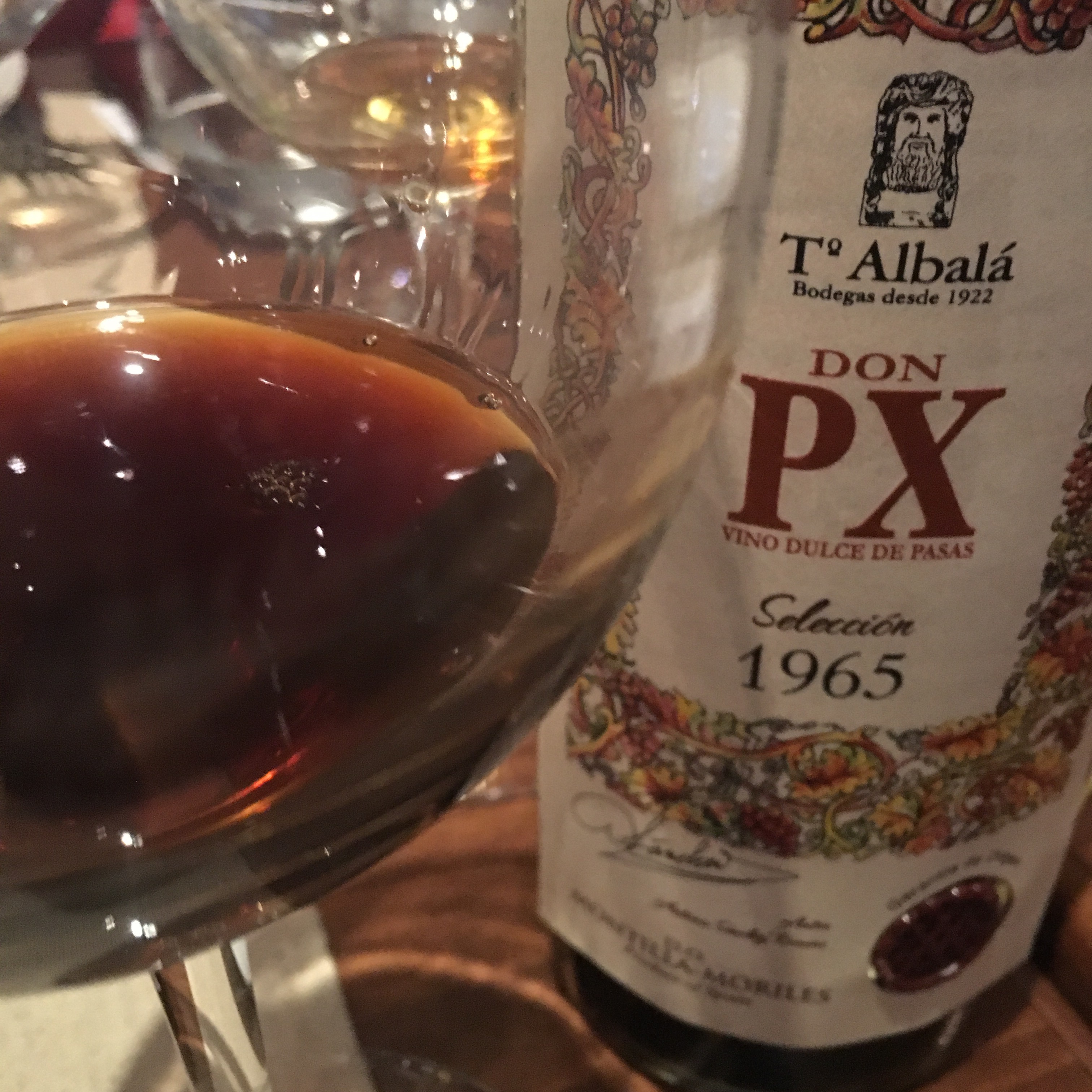
Don PX Selección 1965

Second wine of a fantastic tasting was this 1965 Don PX Selección. Again a single añada wine, again 100% pedro ximenez, but this time a sweet wine with I can’t imagine how much sugar per litre. And of course it was a mere 51 years old (I now realize I didn’t take note of when these were bottled).

I am really going to struggle to describe the colours of these because I can only think of so many words for brown. Anyway, on this occasion there is a pretty good photo. There was a bit of chat about curry but someone called a far better descriptor: the fried tomato preparation they sell around here (with maybe a bit of cloves)and of course raisin. The palate was pretty amazing. The cloves were there again with orange peel, an almost tangible acidity, pepper, and really evident minerals. It also had a fantastic savoury zing and chalkiness to it – real saltiness that made for a refreshing finish.

Another fantastic, memorable wine.


Palo Cortado Añada 1975, Bodegas Tradicion 

Another vintage specific wine, again during a terrific lunch at Restaurante Vinoteca Garcia de la Navarra (you can just see the great Luis in the background there), but this time a 41 year old Palo Cortado (although only 39 years oxidative ageing, from a saca in 2014) – number 39 of the 50 magnums produced. Intriguingly it says Bota Nº1 – wonder how many more of these they have waiting for release?

Again the photo strikes me as deceptive (I didn’t notice dim lighting at the time but it may be the light behind). Nevertheless, it was a deep reddish brown – maybe a touch darker than usual – then on the nose the overwhelming memory is of elegance, a nice salty caramel, fresh citrus, and maybe just a hint of polish.

The palate is even more refined and elegant – a really clean, fresh and delicately structured mouthful. Nice caramel flavours with a delicate citrus flavour, then a pleasingly integrated salinity and acidity, then a slightly more burnt caramel and bitter citrus aftertaste – and a pleasant finish that fades out. What is most notable is that cleanliness and definition. It doesn’t have any of the astringency or old barrel flavours I associate with a 40 year old palo cortado (not having been in a solera it doesn’t have that famous teaspoon of “infinitely old” wine), although perhaps if you were being very critical (and maybe for the same reason) neither does it perhaps reach the very heights of intensity either.

I am often bemused when people call the real brutally intense dinosaurs of the cellar “delights”, but for this extremely youthful forty one year old, that description is absolutely spot on – a delightfully elegant wine.


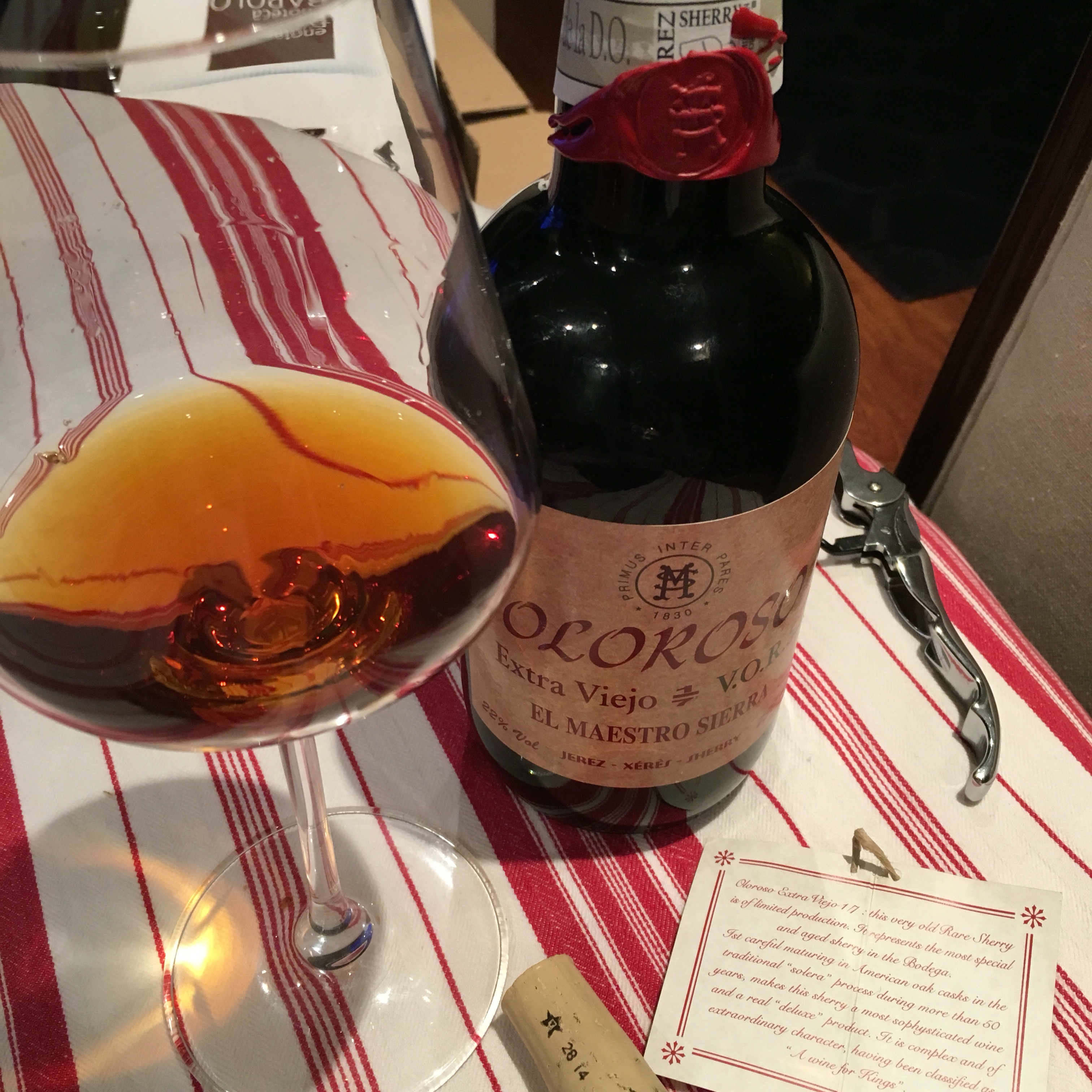
Oloroso Extraviejo 1/7 El Maestro Sierra

When they say “extra old” they really mean it. According to the ficha this has an average age of 80 years of oxidative ageing from a solera of only 7 botas (hence the 1/7) although fed in turn by 1/14 solera – which produces wines of  50 years old. They don’t make much of it: 100 bottles a year – this is 70/100 from 2014 (they also release 300 of the 50 year old). I love the recommended pairing – a good book.

The colour is a beautiful rich chestnut brown and there is real singe on the nose – furniture polish or extremely concentrated walnut. Sweetness in the nose too – real burnt butter caramel.  As the glass warms and empties there are more aromas – pine wood chips/cedar cigar matches and old tobacco. (My grandad was a pipe smoker and this took me back a bit to his attic.)

On tasting there is sweetness on the tip of the tongue but then a spike of acidity and those walnutskin, wood and tobacco flavours. It doesn’t seem astringent or harsh but there are highly concentrated flavours, that walnut again, then really dry dusty flavours and a long caramel finish but one that dries the mouth a little.

An elegant and spicey drink – all you need is the good book because it has the cigar incorporated!

Fino Imperial (in Taberna Palo Cortado)

Madrid is fortunate indeed to have a place like Taberna Palo Cortado, which has a fantastic list of wines by the glass that includes (apart from the reds, whites, champagnes, Tokay, Jura, etc. that are not within my jurisdiction):

  • 19 finos
  • 17 manzanillas
  • 22 amontillados
  • 13 oloroso
  • 15 palo cortados
  • 2 cream
  • 6 pedro ximenez (not counting the finos, amontillados, etc) and
  • 2 moscatels

Not just any wines, either: you can come here and have a glass (or two) of truly special wines like this Fino Imperial, a 30+ year old VORS amontillado fino from Diez Merito.

It has a pretty complete ficha: fruit from pagos that are classified as Jerez Superior (the precise pago is not identified, however), five years under flor then 25 years of oxidative ageing in a solera with five criaderas.

It is a really beautiful colour – slightly reddish amber and seems to glow – beautiful the way the sunshine emanates from it. On the nose there is a touch of volatile (which I love in moderation) then caramel and hazelnut, and even vanilla, with maybe just a bit of residual hay bales at the end from those five years.

Despite the volatile on the nose it doesn’t seem acidic on the palate: tingly more than zingy. A silky texture, in fact, pleasant caramel, hazelnut flavours first up then under cover of that silky caramel “old wine” notes of tobacco, wood and bitter walnut skin – all nicely balanced and a long slightly peppery finish.

Smooth, elegant, tasty and spicey at the end. Really good.

Manzanilla Sacristia AB – 2a saca 2012


I have had mixed experiences wih these (the 1a saca de 2013 (preblog), the 2a saca de 2013, the 1a saca de 2014, the 2a saca de 2014, and the 1a saca de 2015) but it was only recently that I found out that the these sacas are from different bodegas. According to this piece by Spanishwinelover, the first few (the first sacas were 2010) are from Sanchez Ayala, the more recent from Bodegas Francisco Yuste (a new bodega but one that acquired the historic solera of Conde de Aldama).

Wherever it comes from (and I am assuming Sanchez Ayala) this is a real beauty. The colour is a dark, dark gold, on the nose it is very aromatic and yeasty (lot of hay bales for a manzanilla), then on the palate baked apple-like fruit, zingy salinity, and a long, long tail of those fading apple, yeast and mineral flavours.

A really tasty, almost explosive, wine. I have found some of the others shy, refined or restrained but this is none of those things. Wonderful stuff.

Fino la Barajuela 2013

I have been after this wine by Bodegas Luis Perez for a good long while and am glad to say it was worth the wait.

It is a wine from some of the most famous real estate in the area: Pago Corregidor in Carrascal – the Northernmost and furthest inland of the great pagos of Jerez (dead North of Jerez on this map). The vines are on Albariza “Barajuela”, which is characterized by visible sedimentary layers, like a deck or “baraja” of cards and for producing fruit capable of wine with a muscular, horizontal quality. It has been statically aged and is still a baby compared to many finos around at only two years under flor, but there is no doubting its force of personality.

As you can see, it is a crystal clear, slightly golden colour and this might sound odd but I would describe the nose as “compact” – not a yeasty/acetaldehide nose but punchy almonds, melon, herbs and maybe just a bit of salinity. On the palate it is indeed big and muscular – with a punchy yeastiness, maybe some very mellow fruit like melon or pear, almonds, and some sapid zing. It is an intense experience, with a lot of body (still a high glycerin content you would say), structure and flavours but also a long, pleasant, fresh finish.

“Old school” stuff: it is said that back in the days when the wines of Jerez ruled the earth they were wines such as this -big, solid, wines quite distinct from today’s lighter styles. Drinking this you can absolutely believe it. Magnificent.