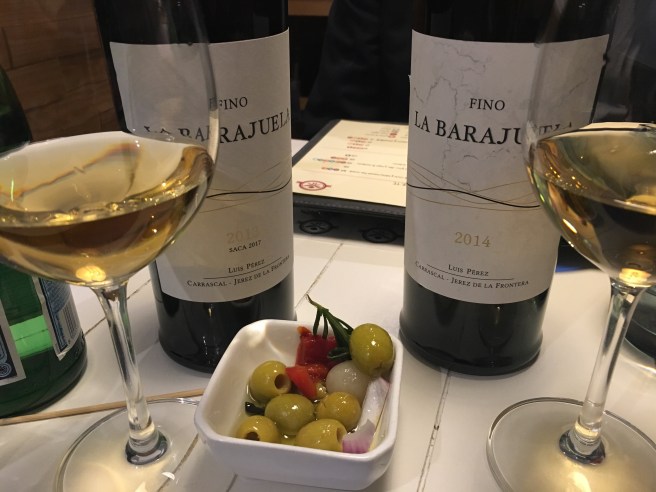
Barajuela Finos again

The boys down in Jerez tease me for the amount of these Barajuela wines I am able to find but to be honest most of the time they seem to find me. I am honestly trying to hold back, and now only order it if I can share it with at least one newcomer to the breed. This was one of those occasions – a lunch at Bache with an old colleague-, and yet again I can confirm that the people love it.

What I love about these wines is how much fruit is there, how the fruit seems to reach down the savoury registers into salinity making a massive iceberg of a wine: as much or more below the surface as above it. On that score, the 2014 Fino has the same white blossom and white fruit nose and top end of the palate as the 2013 Fino (saca of February 2017), but more of the savoury, sapid mountain. It also has less time under flor – isn’t quite as sharp or mineral – but has an even bigger, fuller frame. On the other had, while it is not strongly biological on the nose the 2013 – particularly this second saca – has, if not quite haybales, then at least a little bit more dry herb in the nose and again that sharper profile.

More importantly, both are brilliant white wines for sherry lovers, sherries for wine lovers, just brilliant wines.

Fino Lorente & Barba

It i

They have a quite amazing list of wines at Taberna Palo Cortado with more than 300 references, many of them new to me even after nearly three years of hunting out obscure sherries.

This is just such a one, and a great example of the “new old”. I gather these guys have a five hundred year old bodega – at least the physical premises are said to be that old – but as far as I know they didn’t start selling their own wine until recently. They have been involved in the wine business though providing bottling and other services for other bodegas. Now the time has apparently come for them to sell their own family soleras and this is the fino.

It is definitely what you would call an “artisan” product. Has a deep old yellow-green color and is sweet on the nose, with hints of fennel leaf, and not a great deal of biological influence. Then it is broad and heavy on the palate, saline without being zingy, seems like a fair whack of glycerine and again a lot of that liquorice root. Blind I would probably guessed it was one of the ecological pedro ximenez en rama finos (but since I didn’t taste it blind I am going to say a mosto from somewhere inland like Trebujena).

Not really my kind of thing – but it is certainly full of character.

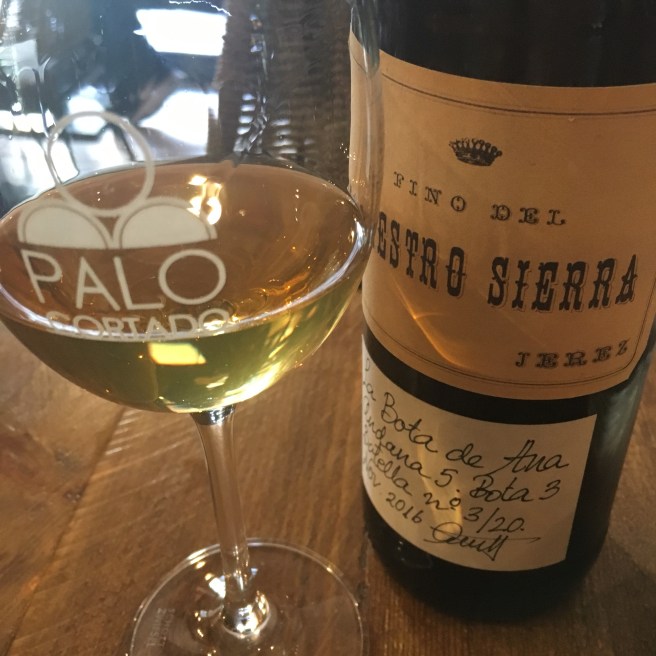
Fino del Maestro Sierra – Bota de Ana (Bottle 3/20)

This is a very rare wine – as you may be able to see on the label only 20 bottles from each saca – from a bota of fino chosen by the winemaker at Maestro Sierra, Ana Cabestrero (and hence la Bota de Ana). The bota itself is said to be one of the two “original authentic fino soleras” (although when I was told that it made me wonder what the other soleras were called)  botas of Amazingly I was able to try this by the glass at Taberna Palo Cortado (one of their 300+ wines from the region).

Maestro Sierra’s finos are characteristically very fine and elegant, with a nice soft yeasty almond texture and flavour, and this is all that. The colour is watery gold and the nose has just a hint of fresh straw to it, with those almonds and maybe a touch of citrus underneath. Then the flavours in the palate are just what the nose leads you to expect: it is big and rich in texture and very long, but there isn’t much width to it – a kind of silky almond rapier. Neither is the salinity overpoweringly zingy – a very refined wine indeed.

The height of refinement, and exclusivity!

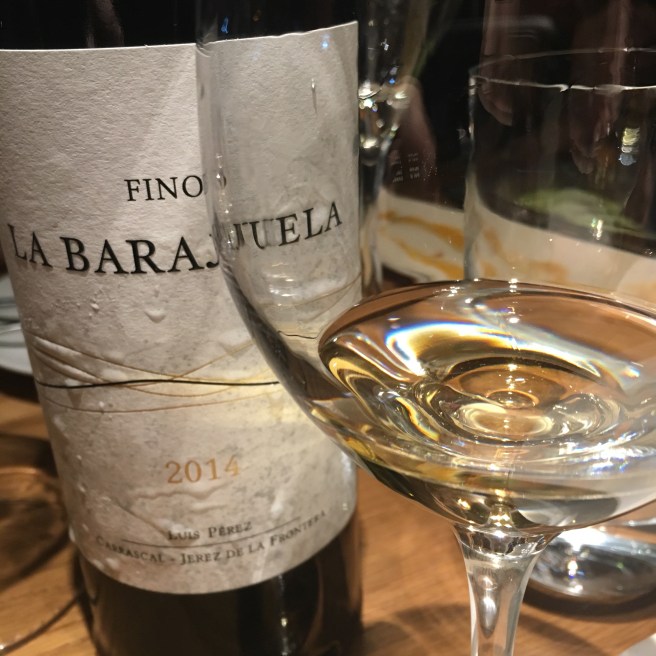
Fino la Barajuela 2014

I was dining at Lakasa last Friday night (and it was absolutely heaving – great to see) with a group of friends from outside my wine nerd bubble but nevertheless was allowed to choose the wine, and even (somewhat controversially) given free reign. I picked two wines that to me seemed blindingly obvious – the Cuvee Saint Anne by the brilliant Alexandre Chartogne and the Fino la Barajuela.

What I didn’t know was that they had run out of the 2013 and had just received the 2014 (in fact I didn’t know the 2014 had even been released) and suddenly a wine I had been waiting for for 18 months (give or take half a glass in a tasting with the man) was on the table in front of me.

This is the second vintage of Willy Perez’s outrageously good fino, and although the 2013 will always have a special place in my heart you have to say that this is even better. It has the same nose or honey-suckle to honey with golden yellow apple underneath, the same bite and palate of fruit but even more mineral sapidity and throat filling savoury flavours. It is frankly epic and totally delicious.

And as always happens with these Barajuela wines, my friends from outside the sherry bubble loved it. It is a tremendous source of frustration to me that when I read the views about this wine from sherry experts and tastings there are grumblings about whether it is really a “fino” yadda yadda yadda. Surely what is important is that it is an outstanding white wine, and one that paired with almost everything we proceeded to eat.

Now begins a heartbreaking period in which I am allowed to purchase a shockingly small allocation of bottles and then feel obliged to hold back when I see it in stores so that a wider public can try these wines. Please, don’t let my sacrifice be for nothing.

Fino Williams Coleccion Añadas 2009, Febrero 2017

A bit of a backlog forming here for the editorial team at undertheflor.com – this was the second wine of an absolutely cracking lunch at Alabaster ten days ago, and there have been several lunches since.

Luckily this one is an easy write up – this wine is class. It is part of the Williams Coleccion Añadas, a single vintage, statically aged fino from añina and carrascal, and one of the most distinctive finos around. It has an evolved, dark straw colour and a pronounced hazelnut aroma and juiciness and that make it very approachable indeed.

I have been exceptionally lucky and have been able to try three sacas, from February 2016, February 2017 and April 2017, and the evolution of the three, from fino to arguably a fino amontillado, was fascinating. (Indeed, I gather the 2009 fino is no more – future sacas will be of a 2009 amontillado.) Moreover, the joy of the Coleccion Añadas is that you can try the 2009 fino alongside the oloroso of the same vintage, or even a box of six, and now you can try the 2010, which is a fish of an altogether different kidney.

A lovely wine if you can get hold of it.

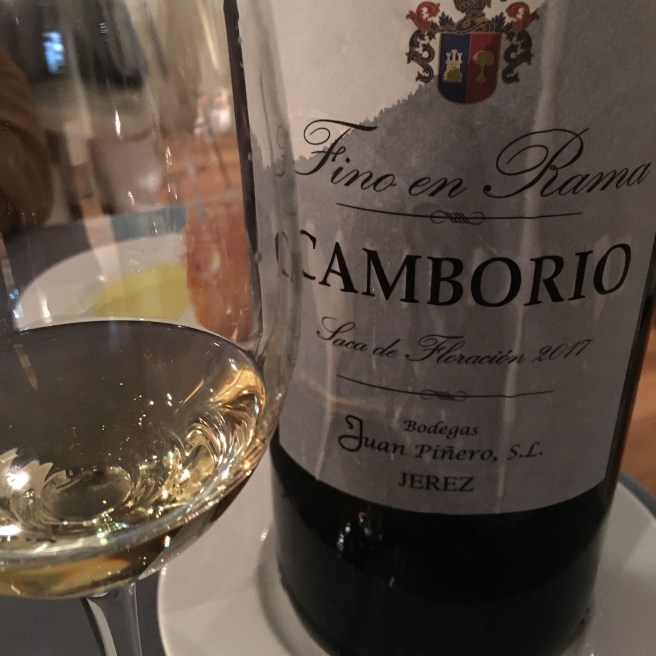
Fino Camborio in Viavélez

Dropped into Viavélez Friday night for dinner for the first time in a long time and kicked off what was a terrific dinner with a glass of this classic, high class fino. It is a fino that has up until now been underrated and little talked about, a circumstance which is likel to change since Camborio has recently been acquired by none other than Peter Sisseck of Pingus fame (but a considerably broader portfolio).

I for one think it is good news. To say that Mr Sisseck is a saviour in the style of Berlanga’s Mr Marshall (as some excited editorials and bloggers have) is maybe a bit overblown, and is certainly unfair on the pretty long list of existing saviours who have for years been working hard to bring the sector back into the winemaking mainstream in terms of quality, terroir and vintages. But it is undoubtedly good news for the image of the region: there is no doubt that Peter Sisseck brings a bit of international name recognition and star quality. It is also good news from the point of view of distribution, because his is the kind of operation that can take this wine overseas. It is also good news from the point of view of the message that it sends concerning winemaking: a guy made famous by a wine from a tiny plot of old vines in Ribera del Duero clearly sees value in a patch or two of albariza in Jerez.

I wish him well and I can tell you he has done a good bit of business picking up Camborio, certainly on this evidence. In fact maybe the biggest difficulty he has will be in improving on this offering of a great wine. The colour is a lively straw color, it has saline and straw nose with toasted almonds and a super elegant profile, starting and underpinned by sharp salinity, then intense savoury almond flavours, tailing off again to a long, spicey and mouth watering finish. Really class: maybe has lost an ounce of that explosive character it had when first released, but as good a fino as you will find anywhere with very few exceptions.

Never mind the label, feel the quality (and now might be a good time to buy).


El Fino Perdido

This is a class fino and the fact that it was the first wine I was offered, before seeing the wine-list, in Bache the other day sent a very positive message.

Eight years under flor and only minimally filtered, it is a lovely dark gold color and for me it has a nose that is old apples packed in straw. On the palate it is sharp at first and then salty, bready baked apples, a slightly darker tang and a fresh finish.

Refreshing, an elegant profile and attractive aromas and flavours: what’s not to like?


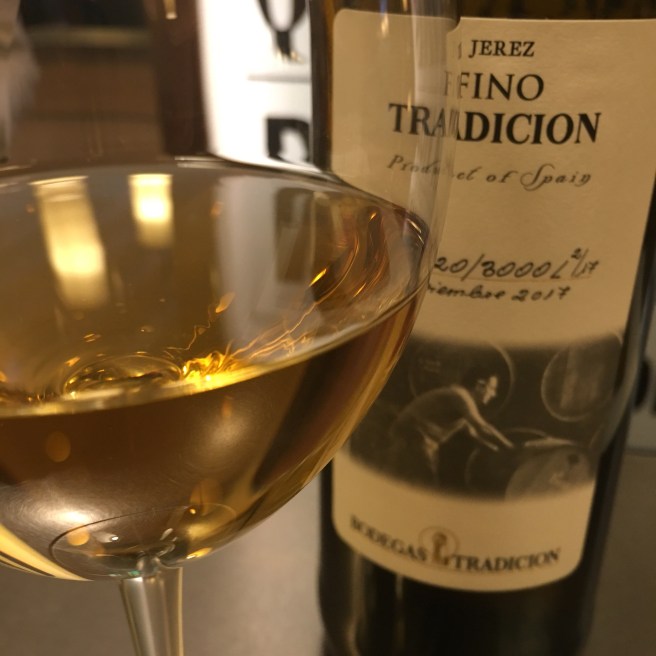
Fino Tradicion Noviembre 2017

If a few of the autumn sacas I have tried are a guide it has been a hard summer for the flor down in el Marco.

This autumn saca of the great Tradicion fino seems to me from memory to be towards the oxidated, roasted, end of the register. Not necessarily a bad thing: gives it plenty of body with a ripe, rich feel to the flavours and the zing of salinity gives it a nice spicey finish and balance.

A serious but very drinkable fino from the top drawer.

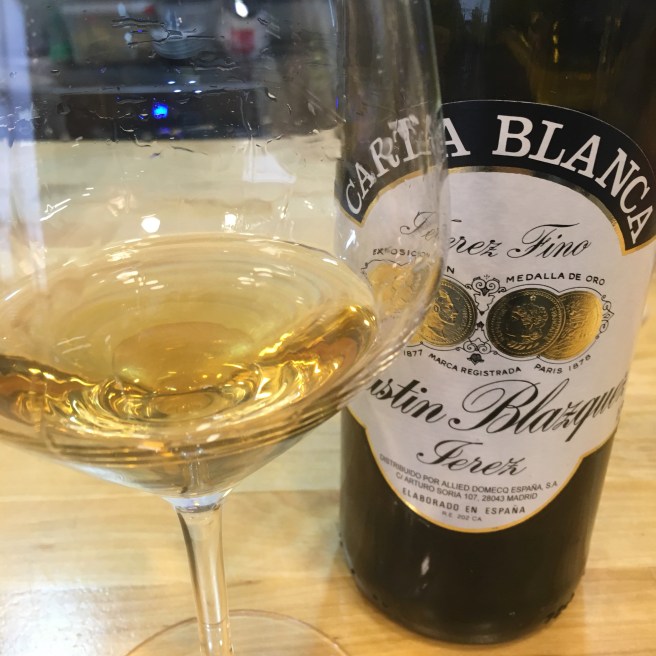
Fino Carta Blanca (de los 90)

Now this is one of those old sherries that have acquired a kind of legendary status (the Spanish prefer the term “mythical” but I can assure you it is real). Agustin Blázquez was one of the many bodegas acquired in the second half of the 20th Century by Domecq and I believe the brand disappeared in the 1990s (when the winemaker in charge was Jose Maria Quiros, now of Tradición). This bottle is from that late era so is around 20ish years old or maybe a bit more, and it was very generously brought along to lunch at Territorio Era by Juancho Asenjo.

And the wine deserves to be legendary: it was absolutely fantastic. Beautifully clear and only a half shade darker than your standard fino, it had maintained its clarity in aromatics and flavours too. Unlike a lot of examples of bottle aged sherries I have come across this seemed to have maintained its shape and balance: compact and with solidity of flavour, and still with a full range from white fruit on the nose and at the start of the palate through those burnt almonds down to salty zing. It may have had more zip and power when it was younger – we all did – but there was certainly plenty left, and I didn’t notice any of the turn to bitterness that I sometimes associate with the older biological wines.

Absolutely top class. Nothing wrong with these golden oldies if you get the right ones!


La Bota de Fino 68, Macharnudo Alto

With the cold weather, your correspondent finds himself flocking to winter watering hole Asturianos and once there there was no question of trying anything other than this majestic fino from Equipo Navazos.

But has it ever evolved – on the left the glass I had here back in January, and on the right, today’s effort. Much deeper and slightly darker in colour – you wouldn’t recognize it in the glass. It had changed on the nose too – whereas back in January it was all savoury and haybale aromas, now it is still aromatic but with more sweet, dried flower or herbal tea. Finally, on the palate too it seemed a little softer and less defined – still rich in flavour and maybe even more complex, with maybe just a hint of hazelnut but also some bitter almonds.

I think I prefer these finos straight up on release but I can see the opposite also being true – this may not have the power and definition of its youth but in only 10 months it is already richer, gentler and slightly more complex.