La Bota de Fino 68 – Macharnudo Alto 

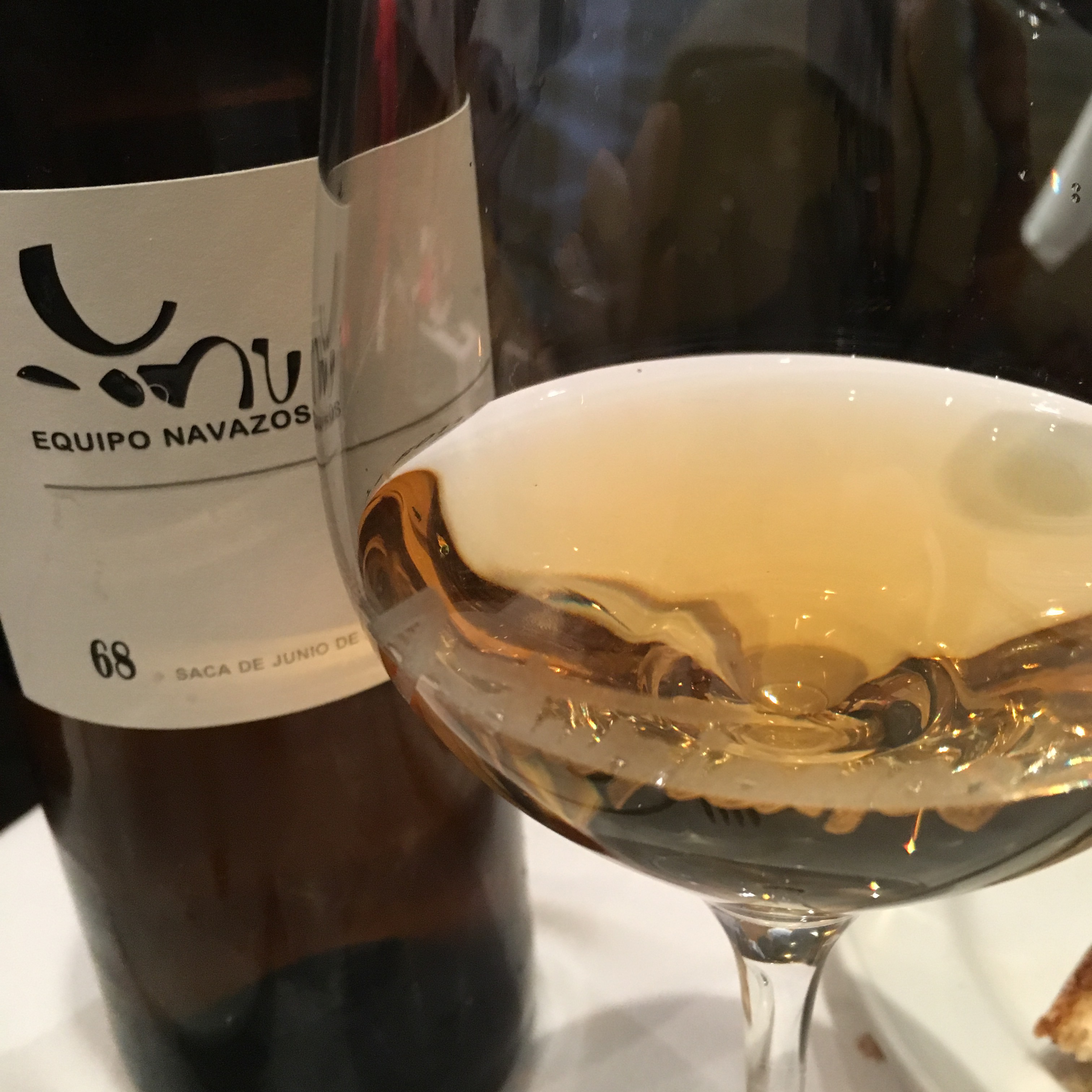
Lunch with an old friend in Asturianosthe new saca of the fantastic macharnudo alto fino by Equipo Navazos. They have produced no fewer than seven of these but I don’t remember a better edition than this. 

Absolutely spectacular, classy with a huge  atomatic nose and flavour profile. A cider vat in a hay barn on the nose. Zingy to the point of stingy, with a lush feel on the palate and big, spicey roast almonds to roast apple flavours. The salinity is beautifully integrated and the finish is long and savoury. 

World class fino – a real belter. 

Fino Lagar Blanco

A good friend of mine recently gave me a chunk of liquorice root – known here as “palulu” – because he maintained that it was important to my wine tasting education to understand this substance. We duly chopped the thing into kindling (using ever larger and sharper knives in defiance of all health and safety regulations and indeed common sense) and gave the splinters a good old suck and chew. The flavour was fascinating – a bitter, sappy aniseed – not to mention the sensation of chewing wood.

He was dead right about its importance in wine tasting terms. It is one of those flavours that you find deep in a lot of the wines from down South, and in particular, I find, in some of these pedro ximenez finos from Montilla Moriles.

This fino by Lagar Blanco – with which we kicked off an excellent lunch at La Malaje yesterday – is one that I have wanted to write about before. It is a seven year old fino that has developed nutty aromas and flavours but underneath there is just a hint of palulu bitterness, which I must admit I had found a little disconcerting in the past (before I embraced the chewing of the root itself). Punchy nose and a gentle, seawater salinity to it – not as sharp or sleek a profile as some and plenty of volume in the mouth, with a nutty character of raw almonds and that hint of rooty devilry.


Lustau biological wines in Taberna Palo Cortado

Finally getting around to writing up my notes – thumbs a blur across the iphone screen – of the fascinating tasting of Lustau biological wines at Taberna Palo Cortado last week. We got to try wines from all along the solera process – including the sobretabla and a wine from an intermediate criadera.

Anyway, here we go with my thoughts:

  • Sobretabla – one year old wine that has been fortified and will be used to refresh the La Jarana solera. As a wine you would find it alcoholic, rustic, unready and undefined, but it has personality alright – a really earthy, punchy little brawler. Whatever, I still appreciate the chance to try these whenever I can, because they can give you an appreciation of where the wines come from.
  • Fino Jarana – after the sobretabla you could really appreciate the fine quality of this and the work of the flor, of which it has had around four years. A very nice green apple and salty nose, and green apple on the palate too, with salinity giving it buzz and volume. A very decent young fino.
  • 1a criadera of los Arcos. This wine was not a successor to the last – from the first criadera of amontillado, but fed with manzanilla (I guess the Papirusa) rather than the Jarana. It had four years under flor and around two of traditional ageing. Like the sobretabla it was exuberant and a little unmade/undefined – fascinatingly so. Light in colour and slightly turbid, it had a slightly fuzzy, still pungent and salty nose with a little hazelnut to it. Again on the palate you noticed the salinity, which seemed to slightly overpower the nuttiness when it came.
  • Los Arcos itself is the real thing and showed some real benefit for its additional couple of years of traditional ageing (and of course finishing – whereas the previous wine was a bota sample this was a finished product). Four years under flor and four years traditional ageing this had greater clarity and sharpness. Refined hazel/apple or even tomato on the nose here – a sweet cherry tomato. Then a nice zingy bite on the palate and roasted nut flavours with a nice tasty finish.
  • Escuadrilla – now we come back to Jerez, and an amontillado with four years under flor (the Jarana) and a further eight years of traditional ageing. This was a cracking wine, crystal clear and a lovely chestnut colour, with a nose of hazelnut spread – really appetising nose. On the palate too it just seemed to have a bit more flavour and class than its predecessor – nice rich hazelnut and a long mouthwatering finish keeping the flavour going.
  • Amontillado VORS. It was followed by the senior amontillado of the range – a VORS (i.e., at least 30 years old in total). A rich red chestnut colour, again crystalline, this had a much more pronounced sawdust on the nose, then a palate that was more acidic first up, even dryer, concentrated flavour and then a very dry finish.

A really interesting group of wines and the kind of tasting that can be really instructive. I think my favourite was the Escuadrilla but there was no doubting the power and class of the VORS or the spriteliness of the Arcos. Excellent range of wines.

But there was more to come – a bottle of East India Solera was produced with the deserts, and although I am not in general a fan of creams and mediums this one struck me as most opportune and went down very nicely indeed.

And in fact there was even more to come because Abel Valdenebro, a genial chap and genius photographer, had brought along a lovely old Lustau amontillado from the 1960s, which was then followed by another couple of vintage bottles purchased by popular subscription (a whip around) from Paki’s fantastic collection, including a sublime Inocente that had been in the bottle at least forty years. (I rather cheekily asked Paki for a 2016 Inocente as a comparison and it was as stark a comparison as I can remember – will write on that anon.)

So many thanks once again to Carlos from Lustau and to Paki for a cracking evening, and to Abel and the other subscribers to the other wines. Top class all around.

Cata de Lustau in Taberna Palo Cortado

It has been a big week in sherry terms and this was yet another interesting tasting of Lustau wines at Taberna Palo Cortado.

A selection of wines – with a fino and amontillados of different ages and types and a sobretabla and a first criadera of the amontillado thrown in. Made it very instructive indeed to see the progression from that sobretabla through fino to first criadera, then the amontillados of different ages (which I mentally filed as cherry tomato, hazelnut and sawdust).

A bit of a rowdy crowd including none other than Colectivo Decantado – but Carlos did his best to educate the masses and once the wines had been explained we all piled into an excellent dinner – tataki the ternera was brilliant and an excellent match for the wine – finishing with a luscious bottle of East India Solera.

I will need to find time to write up my notes properly but wanted to mark the occasion at least and express my thanks to Carlos from Lustau and Paqui for a great evening (and to Abel Valdenebro who brought along a special treat for afterwards: a Lustau amontillado from the 196os no less).

Thanks also to the wellwisher who said hello at the end and said such nice things about the blog. I am sorry I didn’t catch your name but many thanks indeed – really means a lot and hope to catch up again soon.

Fino Camborio

Was chatting this week about under-rated finos with Juancho Asenjo and this came up so I thought I would have another dip.

I wrote about this before back in December last year – palomino sourced from Macharnudo and Añina that has been biologically aged for 9-10 years in a solera with only three criaderas, with one saca per year. The memory I have of that last bottle was that I enjoyed it more and more and to be honest I have no idea why I didn’t get a bottle  – they had it by the glass in a couple of places and I was just too lazy I suppose (there are also severe storage space restrictions).

Anyway here we go again and you know I look at that note and I have no idea what I was thinking of. This is mineral but it isn’t the mineral that defines it, but the deep, powerful yeast, citrus and almond of it. It is a very “horizontal” wine with a big wide flavour that you have to drag down and covers your palate and throat with a flavour that, thanks to its own potency and the mouth watering minerals just lasts and lasts.

In one of the poems of Federico Garcia Lorca a third generation “Camborio” is waylaid by the forces of law and order and taken into custody, causing all and sundry to lament the passing of the true Camborios of old, who apparently were not wont to take any nonsense. It is a fantastic poem, and I have to believe this wine is named for those true Camborios, because it certainly doesn’t.


Don Zoilo Very Old Dry Sherry 

This wine, bottled in 1977 and brought put tonight by Juancho Asenjo, was in absolutely spectacular condition for all its years in the bottle. 

Just look at that colour – beautiful gold and, while not crystalline, you would never say this first glass was a 40 year old. First up it has a little bit of salty seaweedy reduction on the nose, but on the palate it is is brilliant. It has a soft, buttery texture and is full of flavour. Whereas a 40 year old table wine can whither away, this is still all there: a zingy start, then nice intense almonds and and a smooth, rich and saline finish. 

An oldie but a very goodie. Thanks again Juanjo!

Bodegas Tradición: 11 wines, 7 sacas, and 45 years

img_3772-1

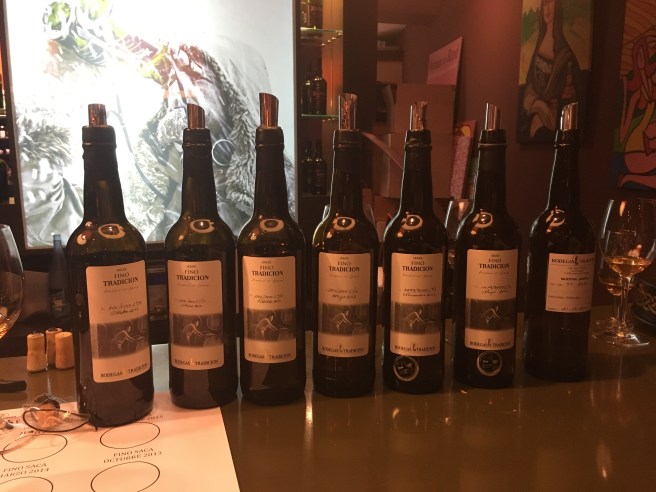
I have been fortunate to attend some really outstanding tastings in the last few years – of sherries and otherwise – but on Monday night I took part in one of the best that I can remember. The tasting was the first of three hosted by Reserva y Cata as part of International Sherry Week and the place was absolutely heaving: standing room only. And that was frankly no surprise because the concept and wines involved were first class: a vertical tasting of wines by Bodegas Tradición from the Sobretabla used to make the fino all the way to their 45 year old amontillado, by way of all seven fino releases and including special bottlings from criaderas of the fino and amontillado.

It was lead by Miguel Llanos, Tradición’s Commercial Director and guy in Madrid who for me has been one of the unsung heroes of the so called sherry revolution. Three or four years ago when sherries started to appear on the shelves of vinotecas and restaurants the Tradicion wines were at the fore and a lot of that was down to Miguel, who was leading tastings of these wines when that was still an unusual occupation. To my great regret I never made it to any of those tastings years ago but this one was worth waiting for.

Even better, we were also joined by Lorenzo Garcia Iglesias and Helena Rivero, the Director General and President of the company and even several of their colleagues, and whereas Miguel focussed on the characteristics of the wines, Lorenzo in particular provides some fascinating thoughts and explanations of the way the project and the wines had developed (and in relation to Esparto grass and its uses in furniture and footwear manufacture).

And that was really the central theme of the tasting: the way that the bodega, the fino solera and the wines had developed. Tradición’s is a relatively unusual story because despite a long family tradition the bodega itself is relatively new – founded in 1998 – and for the first 14 years it specialized in high quality VOS and VORS wines with average ages well above that of the bodega itself. They didn’t release a fino until 2013 (I was convinced I had missed the first releases but found out I was in on the ground floor) when they realized that the botas of fino originally acquired to refresh the solera of the amontillado had the quality and character needed to make an old, characterful wine in its own right. From there, what was a handful of botas, subject to static ageing in a corner of the bodega, has now become a solera with four criaderas producing two sacas of 3,000 bottles a year of a fino with an average age of around 12 years (which in turn is used to refresh the amontillado solera).

I love tastings which include a nod to the raw materials and and give you a sense of the different stages of the wines, but there were a lot of wines here so I am going to have to summarize my notes somewhat (I also link to past tasting notes):

  • Sobretabla – 100% palomino fortified to 15º that had spent around 6-8 months in bota. Raw and exuberant, I loved the sweetness of the fruit and herbs on the nose.
  • 2a Criadera of the fino – this would have had an average age of around 6-7 years and was already very fine. It had a nice herbal, floral nose with a touch of sweetness and a silky mouthfeel after the Sobretabla. Refined and very elegant.
  • May 2016 – one of only two finos that I hadn’t tried before this was a very elegant, very fine fino indeed. Had nice aromas on the nose – something like eucalyptus or woodchips – nicely integrated salinity, a compact palate of citrus and fresh almond flavours and a long mouthwatering finish.
  • November 2015 – quite a contrast to the previous wine this had a punchier, yeasty nose, bigger body to it and slightly more bitter almond flavours. 2015 had apparently been a very hot summer, even by the standards of el marco, and there were definite signs of oxidation and concentration in the wine.
  • May 2015 – probably my favourite fino on the night and again a big contrast with what had gone before – both with the November saca (which stands to reason) and with the 2016 saca. A really powerful, intense, sharp and compact fino this one, with a seemingly richer mouthfeel and more pronounced salinity. A really, really long finish to it too. Apparently 2015 was a year of expansion in the solera with new wines being fused with the old and this certainly seems to have an extra gear compared to the old wines that followed it.
  • October 2014 – you wouldn’t say this was as powerful as the May 2015 or as horizontal as the November 2015 but it had a lovely gold colour and again yeasty, slightly overtoasted almond aromas and flavours. The summer of 2014 wasn’t as warm as that of 2015 and the wine doesn’t seem to have been toasted in the same way. I found the citrus just a touch more pronounced – and a little more grapefruit than the others – and again a lovely long finish.
  • March 2014 – the other wine that I had not tried before (and I was allowed a double helping of this one). Again, a very different wine – lots of the same characteristics but this to me had a really salty sea air nose to it, a heavier, sea water salinity and maybe just a touch more of the herbal bitterness of age to it.
  • October 2013 – the summer of 2013 was also relatively fresh and this again doesn’t quite have the body and girth of the later autumn sacas. Has a very attractive slight sweetness to the nose though and what it lacked in power it made up for with maybe just a touch more definition with that suggestion of sweetness.
  • May 2013 – this was apparently the only bottle that had been located from this saca which gave a bit of extra frisson to tasting it and it was a delicious little half glass. Again had a touch of sweetness and lightness to it, and was slightly juicier than the other wines roasted almonds or even hazelnuts and even a little bit of dairy to it. Again I found it very elegant – the only problem was the quantity involved!

And those were the finos: an absolutely cracking flight of wines. It was great to taste them altogether and it made me change my mind about quite a few of the things I had written in the past. It was also fascinating to think about the wines in the context of the changes from static ageing to the solera and its expansion, the experimentation as the solera was built up and the different climatic conditions. (And it must be said, a chance to try wines from a new solera that has been created in recent years, even if from older wines and older botas, is rare indeed.)

It was also one of the clearest demonstrations of the value of seasonal sacas and dated bottlings. The differences in amplitude between the spring and autumn sacas was very clear, but also the differences in the wines of the different years. In particular I was intrigued by how different the spring sacas were: super fine, elegant fino in 2016; a meaty, punchy and sharp wine in 2015; seawater salinity and mineral in 2014; and floral and almost juicy in 2013. Some of those differences would be down to bottle ageing, but not all of them, and the variety in the wines  made an enjoyable tasting even better.

And we didn’t finish there either. We went on to taste wine from the second criadera of the amontillado and the VORS amontillado itself. These wines are absolute masterpieces and I am shocked and dismayed that I haven’t tasted them on this blog. I will search out an opportunity and write a proper post soon because after all those finos I just couldn’t give them my full attention.

In the meantime, I was really glad of the opportunity to taste the second criadera. If my notes are accurate the amontillado solera would have six criaderas, fed in turn by fino that has been fortified and with an average age of about 15 years. This second criadera was itelf a VORS, or at least a VOS, at about 30 years old, and had a fine slightly, sweet and citrus nose, rich flavour and balanced salinity, but the finished article was even better. According to my notes,  greater clarity and a richer colour, a “mixed marmalade” nose of sweet citrus, and bite, acidity and some bitter wood flacours to balance the blackened caramel. (I had never reflected on it before but the sheer amount of biological ageing of the fino that feeds these soleras really contributes to a very fine, elegant amontillado indeed.)

So an outstanding evening all round. As I posted at the time, my sincere thanks and congratulations to Bodegas Tradicion and Reserva y Cata for an outstanding event, one that will live long in the memory and already has me looking forward to the coming sacas.
Bodegas Tradición in Reserva y Cata 

Viva Sherry Week. What an outstanding tasting this was. Bottle ageing, seasonality of sacas, wine making, static and dynamic effects. Tasting a line up of brilliantly made finos, with a clear family thread but fascinating individual personalities, and with the information to make sense of some of it. And the Tradicion Amontillado to finish – absolutely epic.

I will write this all up – 8 1/2 pages of notes – as soon as I make sense of it all. For now, just sincere thanks to Reserva y Cata and Bodegas Tradicion for a really top class event.

Tasting the Great Gran Barqueros 

As trailed in my last post, last night I was lucky enough to attend a tasting of Gran Barquero wines given by José Ruz of Perez Barquero at Reserva y Cata, with the added bonus of the presence of Paco del Castillo.

There were four wines, all from the Gran Barquero range: the Fino en rama (a saca from October 20, 2016); a wine taken from the second criadera of the Amontillado Gran Barquero; a 2016 saca of Amontillado Gran Barquero and a 1996 bottling of the same wine. It made for a really instructive tasting which demonstrated the effects of oxidative ageing over time and, interestingly, of bottle ageing.

We started, of course, with the Fino en rama, which is from unfortified, 100% pedro ximenez and has spent 8-10 years under flor in a solera with three criaderas. It is an excellent fino en rama – intensely yeasty, flavourful (slightly bitter almonds) and mineral, and one of the things that always strike me about these Gran Barquero wines is how very fine they are in texture – the sense of how the glycerine and body you might expect from the pedro ximenez has been reduced by the flor over those years. (Interestingly, I was able to sneak a glug of a second bottle of the same wine and it had a quite different green apple and popcorn nose.) It was bottled only 8 days earlier but seemed to have  stood up to the bottling – will have to try and get some to see how it tastes in a few weeks.

We then moved on to the wine taken from the second criadera of the amontillado solera, which is refreshed from the solera of the fino en rama and also has three criaderas. Again there has been no fortification (we were told they hadn’t fortified for ten years or more) and the finished wine bottled as Amontillado Gran Barquero will have had an average of 15-20 years oxidative ageing on top of the 8-10 of biological ageing of the fino. It wasn’t fully clear to me what the average age of this wine from the second criadera was but I guess we are talking 8-10 plus 8-10 or similar. I found it a very enjoyable amontillado indeed – lovely straw and hazelnut nose, and even a little bit of raw yeast and juicy hazelnuts on the palate. Not powerfully acidic but a nice bite to it and good, mouthwatering salinity. Elegant and compact but full of fun.

Next came the finished Gran Barquero amontillado (from a bottling in September 2016) and to me it was a little step up in class and refinement. On the nose the sweet touches of the second criadera had gone but there was a richer yeastiness to it. On that little bit of extra acidity and salinity give it an even sharper entry and finish and the hazelnut flavours of the second criadera have intensified into roasted – borderline burnt – nuts and lead to a long, umami rich finish. It it a classic wine.

Finally, we were able to try a Gran Barquero amontillado bottled in 1996, giving us the chance to appreciate the effects of those 20 years of bottle ageing. As a caveat, it would not have been quite the same wine in 1996 – with a total age of closer to 15-20 years than 25-30. Moreover, I gather that these specific bottles have not exactly had a restful 20 years either: they had been shipped to and from the Canary Islands, no less, and with no guarantees as to the storage conditions.

Nevertheless, these bottle aged wines are all the go now so I was intrigued to see the differences – and surprised by the differences that were there, to be honest. First, and maybe least surprisingly, it looked its age: much darker in colour, not quite crystalline and with crumbs of sediment (see above). The most striking difference was on the nose – whereas the previous wine was all yeast, straw and herbs, this had an aroma of dusty old leather bound books – but also on the palate for me it had lost a little bit of the spring in its step, getting a touch dryer and with more bitterness, and even in terms of definition, again with a slightly dusty sensation to it. Really interesting to have tasted because the differences I noticed were things that in other wines in the past I had attributed to the length of the time in the barrel, but not quite my cup of tea as you can probably guess.

Overall though four top quality wines and an excellent structure to the tasting. When you throw in the knowledgeable commentary and explanations of José and Paco before during and afterwards it was an excellent night all round during which I learned a great deal. My sincere thanks to Ezequiel at Reserva y Cata, José and his colleagues at Perez Barquero and Paco de Castillo – brilliant stuff.


Fino el Pato Especial

One for fans of Montilla Moriles here: the “Special Duck” from Bodegas Luque. As the label says, it is a fino en rama without clarification or filtration. (Since the explanation is redundant I assume they must be trying to make a point.)

The wine certainly comes across as rough and ready – incredibly pungent and meaty, with a big heavy texture and flavours like chewing a ham bone and a stick of bitter liquorice. There is salinity too but not a lot of zing or definition. To be honest not really my cup of tea but you can’t deny it has character.