Amontillado Solera Fundacional 

To my mind this was the clear star of my recent lunch with Bodegas Alvear and one of the finest amontillados I have come across to date. 

I agree with the protagonists of Edgar Allan Poe’s great story. For me you cannot beat the amontillado style for flavourful elegance – manzanilla pasadas and older finos can be as elegant and complex but when the amontillado is good it can be exceptional. Experts tell me that back in the day the wines considered top of the pops were the amontillados and I believe them. And from what I have seen there is no doubt how they get their name: the amontillados from Montilla Moriles are as good as any you will find. (The Jerez propaganda about the style being named for the “ruined” wine that arrived by donkey from Montilla can be archived in the (overflowing) blarney file.) 

This Amontillado Solera Fundacion is one of the very best. It is taken, as its name maybe gives away, from the foundational solera and must be of a ripe old age, but wears its years with incredible grace. I may have been softened up a bit by the four top wines that preceeded it, but my notes are extremely, er, enthusiastic. 

It is very easy on the eye, crystal clear and a rich, hazelnut/amber in tone, and has just an outstanding nose. Concentrated, rich, compact nose with a lot of sides to it, like one of those 20 sided dice mathematicians love, with everything from caramel through nuts and leather to just the slightest hint of the darkest chocolate. (With the glass empty it was all sweet pine sawdust.)

On the palate it is the archetypal best of both worlds – elegant, silky and fine in profile but rich in flavour and expression. A sharp acid start, a controlled explosion in the middle involving a spectrum of flavours from nuts and caramel through cigar box and leather to dark chocolate and even coffee, then a smooth salinefinish with no astringency. 

Really fantastic. A touch of magic to this wine. 

Criadera /A

Am going with the short version of the name here. This was wine number four of an outstanding lunch with Bodegas Alvear last week and had a tough gig, wedged as it was between an outstanding fino (the Fino Capataz Solera de la Familia) and a quite sensational amontillado (Amontillado Solera Fundacional). 

Said to have an average age of around 13/14 years (compared to 10/12 for the fino) this is the “fino que va para amontillado” – the biological wine headed for the amontillado solera. It has had more oxidation than the fino – the flor starting to disappear for seasons from around eight years onwards – but hasn’t really had the full roast of oxidation of an amontillado. 

It is only slightly richer in colour than the fino, a lovely rich amber. On the nose it is less aromatic – you really notice the reduced exposure to flor – and although there is a touch more hazelnut in the nose there is less of the sweet wet hay aroma, making it seems less sweet overall. 

On the palate it is a similar story, a tighter, slightly less expressive wine compared to the fino, with a touch more intensity and a sharper profile. Punchy, acidic start and a fresh finish gives it a nice elegant profile. (Curiously once the glass is empty the aromas are much more lively – sweetness and haybales.)

Another very fine wine, elegance and intensity. 

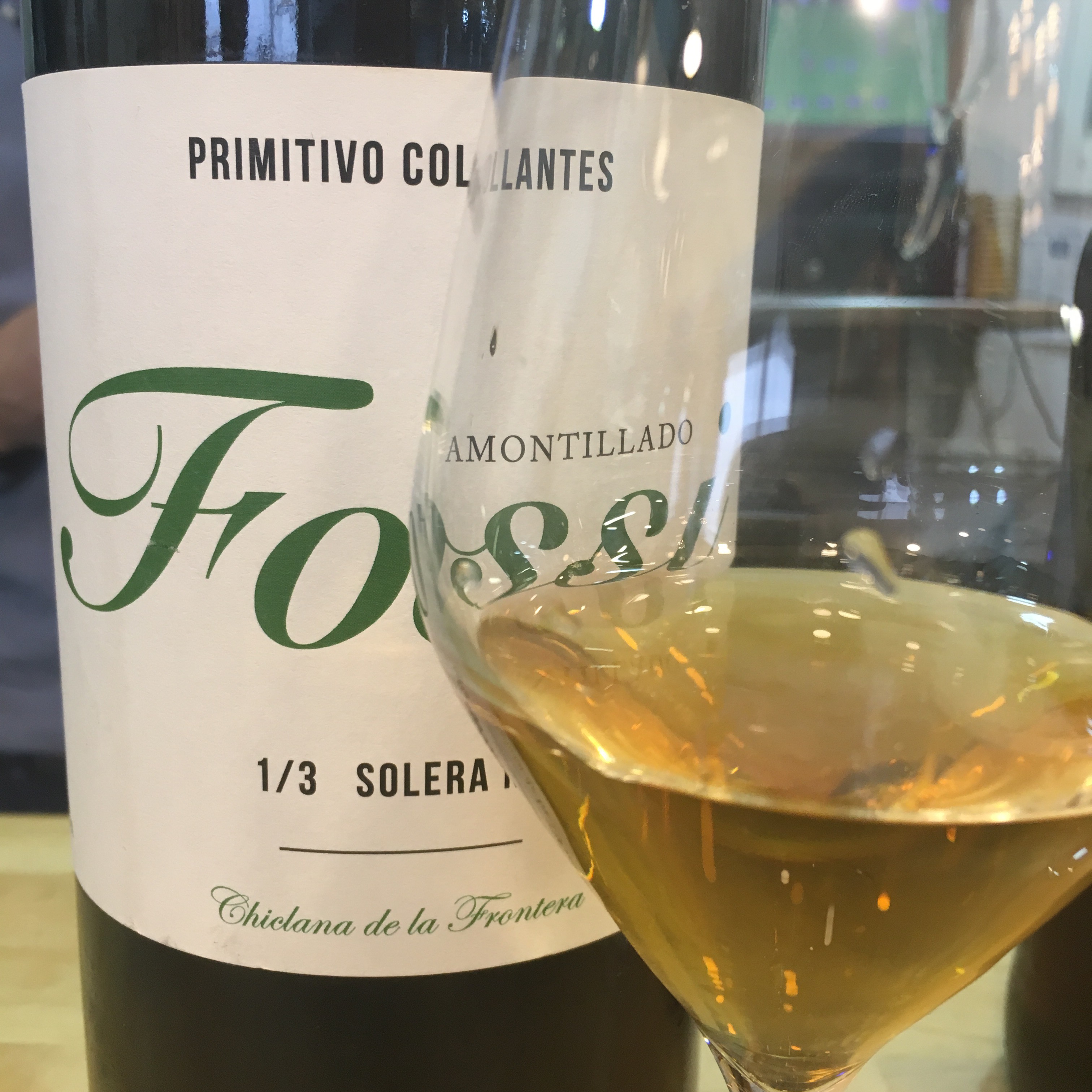
Amontillado Fossi 1/3 Solera No 

I have written many times about the Fossi – a lovely amontillado fino that is one of the most underrated wines around – but here we have a very special edition. This is a magnum drawn from a solera of three “Botas No”: botas that have been set aside for years, without sacas, and only refreshed to replace the angels’ share. (I am not sure how many of these magnums were produced but probably not many – I tried this at the bar of Territorio Era.)

The first thing I notice about the wine is the colour – to me it is a shade more amber/straw coloured, and less caramel-hued than the standard Fossi. On the nose it is punchy and on the palate too it strikes me as more of a missile – sharp and direct, more concentrated acidity and salinity, slightly less juice and caramel flavour. Very fine and elegant, a nice structure and profile. 

A more serious version of the standard but I could still drink bucketloads.  

Fino que va para amontillado Criadera/A – 1/2017 

img_6648

I think we have now reached the limit in terms of length of wine name – this is getting to Riesling-like proportions. Was going to write this up as an amontillado fino but have gone with the manufacturer’s instructions.

It is the first saca of 2017 (or ever), one of the new releases by Alvear (you can try them all at Territorio Era), and as you can see is a pretty limited release – 1060 tiny bottles. 100% pedro ximenez with an age of around 10-12 years under flor and apparently from the criadera used to feed the solera of the amontillado VORS.

It has a bit more reddish brown than straw in colour and is pretty clear, if not quite cristaline. On the nose I find it much closer to an amontillado than a fino. I don’t get quite as much haybale biological action in the nose, just maybe a bit of sawdust whereas there is a piercing salty bitter almond aroma. On the palate too it wasn’t as fat or fatty as I expected. In fact I was surprised by just how dry and fine it is. An elegant palate, with a nice sharp acidity, a very piercing bitter almond flavour and a fresh, saline finish.

An elegant wine in a cheeky little bottle: get one if you can.


Amontillado Seco Valdivia Dorius (2006)

Another long lost label – this one once of Ruiz Mateos, later absorbed by Garvey, recently acquired itself by Fundador – but David at Territorio Era has somehow got his hands on a few bottles, including this one dated 2006. A middle aged amontillado with a deepish colour, relatively quiet, nutty nose (with a bit of reduction first up that soon blows away), then a palate that is relatively mellow and roasted-nutty with a little bit of bitterness from the time in the bottle.

Amontillado Fino Agustin Blazquez 

The second of two very special wines served after an already brilliant tasting with Bodegas Tradición at Taberna Palo Cortado last night, this one was a homage to the star of the evening, Jose Maria Quiros, who had for a time worked at the legendary and now disappeared bodega of Agustin Blazquez. It was very generously opened by Paqui, who had already given up her evening to host us and had laid on the usual delicious tapas – I just wish I had a wine good enough to have reciprocated.

Because this wine was also top drawer. Estimated as being bottled in around 1950, it came from an original wooden case and was wrapped in original straw packaging (you can just see it above). The cork had not survived the passing of the years, or rather had been partaking a bit too heavily, which explains the debris in the glass above, but otherwise the wine came across as as clean as a whistle.

This would have started as an amontillado fino – probably not unlike the older finos that Tradición make today – and has probably gained some colour. As you can see, a lovely clear brown (interesting to me how similar it was in colour to the manzanilla of the same kind of age that we had tried just before). This had just a touch of reduction on the nose and aromas that were a bit more serious, like bitter almonds. Then on the palate again it was still compact and clean in profile. Not a big structure or punch but a little bit of acidity and a nice deep, almond to bitter almond flavour.

This must have been some wine when it was a young’un – and in many ways it still is.


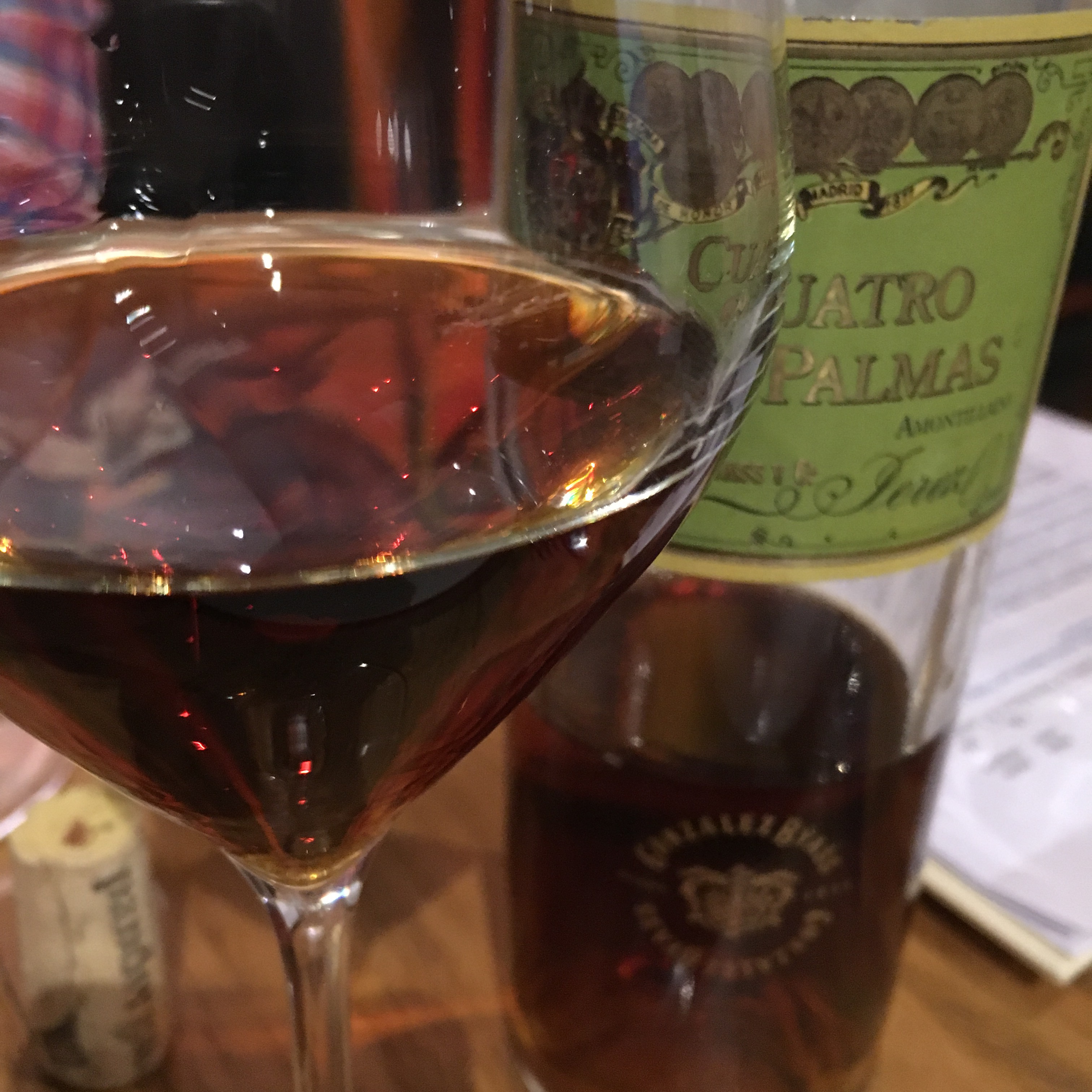
Amontillado Cuatro Palmas 2016

The end of a superb dinner at Angelita and an appropriately superb finish. 

One of the most elegant of the old amontillados available, this 2016 saca is right in my wheelhouse. Whereas I remember more orange in a previous saca this is a deeper chestnut in colour and has a more nutty profile, dryer and finer in profile even. It strikes me that the elegance I associate with it may come from the finely integrated salinity – zingily present but not excessive and not separate from the rest of the wine. Also the concentration of the wine is not overdone – has a better balance of flavour and acidity/alcohol than some bigger beasts. 

A really fine old wine out of the very top drawer. 

Chiclana power: Primitivo Collantes in Enoteca Barolo

1f3cf748-4c9e-4bee-ae62-724f82689e97

I can’t believe over a month has gone by since the magnificent cata by Primitivo Collantes in Enoteca Barolo. As I said back then he is one of the unsung heroes of the so called sherry revolution and I got the feeling at the time that a lot of people were taken by surprise at just how good the wines – and his presentation of them – were.

One of the most impressive aspects of the night was the emphasis on terroir and viticulture. A first class description of Finca Matalian, its elevation and exposure to the elements (between two “mares” – a joke that is frankly untranslatable and even in Spanish doesn’t work unless you have the accent of the guys in Cadiz) that was followed by explanations of the pruning, the benefits of hand harvesting, the impact on the vine and the effects of a vine under stress, the prohibition on irrigation and importance of the absorbency of the soil. We also had some geology and some talk of abundant diatomeas and then emphasis on the relevance of the location so close (8km) to the sea but high (96m-114m up) – the advantage of the breeze and winds but with the quality albariza. A really top class setting of the scene.

When a winemaker brings two different soil samples you know he cares about terroir. It was fascinating to see these two: from Matalian itself and his other finca, Pozo Galvan. From far away Matalian looked chalky white and Pozo Galvan mottled, but from close to it wasn’t anywhere near as marked. I could try and convince you that they seemed to crumble in different ways but to be honest both were granular: maybe just a slightly finer dust to the Matalian. I did the old TV cop “cocaine” test with the tip of the finger and the diatomeas in the Matalian were immediately apparent. In fact it was clear to me that they were cold water diatomeas* (* these are alternative facts, as far as I could tell they also smelled and tasted the same (and I wouldn’t know a cold water diatomea if I sat on it in the bath)).

Then back to the vine and the yields, and the timing of the harvest in several passes, but thankfully during a lot of this time we were also tasting the wines (which is important, because there is only so much chat you can listen to dry). Specifically, we were supping away at sobretablas from Pozo Galvan and Matalian. A sobretablas is not a mosto – these are fortified and have spent time in a deposit with the occasional little island of flor – but they seem all the more raw for it, and these were spikey and punchy on the nose, with the Matalian slightly more piercing, the Pozo Galvan slightly rounder. On the palate that difference was more evident – the Matalian was that bit sharper and seemed much more direct, straight line, and longer.

After the sobretablas we moved on to two unfortified wines and specifically the Socaire 2014, which in itself is one of those fantastic flavourful palomino wines that stand out, saline but full of herbal, almond, almost-fruit, and then a chance to try a Socaire 2014 Oxidativo, with a touch of further oxidation from an additional 8 months bota ageing. You will have to believe me when I say you could bank those 8 months – I had the two together and the wine is only getting stronger. (Socaire itself means “shelter from the wind” and is a reference to the meteorological conditions on Finca Matalian – again showing how this wine has a clear sense of place.)

After the Socaires, we moved on to two biological wines, the Arroyuelo Fino en Rama and Amontillado Fossi. Now I have had these wines many times but at this tasting they absolutely sang. I had always found the Arroyuelo en Rama exemplary in terms of labelling but I never realized that they were bottled and labelled as the orders came in – with your man to select them. And what a wine it was on the night – a clear inheritor of the beautiful direct line of the sobretablas, but next to the sobretablas (I cunningly kept some from earlier) you could see the progression in verticality, saline edge and vegetable power. A superb example. And the Fossi was at its best too, with direct salinity and honeyed caramel flavour in bags. It is apparently around 18 years old on average already, and Primitivo told us that soon he hoped the average age to bump above 20 years into VOS category. I must say I find that really remarkable for a wine that is as elegant as this one. One of the most underrated wines around.

But however good those wines were there was no doubt about the star of the night: the mother of all moscatels. A frankly beautiful, elegant, light and spritely fifty year old from the “sacristia”. This wine – the grandaddy of the already very good Moscatel Oro Los Cuartillos -was a Fred Astaire of wine, incredibly agile for its content. It had a fantastic menthol quality and lightness and a seriousness of business – like a pianist playing hard with both hands. What a wine it was.

And since then the name of Primitivo Collantes has rung out in Madrid, no doubt. I have never seen the locals so enthused after a tasting – and with good reason. It was top drawer.

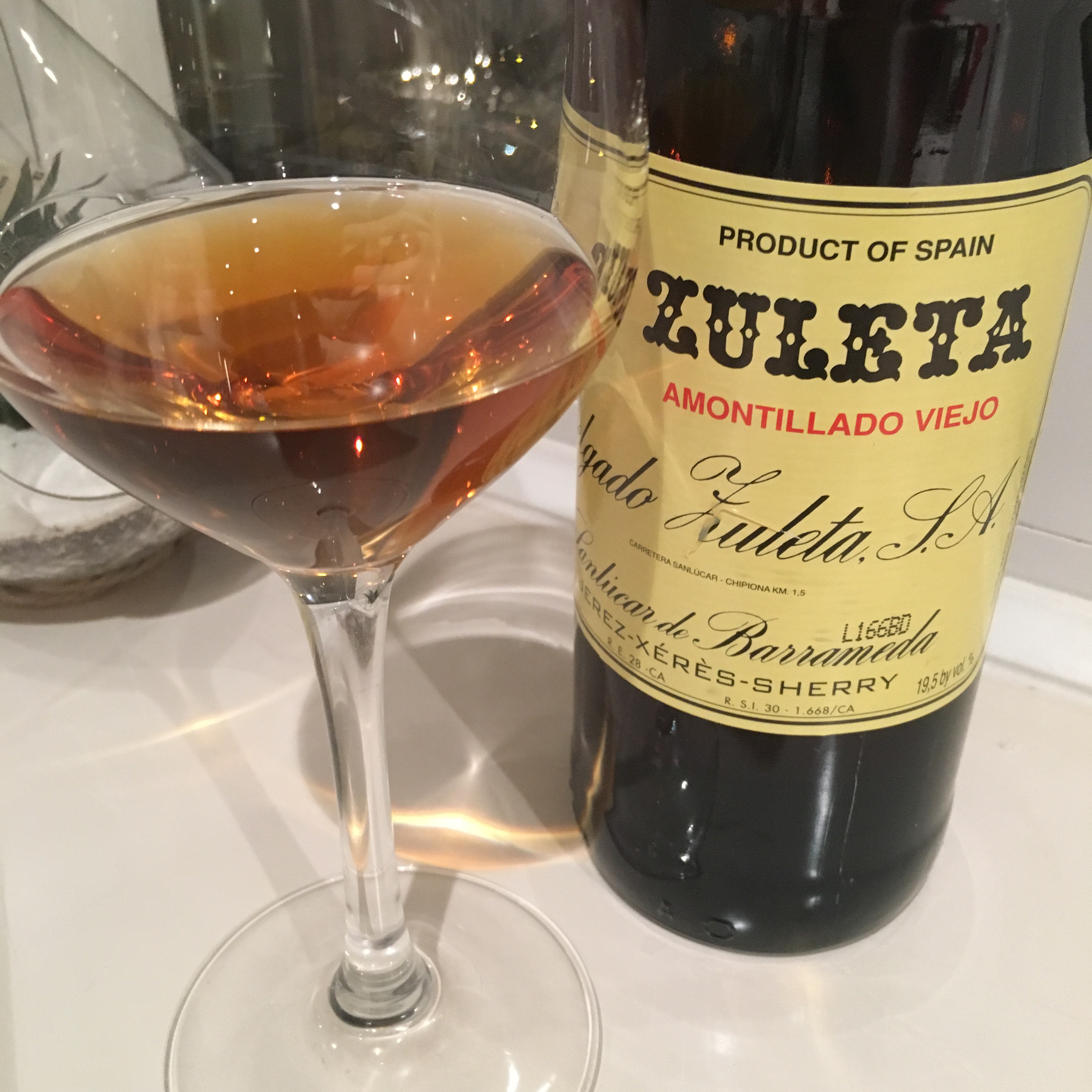
Zuleta Amontillado Viejo 

Hunting around in my little minibar last night for something nice to sup and happened upon this old classic. The second of two bottles I picked up from the Cuatrogatos wine club a year or so ago and probably the last of its kind to be seen around here.

It is a lovely tipple. A great example of a Sanlucar amontillado – elegant and sharp – but relatively fruitful too. As you can see, it is as clear as a bell and a lovely red-brown amber. On the nose it has seasalt and burnt hazelnut caramel, nice inviting sweetness to the nose. On the palate it has a nice clarity of flavour and shape. A lovely spine of salinity through it, starts razor sharp and finishes long with the mouth watering, and a mellow sweet-sour caramel flavour with waspish acidity at the end. 

Am I glad I had a second bottle of this. Lovely drop: enjoyable but serious too. 

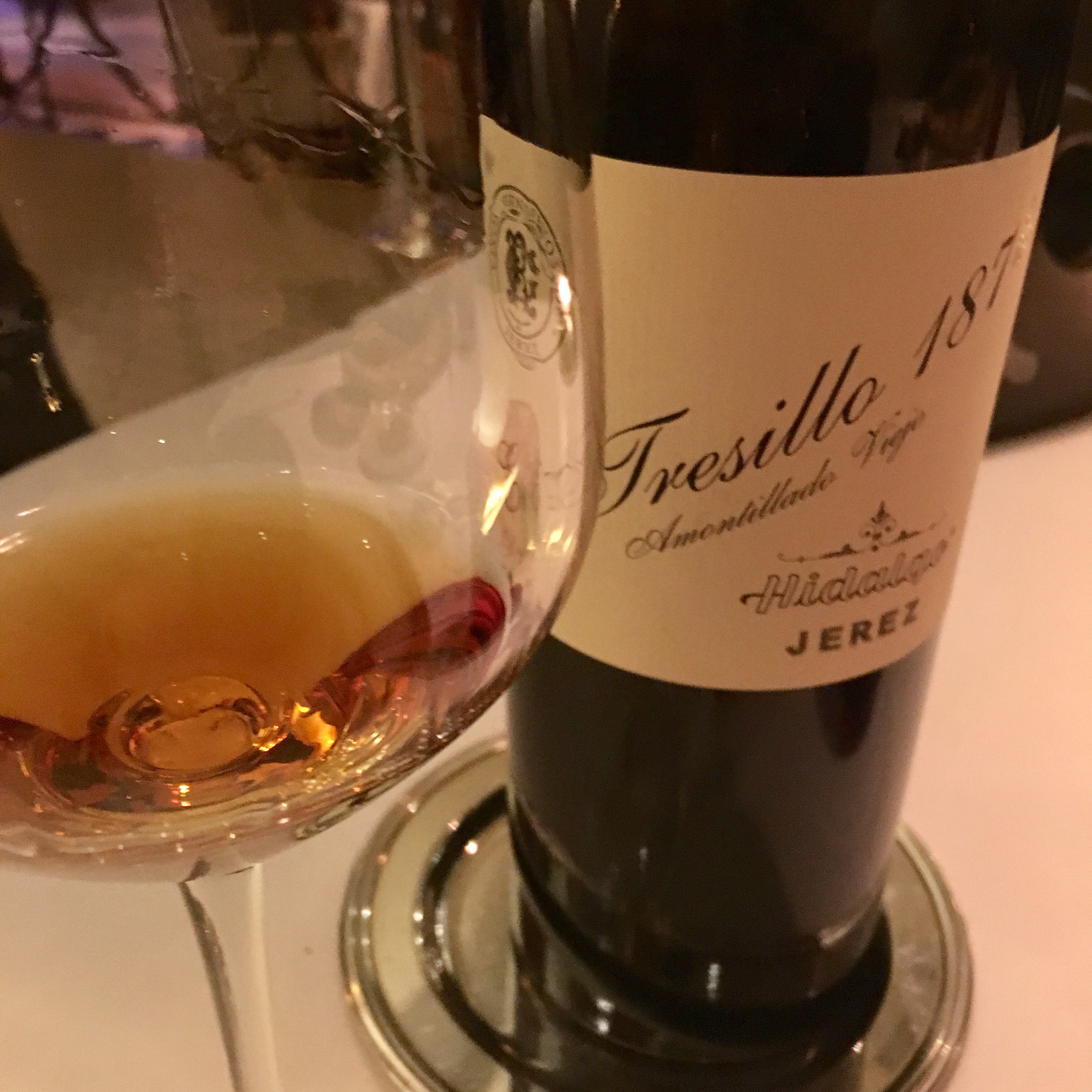
Amontillado El Tresillo 1874

What an absolute gem of an amontillado, ladies and gentlemen. Not had a glass of this – for far too long – 2015 if this blog is to be believed. So a happy reunion when I was given this last night by David Robledo at Santceloni, paired wonderfully with a rodaballo confitado in jus de champignon. In fact it showed its class in general – concentration of flavour but elegant, dry and fine.

It was a night of fantastic pairings, and this followed a a 20 year old malvasia madeira wine from Henriques & Henriques. That comparison was itself fascinating – and may have added to the impression of dry elegance in the amontillado, but I also found the amontillado more aromatic, and expressive in aromas of caramel, sawdust and citrus, even a suggestion of brandy.

Fantastic stuff – no way will it be another year before the next glass.