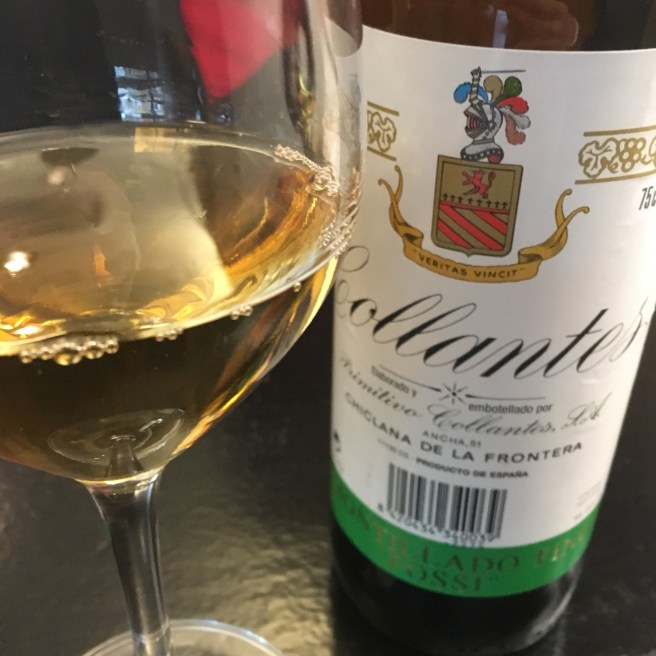
Amontillado fino El Fossi

The first of two amontillado finos during a nice lunch in Surtopia.

In colour it is an appetising dark gold – yellow brown rather than the orange or red notes of an older amontillado. After the fino and the en rama it is no surprise to find minerals, ozone, sea air in the nose, but the sweet caramel fruit aromas envelope and balance them in this and make it a less aggressive nose overall.

In the mouth there is that same zing, those salty minerals, although for me the texture is slightly finer (maybe it is more in keeping with this fuller flavoured wine), and there are sweet caramel, fruit flavours that again balance the saltiness, fill the palate and, it may be my imagination but seem to me to get back to the fruitiness of the mosto.

A really enjoyable wine with a nice edge of mineral complexity.

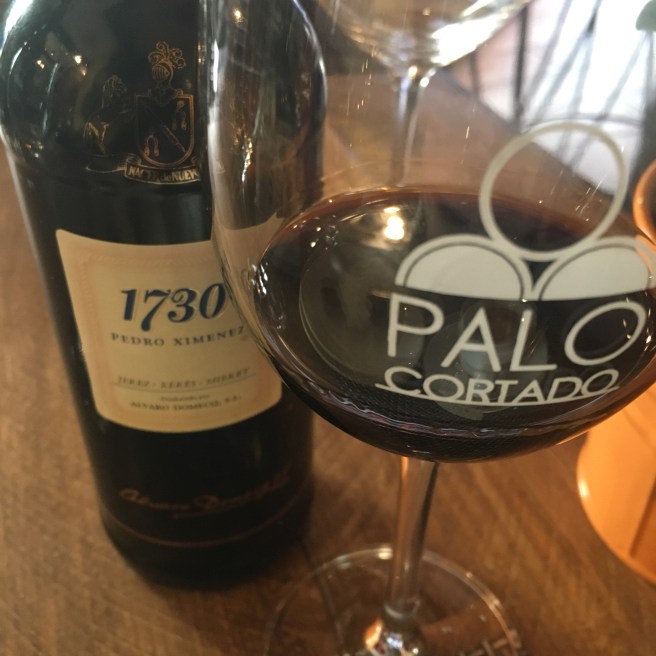
Pedro Ximenez 1730

These 1730 are an underrated and great value range of old wines that seem to fly under the radar. By Alvaro Domecq, a scion of that legendary family that acquired what was formerly the almacenista Pilar Aranda, they make and sell some really nice old wines at what seem like very generous prices. I tried the VORS amontillado a while back, and even before that I remember a very decent palo cortado too.

I had this PX in Taberna Palo Cortado a couple of weeks ago and it really hit the spot: sweet as nectar but had that little bit of mineral, almost steely bitterness and concentration that you get in particular from the older Jerez PXs, with just enough salinity to keep it (relatively) fresh. Very very easy to drink, for all the sugar per litre, which is never a bad thing after a nice long lunch.

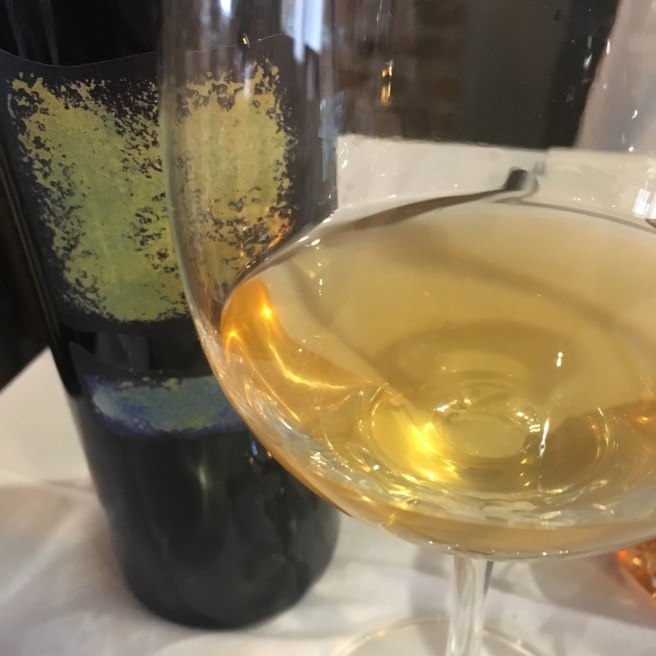
Terrazze dell’Imperiese Bianco 2013

If you are only interested in sherries, look away now, because as its moniker suggests this is not a sherry. It is not even a palomino, or a vine grown on albariza. Unlike an increasing number of wines from around Spain it hasn’t had any flor, or spent any time in an old oloroso barrel. On the contrary, it is a 100% vermentino that has spent 19 months on its lees.

But it is slightly oxidized and doesn’t half smell and act like some of the palomino wines – it was suggested to me by Victoria in La Piperna (Madrid’s premier Italian restaurant) for precisely that reason and I am very glad she suggested it because the similarities and differences are very interesting. (After all, what do they know of sherry, who only sherry know? As a great man nearly said.)

Aromatically it is very similar – on nose alone I would have called this palomino, without question. As you would expect, the flavours on the palate are not dissimilar – maybe a bit more towards ripe fruit and plums than white fruit – like a palomino there isn’t much acidity and there is that touch of oxidation, to which palomino seems very prone. Having said all that, it lacks the distinctive salinity of the albariza wines, which leaves it feeling a little blunt at both ends, and for me the palate over all is less defined – less discernible herb.

Would be a good one to sneak into a blind tasting for all the new sherry experts (unless of course they read this blog).

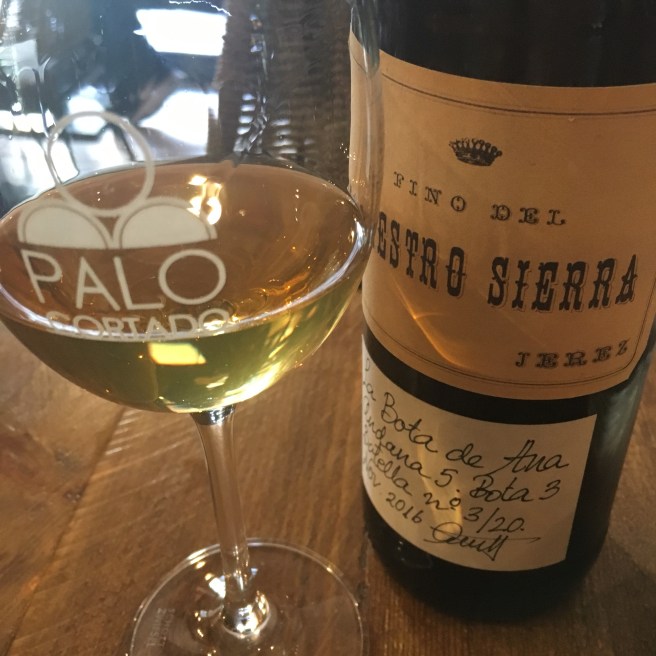
Fino del Maestro Sierra – Bota de Ana (Bottle 3/20)

This is a very rare wine – as you may be able to see on the label only 20 bottles from each saca – from a bota of fino chosen by the winemaker at Maestro Sierra, Ana Cabestrero (and hence la Bota de Ana). The bota itself is said to be one of the two “original authentic fino soleras” (although when I was told that it made me wonder what the other soleras were called)  botas of Amazingly I was able to try this by the glass at Taberna Palo Cortado (one of their 300+ wines from the region).

Maestro Sierra’s finos are characteristically very fine and elegant, with a nice soft yeasty almond texture and flavour, and this is all that. The colour is watery gold and the nose has just a hint of fresh straw to it, with those almonds and maybe a touch of citrus underneath. Then the flavours in the palate are just what the nose leads you to expect: it is big and rich in texture and very long, but there isn’t much width to it – a kind of silky almond rapier. Neither is the salinity overpoweringly zingy – a very refined wine indeed.

The height of refinement, and exclusivity!

UBE Maina 2015

Like the other UBE wines this is a 100% unfortified Sanlúcar palomino by Ramiro Ibañez at Cota 45, but whereas the first two in the series were from Carrascal (de Sanlúcar) and Miraflores, this is from Finca la Charanga, a vineyard on Pago Maína that is a byword for producing the most corpulent, flavourful wines in Sanlúcar. The reason may be partly climate, since it is tucked inland a little way from the coast, but is probably more strongly linked to the soil involved, since the albariza here is of the barajuela variety (layered like the deck of cards for which it is named) and in addition the pago is said to be very high in marine fossils – the famous diatoms.

For whatever the reason, it is the most “horizontal” of the Sanlucar wines and I enjoyed this bottle immensely. On the nose this time I really noticed leaves, herbal tea in there but real green foliage as well, and dried apricots underneath. Then on the palate it has that savoury quality, like bouquet garni and coating the sides of the throat. It is a really meaty white wine, and although I once described this wine as broader than it is tall it is, in fact, really long. There is salinity there but it doesn’t cut through and there is fruit on top, again reminiscent of dried apricots.

Once again I feel obliged to point out that these palomino white wines need time in the bottle and you get the most out of them when you have time to enjoy them in relaxed fashion over the course of an evening. If I was organizing a cata I would treat them like a chablis – big decanter, on ice if you like but not too cold, and let them breathe for a goodish while before showtime. (Or maybe I am reading this all wrong. Maybe the truth is that they are great from the beginning but it takes my little mind time to adapt to them.)

Absolutely top drawer. .

La Taberna de Pedro (and the Restaurante Vinoteca Garcia de la Navarra)

As I write this I should declare that Pedro, Luis and the guys at la Taberna de Pedro (and the Restaurante Vinoteca Garcia de la Navarra) are friends of mine. For years my apartment was six floors and eleven metres from their door, and for well over a decade the Taberna, in all its forms, has been one of my happiest places. So this is not an absolutely objective appraisal. But I assure you that every word is true.

First, the food is outstanding. The hallmark of Pedro is taking top quality produce and preparing it beautifully. And while most people talk about “produce” they are thinking top end, whereas for Pedro the obsession is from top to bottom, whether it is the mature and aged steaks and the outstanding fish and assorted sea creatures he proudly posts on facebook, to the chard, borage, tiny “teardrop” peas, artichokes, and runner beans that he cooks like no-one else I know. His pisto is outstanding (and I don’t say that just because I get given an extra egg) and his menestra is the best in Madrid but his callos and, above all, the lengua (veal’s tongue) are special. There is also great variety – the stuff that is off menu is always worth trying if you can (and I say if you can because on more than one occasion my order has been overruled by Pedro in the kitchen). Yesterday we had the chard, runner beans with scallops, pochas and callos and I could not fault any one of them.

Second, the wine list is equally top class. In fact yesterday was the first time I have seen the wine list in years – I nearly always take the recommendations of Luis – but just behold the magnificent two volume, 90 odd page effort, with no fewer than 45 sherries by the glass (and rancios and dorados de rueda for the fashion conscious). With yesterday’s callos we had the mighty Villapanés, but there are a number of wines on that list that I am going to have to come back for. There is no doubt, if it weren’t for the thousands of other wines, this place would be famous for its sherries.

And there are thousands of other wines – it is a staggeringly varied list with wines from all over Spain and around the world, verticals and classic old vintages, frankly everything the most demanding winelover could desire, kept up to date by the sommelier’s sommelier – Luis. The man is an absolute legend and excels at finding great value wines in accesible styles that you probably haven’t heard of, but even more impressively he seems oblivious to the crazes, fashions and trends and if he thinks the wine is right he will recommend something you had forgotten about and written off years ago.

The guys split their time between the two locales but if you want to be close to Pedro you should aim for the Taberna, whereas if you want the fully immersive Luis experience you want the Restaurante Vinoteca. By long tradition I am a more frequent visitor to the Taberna – I have known some of the staff there since they were teenagers after all – but Luis seems to have forgiven me so far (although he does make a point of mentioning it).

And that would be my final word. These are two top restaurants run by two brothers, each of them great guys and outstanding in their fields, that draw you in and make you feel part of the family. At least they did to me.

Don Pedro, Don Luis, see you on Monday!
De Alberto Dorado

You know that the guys in Jerez are doing something right by the number of would-be Jereces that are appearing. These days it doesn’t matter what region you are making wine in, you aren’t anyone if you aren’t making something under “flor”, something oxidated, something does with palo cortado or at the very least something aged in a barrel that was once used for fino, manzanilla, oloroso or similar.

Now the guys in Rueda have an answer to this. Their “dorados” are oxidated and are in some cases from soleras, but are no recent invention: if you know your history you will know that they are in fact backed by a long tradition.

Even so, it is surely no coincidence that after fifteen years in Spain I only start to see them now, with the “sherryrevolution” at full steam. And indeed in just a couple of weeks I had my first during a spectacular lunch at Alabaster and this, my second, during a cheekier lunch at Angelita. (Unless we include Beatriz Herranz’s Bruto, but that is 100% palomino so doesn’t seem to fit the bill.) Since then I haven’t stopped seeing them all over twitter, and although you never know whether it is the same 6 bottles in all the pictures it certainly seems like they are making a splash.

This one is 100% verdejo (it says here) and was very interesting if not to say quite curious. As you would imagine there is fruit in the nose but whereas your oxidated sherries give you an impression of sweetness on the nose here it came across as bitter fruitiness, like an orange marmalade. Then on the palate it had a bite of acidity and then again that fruity bitterness. To be honest I found it difficult to get into, but if twitter is anything to go by it won’t be long until my next opportunity.

Oloroso Callejuela

One of the wines from a recent stop in at Kulto this was a perfect accompaniment to the manitas (pigs trotters) in thai red curry, and given that combination you can probably guess that this was tasted in less than laboratory-like conditions. A real world tasting, you might say.

The wine is characteristically drinkable. It slips in easily enough and a burntish caramel sweet taste, then slight sawdust and woody flavours, which turn to burnt wood bitterness and a really intense, long burn at the finish – acid and salinity. It is a very tasty wine alright – more than a match for the curry – but fine and elegant for all that.

Top bombing once again from the guys at Callejuela.


Oloroso Gobernador

Enjoyed this with some meaty callos in La Antojá and it is a winning combination (if anything callos could have been a little spicier to match the oloroso, but it was close enough).

It is a classic oloroso. Just look at that beautiful clarity and deep, rich color. On the nose it is nutty and inviting, just a suggestion of caramel, but on the palate it is crisp, dry, acidic – some nutty and burnt caramel in the middle – and then more heat on the finish.

A no-nonsense wine for a no-nonsense dish.


The Cuatrogatos Wine Fest 2018

It is back: the Cuatrogatos Wine Fest III – on February 24 in Puerto de Santa Maria.

To be specific, you will find the merriment taking place in a tent at the bottom of the garden of the Hotel Duques de Medinaceli between the hours of 11:00 and 19:00 (although I wouldn’t expect full readiness at 11:00).

It is the big event run by the fantastic Federico Ferrer of the Cuatrogatos Wine Club and knowing him will involve laughter, and wine, in that order, and in great quantities. The list of bodegas is class:

Quinta Milú, Almaroja, Verónica Ortega, Primitivo Collantes, Juan Piñero, Lagar de Sabariz, Cota45, Mayetería Sanluqueña, Entre os Ríos, Barco del Corneta, Alexander Jules, Viña La Callejuela, Coto de Gomariz-Xose Lois Sebio, Luis Pérez, Forlong, Casa Castillo, Celler Pardas, 4OJOS Wines, Goianea Koop -Txakoli UNO, De la Riva and Clos Lentiscus

and there will also be some quality tastings throughout the day.

In any event, it is highly recommended – as the extensive coverage of last year’s festivities probably gives you an idea.

See you down there!