La Panesa

A lot of stuff on this blog hasn’t aged well – when I started writing it only just over three years ago I was a little bit of a wide eyed novice. Everything was awesome, it was fun to be part of the team and I may not always have been the most discerning.

But there are a few things that have stood the test of time. A thousand or so posts later I can confirm I was dead right about La Panesa. It is pure class and absolutely superb. Savoury and toasty nose, sharply defined and elegant in profile, full in body and rich in flavours, from butter, nuts, curry and spices, with a mouthwatering finish.

A beautiful wine. Fashions come and go, class is permanent.

Marquistas: de marca blanca a Equipo Navazos

Was an honour to participate this summer in a tasting lead by Armando Guerra as part of the series of summer tastings at Taberna Der Guerrita.

A really interesting, ambitious tasting too, aiming to cover the phenomenon of the “marquistas”: the practice of selling someone else’s wine under your own brand. In fact in this case even more ambitious all the way across the spectrum from the “white label” of the supermarkets all the way up to Equipo Navazos.

Armando invited me on the strength of some musings of mine back in February on this subject and I was delighted to accept even if it is a bit of a hospital pass: for some reason people get very offended if you suggest they may be a marquista.

The scope was too ambitious for me – I am very far from an expert in white label wines and that business strikes me as absolutely distinct, in terms of the volumes, characteristics and role from the business of the “bota hunters” I am more familiar with. (In fact one interesting point to come out of the cata was the discovery of a third category in a kind of middle ground – the own-label exporters.)

That broad scope may also have prevented us from getting as in-depth into the phenomenon as we might have liked. Not that there wasn’t debate: it was a pretty lively group in the room too and there were some pretty frank exchanges of views. But for all that we didn’t really advance very far.

There really wasn’t much discussion of the supermarket level, but on the “bota hunters” and exporters there was broad speaking agreement as to their useful role: marketing and explaining the wines, providing novelty, different vision. Some in the room firmly believed that the special selections were better than the standard wines from the bodega (I tend to find the law of averages persuasive). There was also general agreement that the marquistas do most good – and least harm – when they identify the source of their wines.

But Armando made an interesting comment that rang true, which is that the “bota hunters” face an increasingly uphill task. Put simply, with the upturn in interest in these wines there are not as many special old botas lying around to be discovered, it is getting harder to find something different to say to better educated consumers and the bodegas too are getting more sophisticated in terms of their own approach, squeezing the space the marquistas used to have to themselves. Another challenge is carving out a unique message in an increasingly crowded space: new pretenders cannot simply take for their own the “magic numbers” of Equipo Navazos and you find some increasingly novel ways of describing the uniqueness of the wines.

And when you think about it it is interesting to witness the evolution of Equipo Navazos, for me the number one marquistas and one of the undisputed stars of the sherry story in recent years. You certainly can’t fault them for standing still: they may have started as bota hunters, but it is noticeable that the wines increasingly come from tried and trusted sources or from far and wide, that they increasingly make their own wines and have even diversified into rum, whisky, and even gin.

While all this was going on there was of course a lot of wine going down: or in my case, being spat out (I had to drive back). A really top lineup in fact, with everything from supermarket fino via Sacristia AB, and Equipo Navazos to the legendary “Teran Salvaje”. In fact at least one wine was wrongly included: the De la Riva oloroso in the final flight. De la Riva is a new project but certainly not a marquista. Ramiro Ibañez and Willy Perez, beloved of this parish, actually bought the solera involved (“with wood” as they say around here) and have acquired wine to refresh the solera on an on-going basis. Noone is making or bottling wine for these guys and the brand is registered in their name. (Having said all that, what an epic, flavorful oloroso – no complaints with having a glass of that.)

It was a fascinating and fun discussion albeit one that tended to confirm my beliefs rather than challenge them. I for one think that Equipo Navazos and others like them have done a fantastic service to the wines of Jerez and Sanlucar by bringing them to the attention of a wider public, and by showing how special they can be. And marquistas are always going to be around: the best marquistas have deservedly strong brands and even if they didn’t in some places it will always be easier to sell a new, exclusive label than a traditional brand.

But the marquistas are no more the future of the region than own label brands. You can see the future in fact in what Equipo Navazos (and many others) are doing – making and experimenting with new (or old) ways of making wines and focussing on vintages and terroir. In fact the real future is probably neither the marquista or the bodega, but the vineyard.

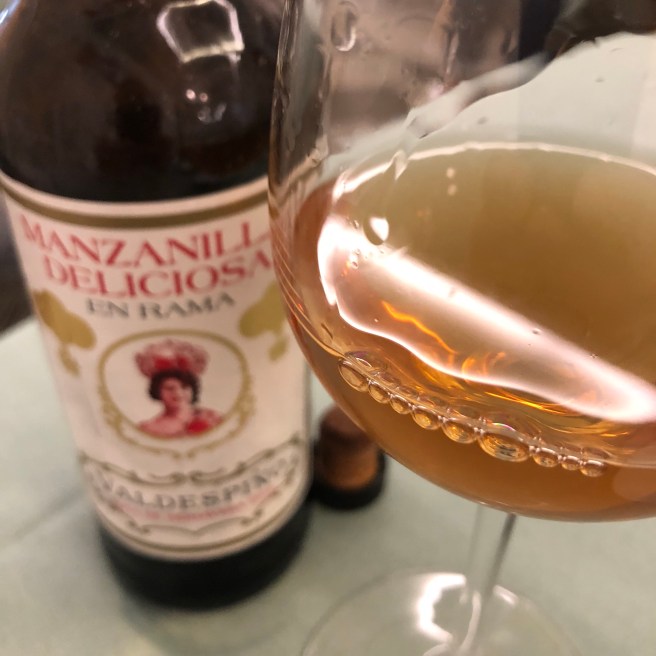
Manzanilla Deliciosa en rama, May 2016

Look at the colour of that. Rusty water, with a touch of rusty nail on the nose and palate (or is it suggestion?). Couldn’t help but think of the manzanilla en rama la Guita when I saw it, although unlike that second cousin this wine has acquired its colour from two years in the bottle – as you can see if you compare it to how it was two years ago.

Interesting to compare that note with this wine – this is still aromatic and yeasty, but a touch sour, slightly more mulchy haybales on the nose and a lower register in fruit flavours. Very enjoyable with the oxidation and a fun thing to try (here in Zalamero Taberna by the glass).

Delicious little bottle.

Lunch with Bodegas Tradicion in Taberna Palo Cortado

It is one thing to have an overdose of gainful employment and a backlog of posts, but it is quite another thing to fail to acknowledge an absolutely cracking lunch like the one I had with the guys from Tradición in Palo Cortado at the end of June.

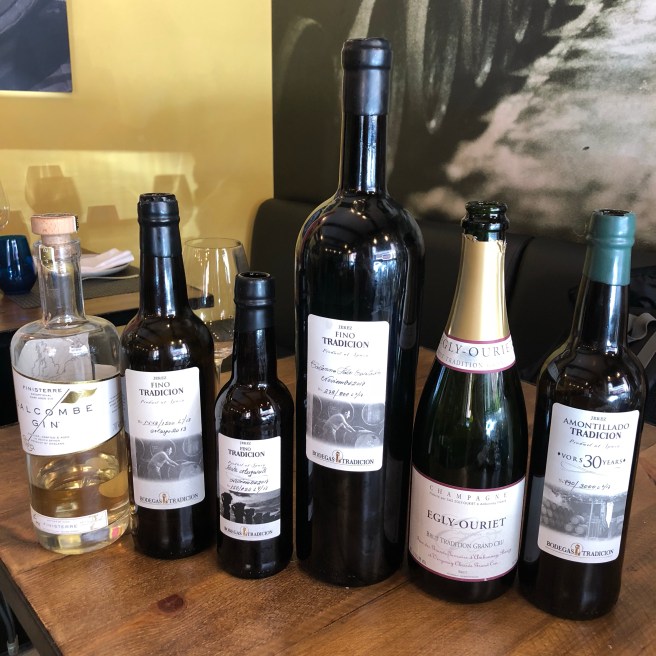
We kicked off with a “martini” made with Salcombe gin and fino and there were bubbles and a superlative Amontillado to finish, but the stars of the lunch for me were the finos that came in between. First and foremost a bottle of the May 2013 saca of the Tradición fino, a little bottle of the fino bottled for Mugaritz and a magnum of the November 2017.

Really fascinating to see that 2013 again. The only other time I had tried it was at a superb vertical tasting of all the sacas at Reserva y Cata in Madrid in November 2016 and even then I remember the complexity and additional dimension it had. A year and a half longer in the bottle and there was caramel softness to it, and a bitter almond and butter feel to the flavours. Really fascinating and almost enough to make me want to keep a bottle for a few years (if it were not for the ease with which the November 2017 were slipping down). One day I will invest in a cellar that is far enough out of reach to protect the wines from erosion.

For the time being all you can do is give thanks that wines like these are being made year after a year and at such a high level. It certainly makes for a brilliant lunch.


Manzanilla Pasada Los 48 de Garcia de Velasco

This is a very coveted little bottle of wine amongst aficionados: a label that disappeared long ago but the guys talk of down there in hushed tones, and if you know a little bit about the area you will have seen the surname “Garcia de Velasco” in a few different famous family trees. It was somehow acquired by a good friend and brought to a fantastic lunch this summer in Cataria.

To be honest, the lunch might have been too much fun, because with all the laughter and, let’s be honest, other wines, I neither took notes nor have as clear a recollection of this as I would like. What I do remember was a wine whose minerals had almost precipitated into chalk particles and whose fruit had turned to musty, incense like spices. Still an elegant sup with a very light start and a mouth watering finish and flavourful but dry as a bone in the middle. As so often happens, I found myself wishing I had met this bottle 20 years ago.

Legendary stuff and you can still see why.


Socaire 2016

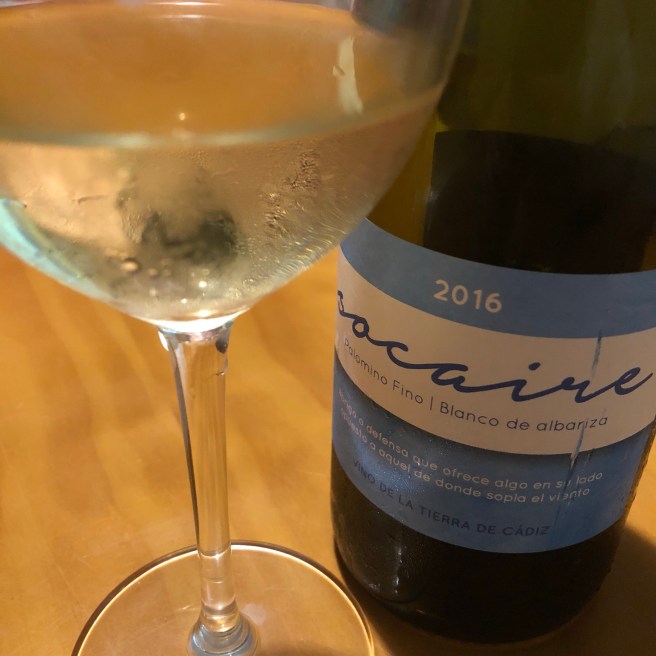
There she goes, the third vintage of Chiclana’s finest, and a wine that has in its short history acquired its own cult – socairismo. It is by Primitivo Collantes, a 100% unfortified palomino from the vines on Finca Matalian (I think), fermented and aged for more or less two years in botas that had formerly held Fino Arroyuelo. Not necessarily under flor, bot not necessarily not under flor either: there is definitely a touch of biological on the nose and the palate (although that might be accounted for by the barrel).

Whatever the process, the result is a cracking wine. A clear gold in appearance, has a nose of chalk, ripe apples, nuts and chamomile, then a zingy, tangy palate that is rich with a mineral finish. An exuberant, tasty wine (for connoisseurs, this is much closer to the explosive first vintage in 2014, with a touch less acidity and a touch more shape than the 2015).

Love to see the date proudly displayed on the label too – about time the authorities recognized and encouraged these wines. I had this when I visited Primitivo this summer with some chicharrones and a slice of the excellent local cheese. As I wrote then, the most impressive thing about Primitivo is not just the wine he makes, but the progress he has made against the tide. This wine is almost the embodiment: when he first had the idea he couldn’t convince the company, so paid for and bottled at least the 2014 himself.

Class wine from a class bloke.

Manzanilla pasada Maruja

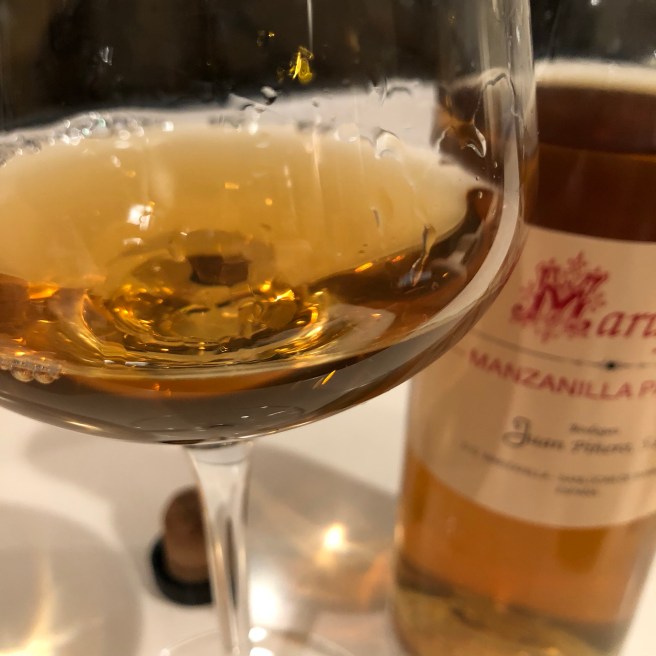
This is an absolutely class wine, one of the very best manzanilla pasadas you will find and one that just seems to get better and better every time I happen across a bottle.

It has a beautiful rich colour which is very nicely shown off by the clear glass bottle and as a result just looks incredibly appetising. The nose is no less inviting: wonderfully savoury, with a combination of sea-air, haybales and spices and herbs (an old spice box from the back of the larder).

And it certainly doesn’t disappoint when you tire of swirling it around the glass and finally take a glug. The profile is superbly elegant: a sharp, zingy start and a long fresh, mouth watering finish, with no edges in between but rather a smooth crescendo to a very intense mouthful of flavours. Savoury, spicey, umami and sweet like a meaty, tomatoey curry sauce – one of those curries with stewed apricots in them. It is the intensity, depth and completeness of those flavours – foreshadowed in the nose – that for me really set this wine apart.

Anyway, this bottle was gone in a blink of an eye. Must get myself two or three more!


Taberna Trasteo, Zahara de los Atunes

Undertheflor on tour this summer took me down to Zahara de los Atunes and after a thorough survey and despite some superb work with the espeto down at the beach there is no doubt that the number one spot down there is Taberna Trasteo.

Really fun, informal food with funky takes on local classics (witness the saam-style tortilla de camarones, with more camarones and more attitude than tortilla) and top class, friendly service despite being absolutely mobbed (it was busy when we arrived and absolutely heaving when we left).

More importantly given the need to rehydrate after a long day at the beach it is a cracking little spot if you want a glass or two of the good stuff. The sherry list is short and to the point, with quality all the way down from the likes of Primitivo Collantes, Callejuela, Maestro Sierra, Yuste and Las Botas, there was plenty of local talent amongst the other wines too (including my favourite Cadiz Cabernet Sauvignon: the Forlong Rosé) and it didn’t take long to find they had a few extraballs off the list like the cracking Arroyuelo en Rama Selección de Botas above.

Top quality and no wonder they get so rammed.

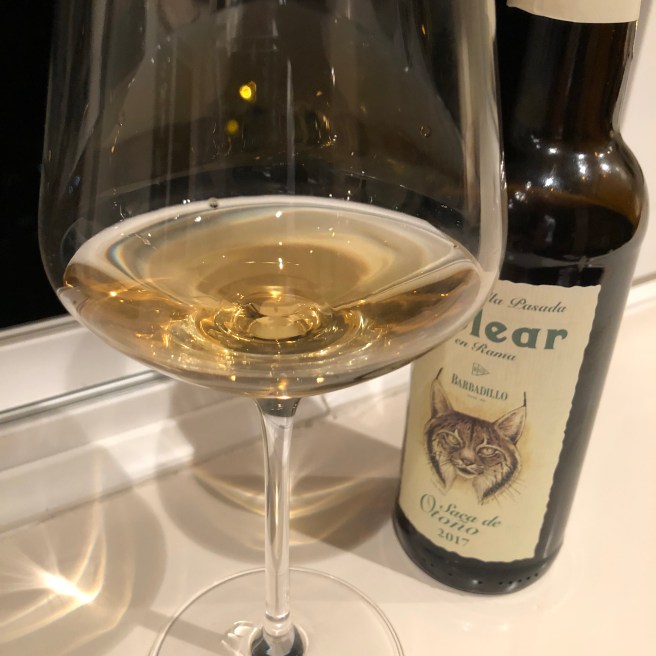
Manzanilla Solear en Rama Autumn 2017 – the Iberian Lynx

Back in Madrid and back in business with this superb little bottle. I remember being slightly underwhelmed when this came out – the wine not quite living up to its majestic label – but after a year in the bottle and a few weeks in which the sherry levels in my bloodstream have dropped to dangerous low levels this is absolutely delicious.

Aromatic like a hayloft after a rainstorm, zingy and sharply saline, packed with vegetable flavour and spice. Love it.

Finca Matalian, Pozo Galván, and the man himself: Primitivo Collantes

Down South they sell cars with a special set of gears designed for slowly making your way out to the vineyards. You start in first before changing up to “dawdling”, then smoothly up through “chugging along “, “ambling” “moseying”, and finally “meandering”, reaching a top speed of around 15 miles per hour within fifteen minutes. It is not for the faint of heart … I am of course only kidding. The real reason for the slightly less than rapid progress is not the gearing of the horseless carriage but rather the consideration of the driver, as they navigate beaten up tracks between once great properties out to remote, rustic locations.

And therein lies the first of a number of learnings from a fantastic recent visit to the vineyards of one of my heroes. The drive out to Finca Matalian and Pozo Galvan, the vineyards of Primitivo Collantes (for it is he) takes you out through one of the lowliest neighbourhoods of Chiclana and out along a road (“el carril”) that once lead all the way to Jerez, and was once lined on both sides by famous vineyards, villas, and plantations. But not any more. Now the road has more holes than road, the vineyards are gone, the villas are no longer famous, and you are beseiged on every side by the dead heads of late season sunflowers (unless, of course, you go earlier in the season).

Where once there were 2,400 hectares of vineyards now there are only 137. Only two bodegas still harvest grapes in Chiclana itself: the cooperativo and our man Primitivo, the Asterix of Chiclana winemakers, who almost alone is resisting the sunflower invasion and now accounts for no less than 39 of the 137 hectares that are planted. (And our man Primitivo is doing more than just resist: 6 of his hectares were planted in the last half dozen years, and he is looking to see where he can plant next.)

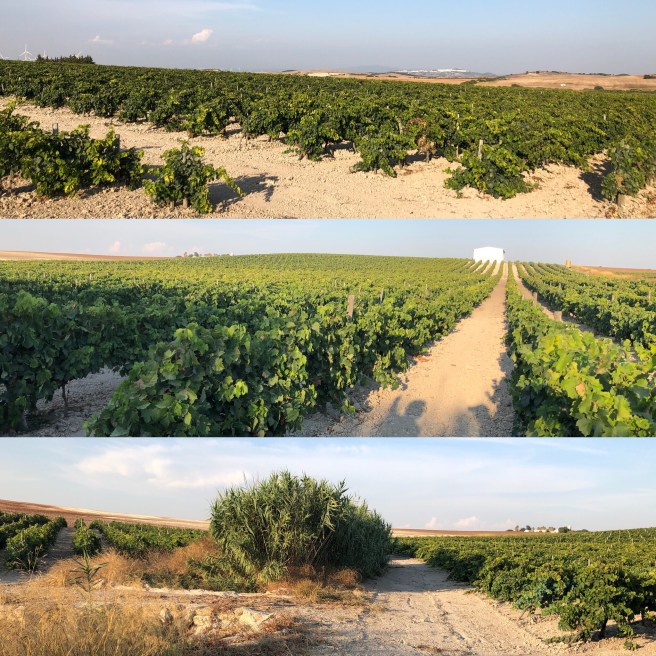
And god bless him for resisting because his are beautiful little properties. From the top of the hill you can see over to the Bay of Cadiz but the vines are a picture too: Pozo Galvan, 19 hectares of albariza that cross a tongue of lustrillo; and Finca Matalian, a gentle downward sloping sea of albariza, palomino, moscatel, pedro ximenez and uva rey planted east to west, with a secret corner behind the canes called Isla el Topo (on the left of the third picture above, with the rest of Finca Matalian to the right).

Isla el Topo is particularly interesting, a tiny 1,5 hectare section of Finca Matalian at the bottom of the slope and protected from the levante winds by a natural barrier of cane. That protection (the origin of the name of “Socaire”, which literally means shelter from the wind) means that while the rest of the finca is planted east to west, Isla el Topo is planted north to south, bringing its vines side on to the sun. The vines get more sun and the first run of these grapes is distributed to stimulate the natural barrel fermentation of the rest.

And when I say Albariza you can see above – a cross section from a drainage ditch in Finca Matalian and a lump of the same give you an idea of what we are dealing with: the good stuff. The other picture is not in fact Pozo Galvan but is from a nearby vineyard with similar topography and shows how the lustrillo (foreground) gives way to albariza up the slope. Really striking color change and fascinating in terms of wine making possibilities.

Gets no less fascinating as you close in on the vines either. I was intrigued by the uva rey – you don’t see much of it around after all – and just look at the difference between the grapes on the vine (uva rey on the left, palomino on the right) and in my palm (confusingly the other way around). The uva rey has some coat on it I can tell you: real crunch on this grape and an acidity and pungency from the skin that lifts it apart from the palomino (and the moscatel, and the pedro ximenez). Or maybe I should say palominos: Primitivo has a few different clones, although mostly palomino de jerez, recognizable by its rough stem (also pictured – of course I didn’t picture the others …).

All of this is harvested by 32 hands (ok, 64 hands, but no machines anyway) in a single “pass” over fifteen days in September (generally the latest harvest in el marco). The grapes are sorted by hand, the wines are naturally fermented in the barrel and go on to become some favourites of this blog: the fresh and gluggable Viña Matalian, the superb, punchy, barrel aged Socaire, the searing Fino Arroyuelo en Rama and the joyous Amontillado Fossi, amongst others. (And there is more to come: the day before I pitched up Primitivo and Ramiro Ibañez had apparently been sketching out some zones of the vineyard in which they hope to produce even more expressive wines: sign me up for a box etc.)
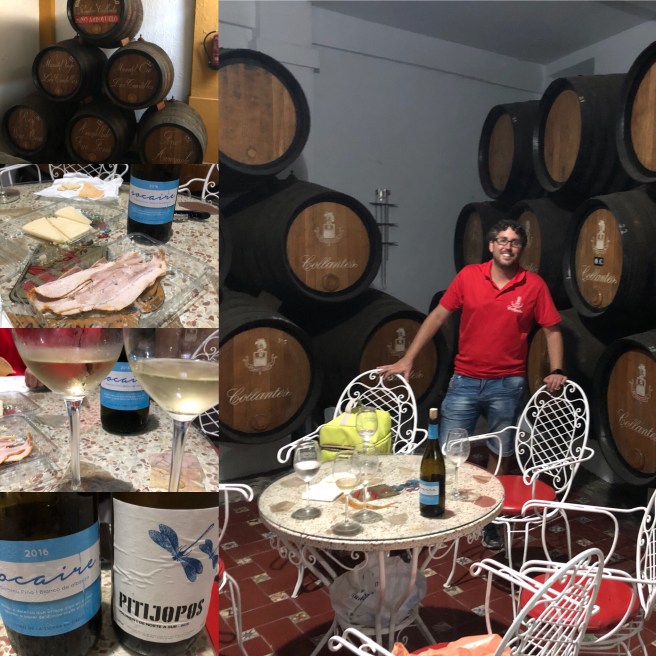
Having seen the vineyards (and since we had forgotten to bring the picnic) we repaired to the bodega for some refreshment. Or rather one of the Bodegas: the Bodega in the “high part” of town, a regal old building home to an uncommon friendly population of bats and a lot of even friendlier looking butts of wine. Once there we headed to the “Sacristia” (above on the right, with the main man included) where we supped the uva rey and 2016 Socaire with chicharones and a cracking local cheese.

And it was at the bodega that I really began to appreciate quite how far Primitivo Collantes has come. I couldn’t believe how small the Fossi solera was: until recently only 500 bottles were filled a year. More importantly, I realized for the first time that this is a bodega with a long history (110 years in the same family) but which until recently was dedicated almost exclusively to the local, bulk market. Primitivo told me that only six years ago they only had distribution in Cadiz province, whereas now you can get their wines throughout Spain (and I frankly am disappointed at the outside world for not getting a piece of the action too).

It is fantastic news. This guy makes proper wines, wines that deserve to be enjoyed and recognized all over: in fact I think he is consistently the most underrated winemaker in el Marco de Jerez. But for me what makes it even better news is the way that it has been done. It has not been done by rediscovering lost barrels or marketing special numbered editions (although there have been a couple and they have been top class). On the contrary what has taken the bodega to the far corners of Spain and caused Primitivo to spend so much time planting is the quality of the unfortified white wines: Matalian and Socaire. Wines that have always expressed their time and place – I will never forget my first encounter with Pitijopo number 6 and the obsession with Finca Matalian that it brought about – and that nowadays have dates and places on the labels (it took a couple of years to convince the powers that be). They could not be better ambassadors for Chiclana or el Marco de Jerez, and in my view their success could not be better news for the region.

And what Primitivo has done has not been easy. I, and dare I say all the half dozen readers of this blog, are fortunate to live in a bubble in which it is obvious that terroir and vintage specific wines are the way forward. But that bubble only contains the entire world of wine outside el Marco de Jerez. I am always shocked on the few occasions that I go down there to hear of the frontal opposition to basic winemaking beliefs (shocked but not surprised, since so few of the big houses have their own vineyards) and it was disheartening to say the least to hear of the obstacles Primitivo has had to fight his way through.

Or rather it was disheartening at first but ultimately uplifting, because he fought his way through those obstacles and he is winning the argument. He is planting more hectares, making better wines, selling them all around Spain (come on the rest of the world, what are you waiting for?), and shows no sign of stopping.

I will never forget my visit to Finca Matalian and the Bodega this summer, I was inspired by what I saw there, and I would like to express my thanks and admiration for the great Primitivo Collantes. Primi, you are the man.