The Wines of Alba Viticultores Revisited 

A fantastic lunchtime tasting yesterday with a few good friends at Wine Attack. The subjects were the wines of Alba Viticultores and to an extent the occasion was a return to a similar tasting a year or so ago.

There were of course differences. That first tasting was the first time I and my colleagues really got to grips with these wines, and there was a sense of freshness and discovery that it would be impossible to repeat. But there were also similarities: some of the wines we tasted yesterday were in fact the same wines with more time in rima, and others were only subtly different to the wines we had tasted before.

There was also a return to one of the big topics of conversation around the wines of Alba Viticultores: their price. These tend to be, by the standards of the sherry region, relatively expensive (roughly €15-€40). However, it strikes me as curious what a big issue this seems to be for those who have been involved in the two tastings (particularly since I paid for the wines on both occasions). First, they are hand made, largely natural, small production wines. Second, if the wines sell then I am not going to argue with the prices (and they certainly seem to, – it is certainly not easy to get them). In fact, to me it is almost preferable that the wines are scarce and that the bubbles have similar price points to grower producer champagnes, for example.

More importantly, the tasting was a confirmation of the quality of the wines. The seven wines were generally excellent, a couple of them were really excellent, they prove that with the right care you can indeed make sparkling and unfortified white – and even rosé – wines with palomino, and all down the list there was a demonstration of palomino fino’s ability to express terroir and vintage.

And it was also a lot of fun. The food and snacks laid on by Antonio, Carlos and the team at Wine Attack were first class, the surroundings could not have been more congenial – sitting around a big kitchen table in the back room – and there was even more laughter than wine. Despite the detailed discussion of Manchester music and dancing greats down the ages I even managed to take a few notes, which I will write up shortly, but for the time being, many thanks to everyone for coming along and my compliments once again to Alba Viticultores for some cracking stuff.


Las viñas de Callejuela 

Lunch with new friends couldn’t have started better. “What kind of wine do you like?” I ask, and “Something different, terroir-driven and expressive” comes back the reply. Bingo, as they say. 

And it was a nice day for it too, because the lads at Territorio Era had just taken delivery of three wines with exactly those characteristics: the new vineyard specific wines from Callejuela. Three examples of 100% palomino fino from three different vineyards, located on three different pagos. 

Specifically, the wines in question are:

  • Hacienda de Doña Francisca, a vineyard at an altitude of 62m on pago Callejuela (Sanlucar) – which must be one of the higher altitude Sanlucar vineyards, located to the North East of the town in an area influenced by the river;
  • Las Mercedes, a vineyard at 83m on Pago Añina (Jerez), one of the more Atlantic-influenced Jerez pagos;  and 
  • La Choza, a vineyard at 74m on the famous inland pago Macharnudo (Jerez). 

Just as they did the first time I tried them back in February, the three wines really did express their roots. The Callejuela wine, despite being a more river influenced pago and its altitude, was vertical and fresh, the Añina wine had more structure and body, and the Macharnudo had a really full flavoured profile. They are also very good in their own right. Young wines, but finer and more refined than a mere mosto and with nice acidity and salinity, which gives them a nice shape in general.

I also have to say that for a project aimed at educating in relation to terroir, the packaging is perfect: the labels are modern and informative, with the name of the vineyard, a profile of the slope (is it the actual profile? Seems steep), the altitude and even a photo of the vineyard. 

Good things come in threes indeed. Worth trying and I would recommend these to anyone wanting to learn about the wines of the region. 

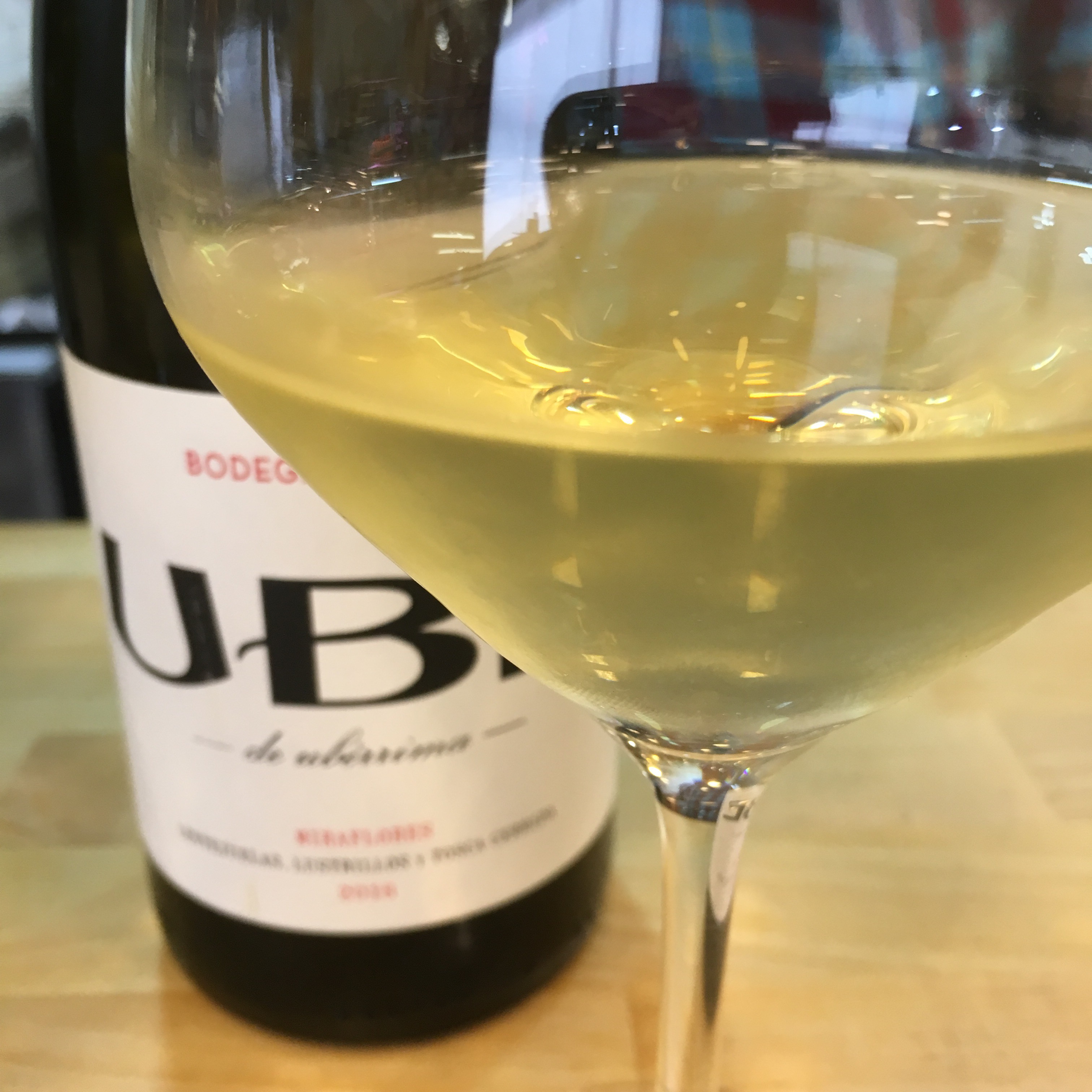
UBE Miraflores 2016

UBE (de Uberrima) is the white wine brand of Ramiro Ibañez’s Cota 45 and he now boasts not one but two wines, shortly to be three.

The first wine is now known as the Carrascal – after the pago in Sanlucar from whence it comes. It is wine from a specific vineyard of old vines and three kinds of palomino. This second wine is from neighbouring Miraflores, like Carrascal an atlantic pago (and probably the most famous of the Sanlucar pagos) and specifically from a combination of five selected vines in Miraflores Alto and Miraflores Bajo. (The third wine, due to be released in September, and is from palomino grown on Pago Mahina, a river influence pago with a huge concentration of diatoms.)

What they have in common, and this is no surprise coming from the creator of the Pitijopos and the manzanilla de añada, amongst others, is their focus on expressing vintage and terroir. Unfortunately they also have in common the fact that production is tiny: 1,000 bottles of each of the Carrascal and Mahina, 3,000 of this Miraflores.

The wine itself starts off as austere with minerals and then grows with herbal, vegetable characteristics. As you can see it is a pale, slightly greenish straw in colour. The nose is austere and mineral first with some savoury stewy herbs in the background like a kitchen far away. On the palate it is fine in texture, nice acidity first up and after that fresh start rather than fruit there is a herbal, almost meaty (in flavour) sapidity to it, fading to a fine finish with lots of minerals.

By comparison to the Carrascal 2015 (a different vintage and pago and a year longer in the barrel) it maybe has a touch less mineral edge, but even so it is a serious, mineral wine and no shortage of flavour.

UBE Carrascal 2015 

The third vintage (at least that I have tried) of this imperious white wine from Sanlucar. (You can see my notes from the 2013 here and here and the 2014 here, here and here.) It comes from some very special vines and vineyards in Carrascal (Sanlucar) and although it is simple enough to explain (it is an unfortified white wine) it is nevertheless one of the more challenging wines you will come across. It is made by Ramiro Ibañez’s Cota 45 and a total of 1,000 bottles were made. 

These are elegant, mineral wines, and I associate them with aromas and flavours of citrus and mountain herbs. By comparison to previous years, the 2015 has a greater concentration of citrus fruit, surprising acidity and a nice buzz first up – a chalky tingle on the gums and tongue. Then the flavours grow in intensity and are herbal and savoury. The citrus flavours persist and turn slightly bitter like gooseberries. 

As I was drinking this – minding my own business at the bar of Territorio Era, a passing genius chose to come and explain to me that there was no point drinking palomino, that it lacked expression and was  only good as solera fodder. I just smiled and looked around for the hidden camera. I have said it before, if there is any argument about palomino and expression, UBE is the answer. 

Fino Williams Colección Añadas 2009 – Saca de February 2017

They are back, the Williams Coleccion Añadas by Williams & Humbert, probably the leading champions of añada wines in el marco. Here by the glass (or two) at Territorio Era.

And this new saca is even more like the old one – maybe even better. The gorgeous colour, the sweet hazelnut nose and the sweet/salty combination in the palate – incredible hazelnut sweetness tempered with a mineral saltiness – and a zingy finish,  which again leaves a long nutty sweetness in its wake.

Not comparable to other finos, or even amontillados, that I can think of (except the ones in its own family of course). A unique wine and a fantastic advert for finos de añada.

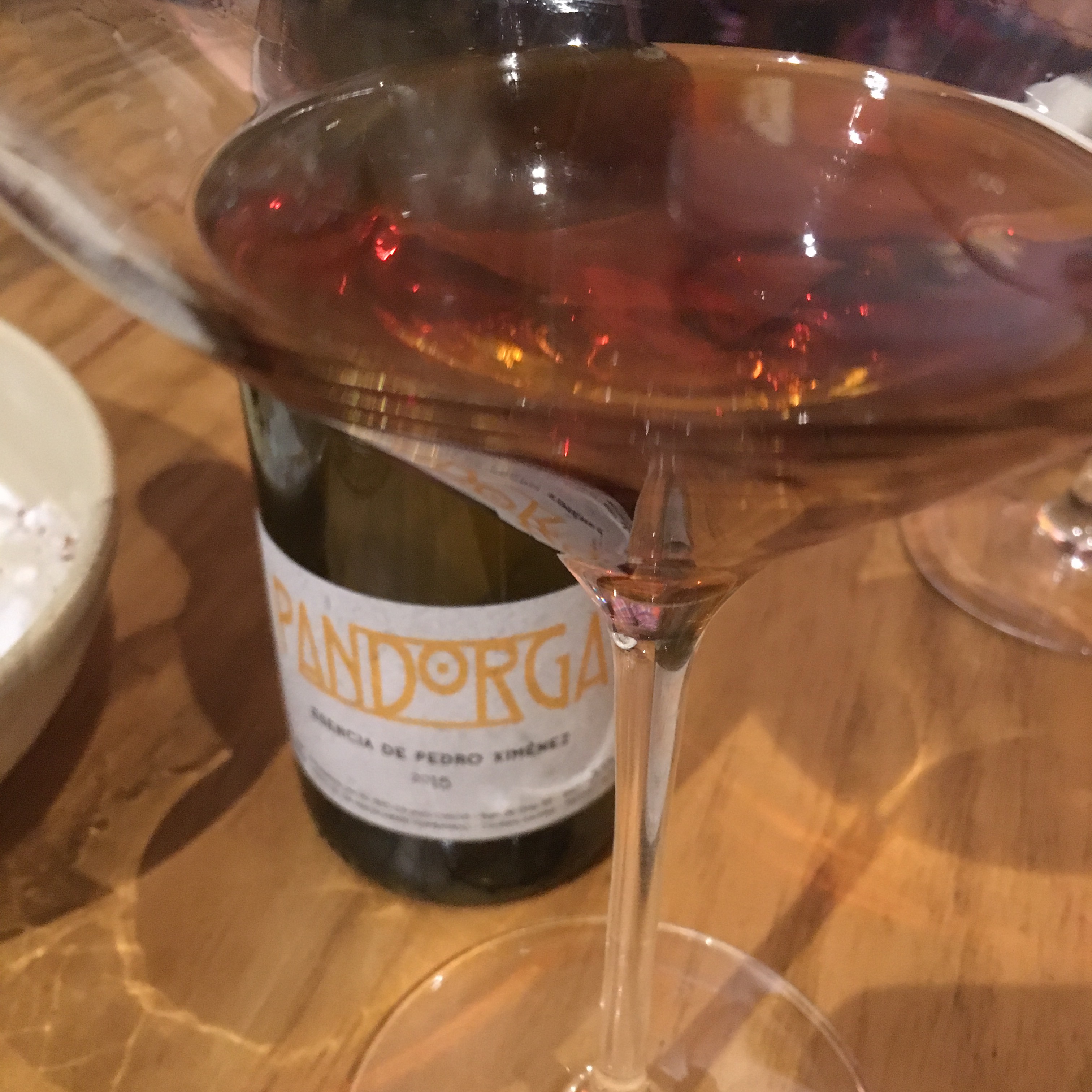
Pandorga 2015 – Essencia de Pedro Ximenez

Here is a wine you won’t see much of, if indeed it is a wine. 

It is the second edition of Ramiro Ibañez’s Pandorga pedro ximenez and, like the first, seeks to express the characteristics of the fruit and the añada – a young wine fermented in bota and no attempt to “correct” the effects of the growing season on the fruit. In most cases of industrial production a cool drying season might be corrected by more days of asoleo and fermentation at higher temperature, and a hot season with fewer days and more controlled temperatures. Ramiro’s approach is pro-cyclical: the effects of the cooler 2014 season given very little asoleo and accentuated by the naturally lower temperatures of fermentation. By comparison the hotter 2015 growing season meant more asoleo and a warmer fermentation. The result is an extraordinary, a tiny amount (and thus sold in tiny bottles) of nectar with 520g/l of sugar and only 5% alcohol – too little to allow it to be labelled wine. 

And if the 2014 was apricot jam this is fresh, ripe apricot juice. Just a touch of acidity to keep it honest, but the words that spring to mind are along the lines of ambrosia, nectar, sherbet and similar. 

Really an exceptional thing. I have my own tiny bottle at home, but we enjoyed this at the end of a sensational dinner at Angelita. (And what other restaurant can offer you wines as rare and unique as this?) 

Manzanilla de añada 2012 – 2/11 – May 2016

The visit of some good friends gave me an excuse to open this special manzanilla and see how it was getting on in the bottle after nearly a year. It is a vintage or “de añada” manzanilla from palomino fino harvested in 2012, fermented and fortified to around 15% and set aside for “static ageing” in individual botas instead of in a solera. There were 11 botas in total and this is the second bota to be bottled (hence the 2/11), on this occasion with around three and a half years under flor.

It is a lovely crystal clear gold colour with just a hint of green to it – exuding fresh green apple, and it did indeed have a sweetness to the nose and at the beginning of the palate, but more like the slight sweetness of fresh almonds, but then some spicey and bitter grapefruit notes that I associate with the time in the bottle (at least I don’t remember it quite as bitter). An exuberantly zingy mouthful and also quite full bodied, maybe even a touch heavy at the back end.

My feeling, looking back at my notes from July, October and November last year is that I enjoyed it a little more back then, particularly in November, and that this may be a touch quieter even only four months later. Unfortunately only two bottles left and one is being saved for the great vertical of 2026, but if I happen upon a stash in the next few months I may need to have another dip.


Ancestral Las Alegrias del Carrascal 2015  

Was on a mission for fish and chips at La Berenjena de Chamberi (thanks to Victor de la Serna, my personal fish and chip consultant) and observed that they had a few nice wines on the winelist – Fino Arroyuelo, el Fossi and a couple of other goodies, and most eye-catchingly this. On another day I would have put to the test my theory about manzanilla and fish and chips but couldn’t resist some Sanlúcar bubbles.

By Alba Viticultores, it is a 100% palomino fino from a vineyard by the name of Las Alegrias on the Pago Carrascal in Sanlucar. Harvested and fermented in 2015 and this one was disgorged in October 2016.

I was having too much fun to take notes but from memory it had a little bit of reduction first up but then a very pleasant nose of herbal apple sweetness and fresh grass. On the palate it was dry, with muted appley fruit, salinity, maybe a suggestion of creaminess and a slightly bitter, carbonic finish.

Very pleasant all around – will have to come back to try the manzanilla and chips another day.

CGWF17: Part 4 – the Barajuelas 

I have written about these wines before but would never miss the opportunity to have another dig, so when I heard the capsule coming off from across the room – even early doors – my feet seemed to move by themselves.

First the Fino 2013, a wine with a massive range from low to high, with a yeasty fruity nose, big intense concentrated fruit, sharp, deep salinity and a crisp finish. A fruit full fino, or a superpotent white wine with added mineral kick. Absolute belter whatever you call it.

Second, the as yet unreleased Oloroso 2013 – here the minerals are turned down a touch but if the fino was full bodied this is immense. That oxidation is still getting to grips with the wine – not caramel juice here just concentrated fruit with a bit of burn to it. Above all there is an impression of solidity about this wine. Love it and hope it will be released soon.

Not a bad breakfast by any standards. 

Los Pagos de Callejuela Vinos

A real treat today courtesy of the guys at Montenegro at whose brilliant event I met, at long last, the Blanco brothers from Callejuela Vinos and was given a sneak peek at their latest project – three pago specific young palomino wines.  

The wines are from Callejuela (Sanlucar, by the Guadalquivir), Añina and Macharnudo and really expressed those origins, with a clear step in structure and body from wine to wine. With only six months in bota they were fresh and aromatic and frankly very promising indeed. 

Three wines to look out for – there was talk of them being released in May.