Surtopia – Cota 45 – Atún – Langostino

The sherry event of the summer here in Madrid – five dishes and five wines, with José Calleja of Surtopia providing the food and Ramiro Ibañez of Cota 45 providing the wines. In fact ten dishes and ten wines, with tuna on July 13 and langostinos on July 14 (lunch and dinner).

No clues yet about the wines involved but I have been told that I haven’t tried most of them (I find it hard to believe) and that they include some “massive cucumbers” (pepinazos gordos): you will have to take my word for it but this is a good thing.

I know I will be there – will be absolutely cracking. 

Mons Urium in Taberna Palo Cortado

Another great night yesterday in Taberna Palo Cortado, this time to taste the wines of Bodegas Urium, a small, family run bodega that is one of the newest faces in Jerez but to judge from last night one of the most passionate.

The bodega has been around for “centuries”, formerly, as an almacenista (one of the “faceless”  winemakers of Jerez, as one of the guys put it last night) and is located on Calle Muro, aka “Wall Street”. The bodega is run by Alonso and Rocio Ruiz, a father and daughter team from a family from the town of Moguer, in Huelva (known to the Romans as “Mons Urium”, from whence the name). Alonso fulfilled a lifelong dream – learnt in turn from his own father – when they acquired the bodega in 2009, acquiring not only a historic bodega but, more importantly, its contents. In total around 500 botas of wines, many of them very old and, to judge by last night, very fine.

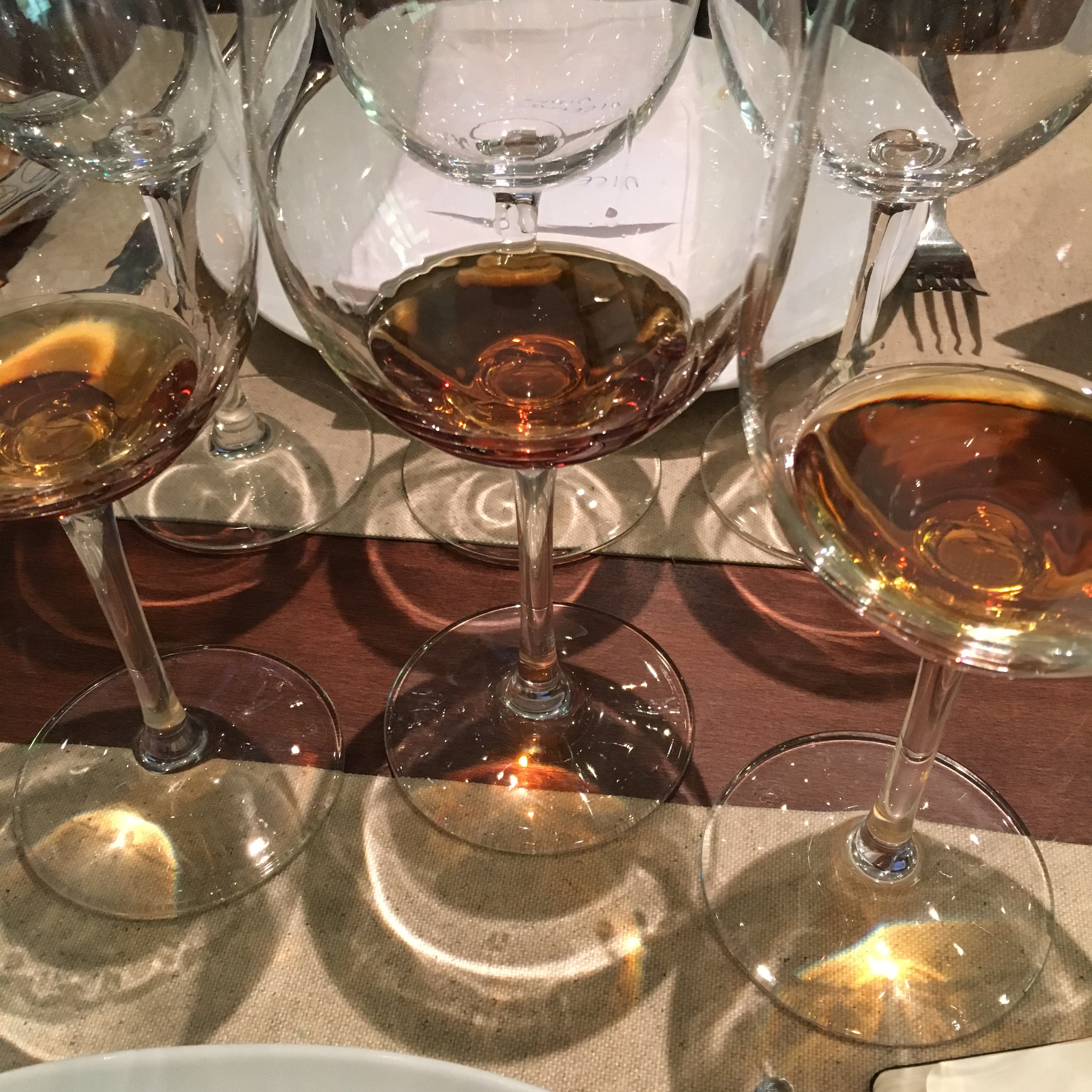
Last night we had five wines: a very nice fino en rama – fruitful, yeasty and juicy – with around eight years under flor, and four VORS wines with an average age of 45 years – the amontillado, oloroso and palo cortado, pictured above, and a very youthful tasting 45 year old Pedro Ximenez.  Five excellent wines – I particularly liked the fino and the punchy, saline oloroso, but the amontillado was elegant and smokey and the palo cortado had a bit of spirit to it.

More importantly, we also had the chance to meet Rocio and one got a clear impression of a project that was moving in the right direction. Having trained with none other than Luis Perez she has a very uncluttered, balanced approach to winemaking that was as free from blarney as it was from unnecessary formalism: wine making with wine at its center, with the goal of making wine that people can drink. It was fascinating to hear her talk about the gradual progress in tasting, assessing and classifying mostos and wines, and the efforts to imprint their own style on the old “jewels” they had inherited. It all sounded like hard work, but despite that there was a lot of laughter and enthusiasm that was captivating.

All in all, another terrific evening in Taberna Palo Cortado and a real pleasure to meet one of the young winemakers pushing the region forward.


Vinoble 2016

Very sad to be missing out on Vinoble 2016, the International Exhibition of “Noble Wines” (which they define as fortified, dessert and natural sweet wines) organized every two years in Jerez. (I must say I find the name a little ironic given the relatively minor importance the vines are generally given in the elaboration of these wines, but maybe it is a good omen for the future.) According to the website the event will include 900 wines from all around the world, including Australia, Austria, Canada, Chile, Croatia, Cyprus, France, Germany, Greece, Hungary, Italy, Portugal, Slovenia, South Africa, Spain (of course) Switzerland, and Uruguay.

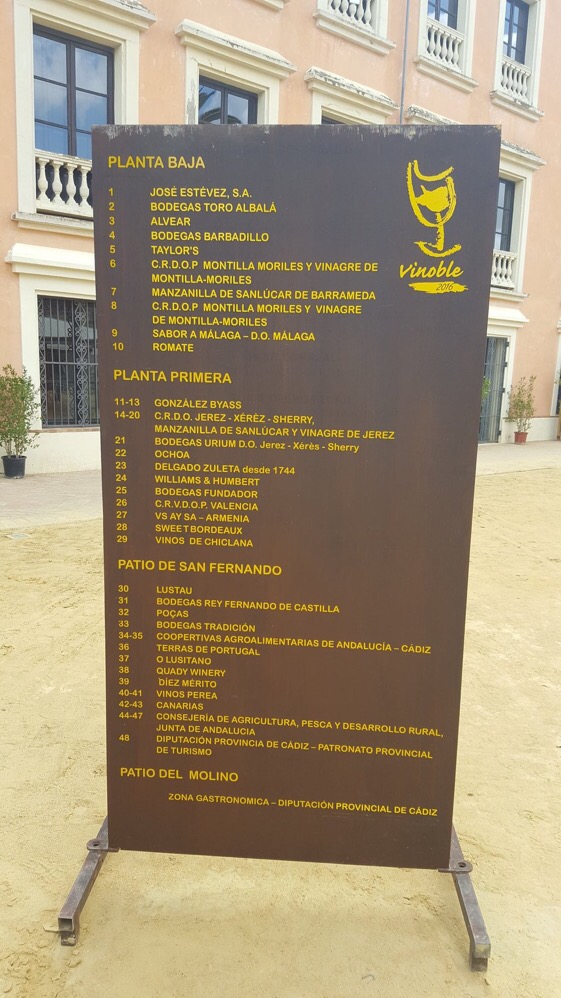
It must be said the board above (photo borrowed from the TL of @VinosSanlucar – the Bodegas Artesanas de Sanlucar de Barrameda) looks a bit more Iberian dominated. I count 34 exhibitors of which 26 are fundamentally dedicated to spanish wines and institutions, 4 to portuguese (Taylors, Poças, O Lusitano, and Terras do Portugal), one is a distributor of wines from all over (Vinos Perea) and there are three from the “ROW” (Sweetbordeaux (France), VS AY SA (Romania), and Quady (USA)). There are, as you would expect, plenty of the wines of Jerez, Sanlucar, el Puerto de Santa Maria, Chiclana, and Montilla Moriles in attendance.

It is a trade gathering and the emphasis is on international buyers and professional events – there are some very high quality tastings arranged during the course of the Exhibition itself. And that is just the main program. As so often with these International Exhibitions there is also a lot going on around the “fringe” – a lot of cracking parties, bodega visits, dinners, lunches and all sorts have been organized.

And the truth is I am sad not to be down there. I have a love-hate relationship with these big gatherings. They are really no way to get to know a wine in my view.  Neither am I from the trade. Nevertheless I had intended to go and had my work not intervened would have done. It would have been a fantastic opportunity to meet some of the winemakers I admire, see some friends again and celebrate their successes, find out what is new – to be quite honest I am intrigued by the wines from the Canary Islands and Valencia that will be on show, not to mention the “internationals”- and just generally see what is happening.

So from stuck in Madrid, with a heavy heart, I wish all of those down in Jerez a fantastic few days. I sincerely hope you sell the traditional wines of Southern Spain to buyers around the world and I look forward to seeing my twitter timeline fill with photos of glasses clinking, ice buckets, rare bottles, suelfies, and all the rest. Cheers!


Jerez: a look forward

W&H-LUIS PEREZ 3

Since 2014 and the celebration of Jerez as European capital of wine, Williams & Humbert, has organized a “Ciclo de Conferencias” and on Friday the guest speaker was one of the most revered voices in Spanish winemaking: Luis Perez Rodriguez (on the left in the photo above, with Jesús Medina, director of W&H), a renowned academic and professional, formerly of the legendary Bodegas Domecq, now of Bodegas Luis Pérez, and multiple prize winner for his enological research. I have never met him personally, but people that I consider to be authorities cite this man as “the” authority. Indeed, just this weekend I was sent a link to this account of the conference with the explanation that this was “the person with the most complete knowledge of Jerez by a considerable distance”.

So it is no surprise to hear that over 150 turned up to hear what he had to say – I wish I had been one of them (in fact I missed two great events this week – Alvaro Giron Sierra gave one of his tours de force in Barcelona on Tuesday). As it is, I have only seen the press stories and the press release that was kindly sent to me by Williams & Humbert but from what I have seen some excellent points were made. As such, since I have found no translation I have had a stab at my own below – not as elegant as Don Luis’ original phrasing but one does one’s best .

W&H-LUIS PEREZ 2

As the title above suggests, the main thrust of the presentation was forward looking, and focussed on how to win greater value for the wines of the region, although interestingly he appears also to have addressed one of the issues that I find most fascinating about the region: the dichotomy between the vines and vineyards, on the one hand, and the “high walls” of the bodegas, on the other.

The issue is summarized elegantly: “since no other wine exists that evolves as much during the ageing process as does a jerez wine, it is easy to see that the world of the bodegas has such a dominant role that it beomes very difficult to see beyond its walls”.

It is clear that, for Don Luis, it would be a mistake to focus exclusively on the bodegas. “The reality of Jerez includes a patrimony that goes beyond the bodegas and as long as three thousand years ago captivated the visiting phoenicians: the vineyards, and specifically the pagos of Albariza”. As he put it “one cannot understand the concept of a wine without its vine” a reality which has been “relegated in the last four decades and which must be recovered”.

As examples of the characteristics of the vine and the fruit being given less importance in recent times Don Luis talked about processes that have lead to a “greater standardization” of wines. Specifically mentioned are the belief that finos de jerez have lost their distinctive characteristics and become more similar to the traditional style of manzanillas (the brilliant verb “amanzanillamiento”) or the way that clarification and stabilization of wines had, until the recent popularity of en rama bottlings, lead to wines that were both more expensive to make and, ironically, less distinctive and perceived to be of lower quality.

For Don Luis, giving greater importance to the vines and vineyards of Jerez would give the wines “characteristics that in today’s world would add great value”, making reference to “winegrowing areas that not only value the character of the vines of the pago but also the even more specific qualities of the precise vineyard” and urging the sector to consider “a classification that differentiates, without creating a manichean black and white, so that the winemaker can characterize his wine harmonizing terroir and crianza”.

He also went on to add that “Jerez today has a strategic opportunity to start such a remodelling. We are talking about a denominación de origen whose current vineyards are more than 7.000 hectares, a surface area that permits it to aspire to the very highest levels of qualiy. Its location makes possible a diversity and a singularity that is very attractive and would permit the recovery of some the varieties of Palomino lost during the 20th Century. This would lead to the production of wines with a real vocation to express terroir”. And returning to his key point, “giving importance to the vine in the wine of jerez, would mean giving that wine characteristics that in today’s world would add significantly to its value.”

The professor went on to make a number of other interesting points about the interplay between science and nature, viticulture and enology, and about the iconic, evocative power of wine in general and the wines of Jerez in particular. For those I can only refer you to the official press release (to which I cannot find a link) and other accounts like the one in Diario de Jerez linked above. But these thoughts on terroir and the characteristics that terroir can imprint on the wines strike me as so important that I wanted to share them.

And although Don Luis appears to have stuck to his resolution to look to the future, the dichotomy that he rightly points out between the vineyard and the bodega seems to me to be a subject that deserves some serious attention. There is no doubt about the miracles that can be achieved in the bodega, and the solera, but neither is there any doubt in my mind of the unique characteristics of wines from different vineyards, and for much of the time it seems that the two camps in Don Luis’ dichotomy are on opposite sides and pulling in different directions, a fight which given the relative size of the parties can only result in the dominance of the bodegas. However, and precisely because of that muscle it is those bodegas that stand most to gain, as this thoughtful conference elegantly points out, and if the renaissance of the region is to prove lasting and real then surely those bodegas will play a leading role.

Even if he were not the great authority on the wines of Jerez and Sanlucar that he undoubtedly is, I believe that the evidence of wine regions worldwide, in every style and tradition, proves Don Luis  correct in his analysis, and I fervently hope that the bodegas, who are more important than they perhaps realize, hear the call.



El salon de los vinos generosos

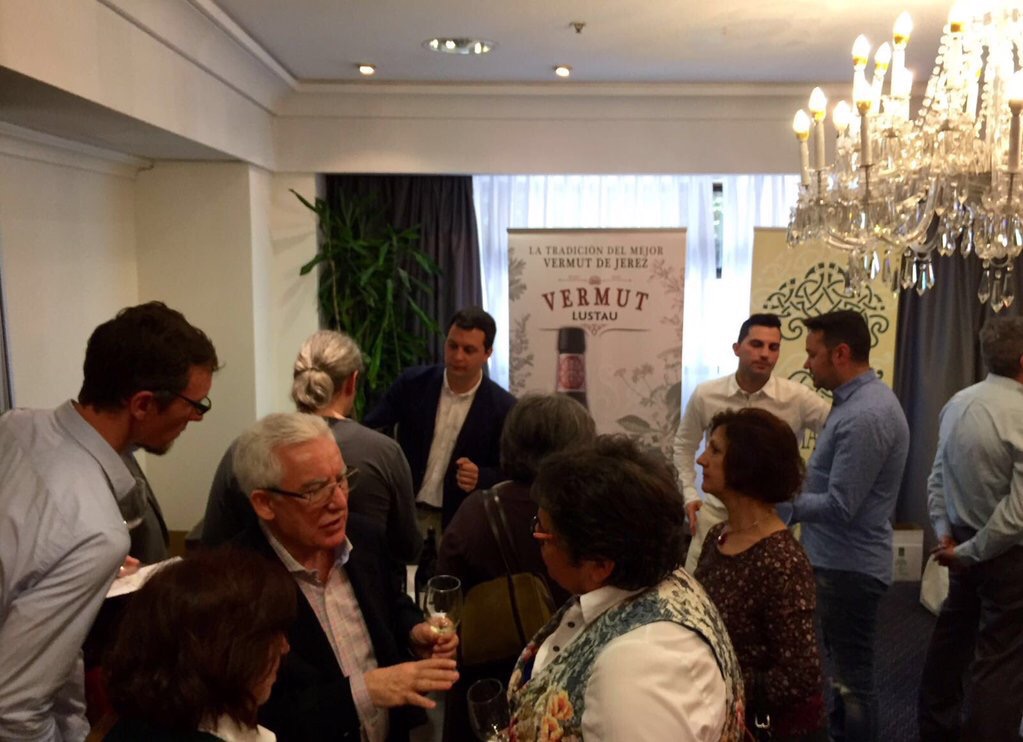
In the many hours that I was there yesterday I completely failed to take a picture of the Salon, the wall to wall stands of top class bodegas, the throngs of happy, thirsty professionals and “semi professionals” or the many fellow bloggers, tweeters and enthusiasts I finally had the pleasure of meeting in the flesh. I never claimed to be any good at this but, really, not a single photo. Neither did I manage, having scrawled down several pages of increasingly unintelligible notes, to bring said notes home. No clue what happened to them, none at all. It is an astonishing new blogging low. (Above graphic aid sent over by the helpful chaps at Lustau – many thanks guys.)

You see (not that it is an excuse or an attempt at one) for large parts of yesterday’s brilliant event in Madrid  I had what is known as a “bit of a buzz on”. (At one stage I (jokingly) offered to defend the honour of the Lustau Fino del Puerto via a fist fight in the carpark.) I did in fact spit out a fair few of the glasses of wine that I was offered. In a couple of particularly egregious cases I even tipped them straight into the spittoon. But these things do not come naturally to me and by far the majority of a very large number of glasses found their way into my bloodstream. It is my great weakness and one I am acutely conscious of.

In my defense, it was a fantastic, convivial occasion and the wines on offer were brilliant, far to good for spitting out. Of the wines that were new to me the standouts were the latest sacas of Sacristia AB Manzanilla and Oloroso; the new version of the Fino Capataz and the Abuelo Diego Palo Cortado from Alvear; the 2001 Historic Vintage Oloroso from Williams & Humbert;  the unbelievably high quality 1955 Solera Cincuentanaria series by Perez Barquero – especially the Amontillado-; Valdespino’s “Coliseo”; and the Sanchez Romate Old & Plus Oloroso, to name just a few. And those are just the novelties. Amongst the top class wines I consider old friends there were: Gonzalez Byass’ Tio Pepe en rama (3 weeks after bottling), the Cuatro Palmas and the 1987 Palo Cortado de Añada; the new saca of Goya XL by Delgado Zuleta; the majestic Fino del Puerto and Fino del Puerto en rama by Lustau;  the Toro Albala 1931 Convent Selección; the Barbadillo Pastora and Solear en Rama; the Tradicion Fino … Frankly,  the list could go on and on and on.

A lot of fantastic wines – too many and too good, really. And I say that because great fun and top class as it was, one of the abiding memories of the salon (other than the sneaking suspicion that once again I made a spectacle of myself), is of the senses being utterly overwhelmed.

At the outset I made a concerted attempt to try the manzanillas and finos against each other, retreating to the centre of the dance floor to take notes and sip in peace, and that comparison was extremely revealing. But after a little while the structured approach broke down under the sheer variety of tempting wines, the competing temptation to try wines across the range of a bodega (like Barbadillo’s trio of Solear, En Rama and Pastora, and Valdespino’s wines from Macharnudo Alto), and the kindness and attention of the people from the bodegas (too many to name here, but I am grateful to all of them). Add to that the chance encounters with acquaintances of every kind and the desire to share a glass with them and chaos ensues. As a result over the course of the day I probably tried in excess of a hundred and fifty different wines of every different style in an increasingly haphazard order: at one point I think I went from a fifty year old PX to a fino, to a vermouth, and then another fino – bonkers.

In addition to the chaotic approach, I honestly think it is unfair on wines of this quality and these qualities to taste such large numbers at a time. Even with an unfortified wine I believe you need to take time to appreciate it – look at it, enjoy the aroma, swirl it around, savour it, think hard about the different stages of its journey across the tongue, past the tonsils and down the neck. With the exceptionally complex wines of Jerez and Sanlucar I think you need even more time to appreciate them: you are stretching your taste buds and memories to the limits in every direction, and if you do it too quickly you can do yourself mischief. In fact on reflection, even with my notes I would struggle to make a sensible write up with more than impressions of the majority. And if I could I am not sure how fair it would be: how can I realistically compare a fino I have tried after an 80 year old amontillado?

But even if the salon was not the ideal location for appreciating these wines it was an absolutely priceless opportunity to try them, to witness the burgeoning interest in them, to meet some real experts and more importantly even, see old and new friends from all over. Twitter, the blog, and all the rest are really miraculous things but you cannot beat actually meeting people and offering to fight them in person … (hangs head in shame).

So bravo to the organizers of the Salon – Calduch Comunicación – and bravo to the bodegas for turning out in such numbers and with such fantastic wines. It really was a pleasure.


Cata de Toro Albala in Taberna Palo Cortado

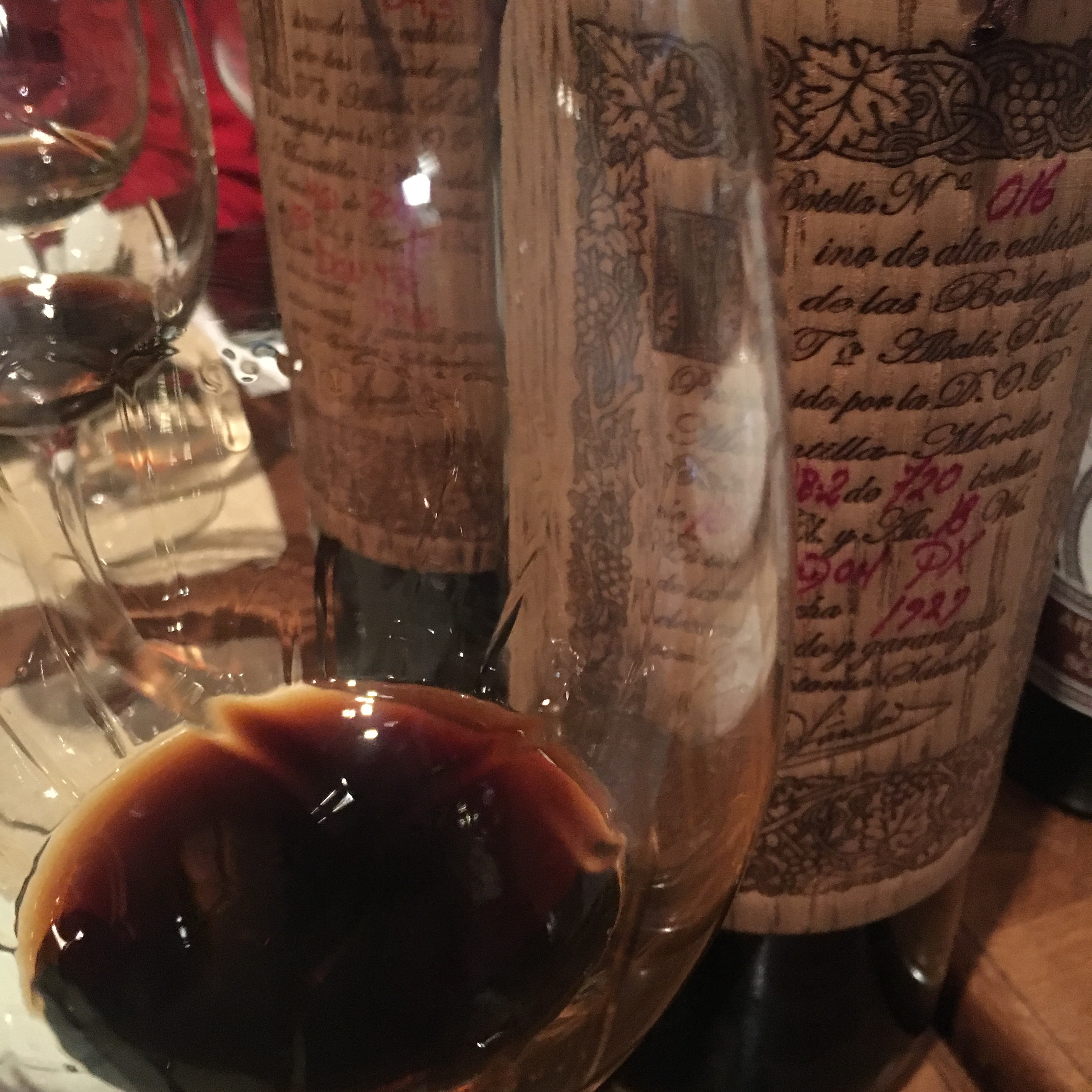
It has been quite a week and tonight was special – a chance to try some really great wines from Toro Albala, side by side, in really knowledgeable company and in sherry headquarters here in Madrid. Frankly amazing wines – 1951 Marques de Poley Amontillado, 1965 Don PX Selección, and the Don PX Convento from 1955, 1931 and 1929.

It was an awesome group of wines and the variation was really intriguing. Probably the two most memorable aspects were the minerals and zing of the 1965 – real salt and pepper – and the big contrast with the 1955 that followed it – nose like a jammy Chateauneuf du Pape and a lighter, citrus and sweetness palate.

And I mentioned knowledgeable company – none other than Antonio Barbadillo of Sacristia AB, amongst others. Made for a very entertaining and educational evening – some of the things we discussed are stilling buzzing around in the noggin and may one day appear as blog posts.

There were, however, two jarring notes. First, the central role played by “Parker Points” in much of the commentary. This is a bodega that prints the points on the label, of course, but even so it was very odd to focus on the numerical values so often and to such an extent. Second, there was a bit too much blarney for my tastes: too much of the old “I wear this one as aftershave” and general references to tears and sighs and the like. It is a shame because the technical skill and biological wonder behind wines that have aged between 51 and 87 years got left out somewhat. (Don’t get me wrong, it was very entertaining.)

Once we finished these really big beasts we tucked into some fantastic pintxos, cheese plates, pates and the like – top drawer – accompanied by the Dos Claveles, an unfortified pedro ximenez white wine from Toro Albala, and the Fino Electrico (named afer the electricity substation net to the bodega, by all accounts). Again very nice stuff – but it was a difficult transition after the wines that had gone before, to say the least (although if we had stayed on the other wines I might have ended up staying all night).

A wonderful night that was over all too quickly.

Salón de los Vinos Generosos

CiAmiVuWEAAXdzj

Sherry fever unabated here in Madrid: yet another event to report on.

This coming Thursday at the Hotel Miguel Angel (Salones Renacimiento) from 12:00 to 15:00 and from 17:00 to 21:00 – with a pretty impressive lineup of bodegas too. All the details are here on the web but as you can see, Barbadillo, Tradicion, Delgado Zuleta, Díez Mérito, González Byass, Estévez, Lustau, Fernando de Castilla, Sanchez Romate and Williams & Humbert will all be there.

Please note: the event is aimed at professionals (although some of us amateurs have also received invitations).


Blind tasting and more in Barcelona

There is a lot going on these days. The problem this week is that it is all happening in Barcelona.

Cataporparejas

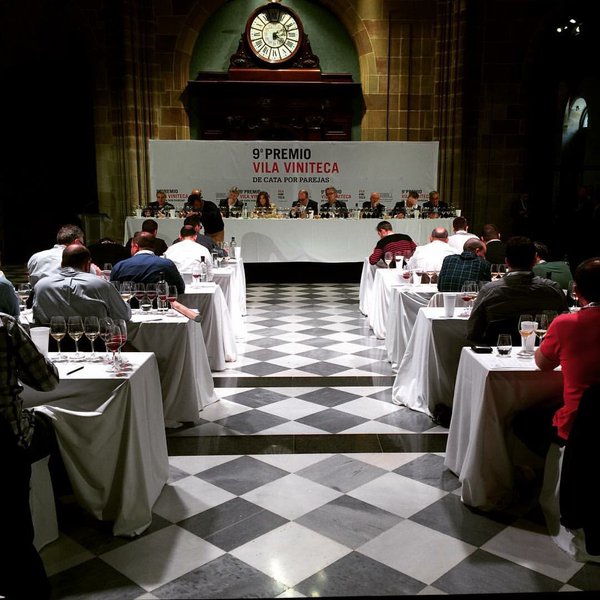
All kicked off yesterday with the 9th edition of Vila Viniteca’s “Cata por Parejas” (tasting in pairs). As you can imagine, it consists of the pairs being given seven wines blind (two white, three red and two “specials” such as bubbles or fortified wines) and asked to identify country, zone, cepage, vintage, maker and name, with tasting notes used as tie breakers. There are two rounds – a qualification stage and a grand final of only 10 pairs – and there is no less than €30,000 in prize money – €20,000, €7,000 and €3,000.

I have no doubt that a contest like this is the best test of wine tasting skills – the knowledge of the characteristics of wines, grapes, makers and vintages and the ability to recognize and identify them – that there is. I personally have never been much cop at blind tasting (to be fair on this blog I only talk about my fails – there have been some successes) because I just do not know enough about the wines I drink, and although recently I have notched up a few in sherries that would only have helped me – maybe – in one of the seven wines (or maybe not, some pretty good tasters up there managed to miss the Inocente, no less).

And this, although only nine years old, is about as prestigious a competition as there is in Spain – previous editions have been won by the likes of Jesus Barquin and Luis Gutierrez. This year the competition was even stiffer than ever: 130 pairs of tasters, compared to  120 in previous years, with more pairs were added given the phenomenal interest, and to judge by my twitter timeline half of Spain was up there yesterday. So frankly hats off to some of the lads for a really great result yesterday: the pair formed by Colectivo Decantado and Jimmy Bubbles bringing home 3rd place (at the first time of asking).

Then today Vila Viniteca follow it up with another brilliant event: La Musica del Vi. A biennial gathering of 180 really top class bodegas:

4Kilos • Aalto • Abadía Retuerta • Abel Mendoza • Adega Pombal A Lanzada • Alemany i Corrio • Alfredo Arribas • Allende • Alonso del Yerro • Alta Vista • Altamana • Alvaro Palacios • Alzinger • Artadi • Artazu • Astrales • Atalayas de Golbán • Batlliu de Sort • Barbeito • Belondrade • Berta • Bodega Contador • Bodegas Antídoto • Bott-Geyl • Ca N’Estruc • Cámbrico • Camino del Norte • Can Grau Vell • Can Ràfols dels Caus • Capçanes • Cara Nord • Castaño • Castell del Remei • Castillo de Monjardín • Celler Credo • Celler del Roure • Cepa 21 • Ceretto • Cérvoles • Chandon de Briailles • Château Cap de Faugères • Château Climens • Château de Laubade • Château Dereszla • Château Faugères • Château Fosse-Sèche • Château-Fuissé • Château Lafaurie-Peyraguey • Château Latour • Château Rocheyron • Clos d’Agon • Clos de Mez • Clos del Portal • Clos des Fées • Clos Erasmus • Clos Puy Arnaud • Colet-Navazos • Comando G • Còsmic • Daniel Landi • Delamotte • Descendientes de J. Palacios • Domaine Andrée • Domaine d’Eugénie • Domaine de Bellivière • Domaine de Fontbonau • Domaine de l’Ecu • Domaine de la Janasse • Domaine de Marcoux • Domaine de Montcy • Domaine de Pallus • Domaine François Chidaine • Domaine Vacheron • Domaine Zind-Humbrecht • Domaines Landron • Domaines Lupier • Dominio de Atauta • Dominio de Es • Dominio del Águila • Dominio do Bibei • Dupont • Eilan Gillan • El Escocés Volante • El Jardín de Lucía • El Perro Verde • El Regajal • El Sequé • Emilio Moro • Emilio Rojo • Enric Soler • Equipo Navazos • Espelt • Etter • Eulogio Pomares • Família Nin-Ortiz • Fenomenal • Finca Nueva • Finca Sandoval • Finca Villacreces • Guitián • Hacienda Monasterio • Hugas de Batlle • Izadi • J.J. Confuron • Jaboulet • Jiménez-Landi • Joseph Drouhin • K5 Argiñano • Kreydenweiss • L’Origan • La Locomotora • La Maison Romane • Lagar de Sabariz  • Las Rocas de San Alejandro • Le Vieux Donjon • Léopold Gourmel • Les Cousins • Llopart • Lorenzo Cachazo • Lustau • Macizo • Maculan • Màquina & Tabla • Marcel Deiss • Marie et Frédéric Chauffray • Marqués de Murrieta • Martín Faixó • Mas Alta • Mas Doix • Mas Martinet • Mas Oller • Mas Romeu • Mauro • Maurodos • Mikulski • Mineral del Montsant • Movia • Muga • Newton Johnson • Niepoort • Numanthia • Orben • Ossian • Ostatu • Pago de Carraovejas • Pagos de Híbera • Pagos de María • Paisajes • Palacios Remondo • Pardas • Passopisciaro • Pazo Barrantes • Pazo de Señoráns • Pingus • Pittacum • Portal del Montsant • Prieto Pariente • Psi • Quinta Sardonia • Rafael Palacios • Raventós i Blanc • Recaredo • Remelluri • Roberto Voerzio • Sa Forana • Salon • Sanclodio • Schloss Gobelsburg • Sei Solo • Señorío de San Vicente • Sicus • Sierra Cantabria • Sindicat La Figuera • Solabal • Sospechoso • Tardieu-Laurent • Telmo Rodríguez • Tenuta di Trinoro • Terras Gauda • Teso La Monja • Thanisch • Tomàs Cusiné • Torelló • Traslanzas • Trimbach • Uvas Felices • Venta las Vacas • Venus la Universal • Vetus • Vignoble du Rêveur • Vincent Girardin • Vins de Terrer • Viña al Lado de la Casa • Viña del Albaricoque • Viñedos de Páganos • Viñedos Sierra Cantabria • Vizcarra • Zárate.

Just imagine being stuck in the office in Madrid while your friends are tucking into that lot: it would be enough to make a lesser blogger weep.

And for those with exceptional stamina and/or time on their hands over the next few days there is  Alimentaria, a massive food industry conference including an excellent series of wine related events with the dubious moniker of Vinorum Think. The program has some really top quality tastings lead by the likes of Luis Gutierrez, Guillermo Cruz, Jose Penin (original author of one of Spain’s leading wine guides), Andres Proensa (original author of the other one), and Victor de la Serna and Juancho Asenjo of ElMundoVino. There are some pretty good sherries in amongst them (including El Cerro, beloved of this parish), although the highlight would surely be the masterclass by Cesar Saldaña and Jesus Barquin on Tuesday evening – just look at that lineup of sherries.


Feria de vinos: Jerez del Siglo XXI


Had a pretty enjoyable afternoon yesterday in Lavinia tasting some nice wines from the likes of Emilio Hidalgo, Tradicion, Fernando de Castilla, Valdespino, Barbadillo, Gonzalez Byass, La Sacristia AB, Diez Merito, Yuste, Maestro Sierra and Baron. There may have been more but memories and notes are somewhat blurred (there was definitely a new bodega with only a palo cortado but the name has gone) – and not for the first time.

Despite the title reference to the 21st century the emphasis was old school/old favourites (notwithstanding some happy discoveries like the manzanilla La Kika). It was pretty rammed by the end but early doors I was able to try the Guita en rama (October 2015), Solear en rama (Winter 2015), Sacristia AB manzanilla en rama (Second saca of 2015), and Fernando de Castilla en rama (December 2015) in quick succession and with the Pastora manzanilla pasada en rama (2015, and which had much less of the apple profile this time, which I was told could have to do with the time in bottle). Very interesting comparison across those wines: a lot of the characteristics that I had remembered were there. I was also able to compare the Sacristia AB manzanilla (from Yuste) against la Kika (also Yuste) then the Tradicion Fino (November 2015) and Panesa, before moving up the gears with marvels like the Tresillo, the Fino Imperial, the Antique oloroso from Fernando de Castilla and the 2014 amontillado and 2015 oloroso by Sacristia AB.

Probably the highlight was trying three Panesa’s bottled in different years – a 2015, 2014 and 2013 (not labelled as such but – the differences were subtle but interesting. Of course it is  debatable whether the differences are due to the wine coming out different in the sacas or the time in the bottle – most likely a bit of both – but at least yesterday the 2013 seemed to have a bit more expression to it.

Unfortunately my methodical approach meant I missed out on some beauties as the horde of patrons consumed all the older and sweeter wines – will have to come back for the Tradicion PX and cream – but by the end I was a few over the eight and over an hour late home so maybe it is just as well.

Overall a cracking event and kudos to Lavinia for organizing. Was also a good opportunity to see some old friends – was great to see Cesar Martin from Lakasa – and meet some top characters from the world of wine and blogosphere. Look forward to the next one!

Feria de vinos, Jerez del siglo XXI, Lavinia Madrid

New sherry based event alert – next Friday afternoon Lavinia in Ortega y Gasset will be hosting a wine fair called “Jerez of the XXIst century” – which looks very promising.

You can sign-up here and although there doesn’t seem to be a lot of detail I am told there will be 15 top class bodegas represented (the only one I know for sure is Emilio Hidalgo, which would be reason enough to go if you ask me).

Lavinia