You win somm, you lose somm


Earlier this year I went for dinner with good friends at a top class, three Michelin star, 50 best restaurant. I won’t reveal the name or location because this is not a restaurant blog (I will say that it wasn’t Can Roca or Mugaritz) but I wanted to share an anecdote about a rather egregious error by the sommelier that, without wanting to be overly dramatic, cast a bit of a shadow over the dinner in my memory.

Picture the scene: there I am, looking forward to a great dinner and I am asked if I would like anything as an aperitif. Of course I would, I say, and since it is a special occasion, I ask for a glass of La Panesa. A bottle of La Panesa is quickly produced, lightly chilled and freshly opened (green capsule, so a newish bottle too) and served in superb stemware  (the best stemware I have seen and one I am determined to acquire when I get around to it). The first sniff was perfect, the first sip an exhilarating mouthful of this magnificent sherry, a deep breath, a hearty toast with the afore mentioned good friends, and I am golden.

But then the sommelier, compelled by who knows what desire to walk on the wild side, feels the need to educate me about La Panesa, and he mangles it completely.

The shock makes it hard to remember the exact words, but he essentially told me La Panesa was a single vineyard wine, from a special, very old vine and that it was unusual because the producer was more well known for manzanilla.

I was a little surprised, to say the least, because (a) no, it isn’t (I mean, it is named after an old vineyard, but that is not where the age of this wine comes from) and (b) no, it isn’t. In fact (b) in particular was a shocking error given that both makers (Emilio Hidalgo, on the one hand, and Hidalgo, on the other) are well known. I was also surprised because, frankly, if someone comes into your restaurant (and not just any restaurant) and asks you for a specific wine by name (and not just any wine), surely you have to assume that they know what they are asking for, no? Even if not, why in the world would you decide to lecture them about it, in particular if you are going to wing it?

I was shaken, I must admit, but of course, the sunshine, the group of friends etc – on we go, and indeed, given the long tasting menu in prospect we entrust the choice of wines for the meal to the chap.

Unfortunately, my memories of what followed are not great either. The first wine he serves with dinner is a much lighter manzanilla which, after the massive, majestic fino I had just supped (and learned so much about – thanks boss) tasted like water by comparison. The next pairing was awful – really not great (in fact I would have switched wines one and two around) and I can honestly say none of the wines stood out for me until a Vin de Paille with the final dessert.

Being fair to the guy, it was a tricky menu to do the pairings for – lots of dishes and some of them very challenging. But nevertheless here I am, several months later, and the first thing I remember about the dinner was that the sommelier didn’t know what La Panesa is. It was a disappointing effort, and I can’t help feeling that a lot of the disenchantment with the pairings thereafter stemmed from that basic breakdown in trust.

I am spoilt. I am lucky enough to know some really top class sommeliers – Ana Losada, at the Chula de Chamberi, Luis Garcia de la Navarra, at the eponymous Restaurante Vinoteca, Oscar Marcos and Fran Ramirez at Alabaster, Marian and Mamen at Taberna Verdejo, Paqui at Palo Cortado – I really am very well looked after. I have also been fortunate enough to have had wines chosen for me with pairing menus by cracks like Guillermo Cruz at Mugaritz and the chaps at Can Roca. If I had to pick one set of pairings, it would be the night in Mugaritz – txacoli, fino, meursault, palo cortado, sake, garnatxa, bandol, … tremendous imagination and superb harmonies, but all these experts have the skill of making wine taste better – Ana and Luis in particular have hit me with some pairings (take this and this, for example) that were memorable.

And as the years go by it becomes increasingly clear to me how very lucky I am and how crucial the role of a sommelier is in any restaurant (or taberna). A wine lover mate of mine gave up drinking for a month last year and, as you might expect, lost weight, but he reckons the reason he lost weight was that he just didn’t enjoy eating as much without a glass of wine. I agree 100% with that and If I have learned anything from the incident above it is that without the right wine, you will not enjoy a meal as you ought to, and unless you can trust your sommelier, you may not enjoy the wine as you could do.
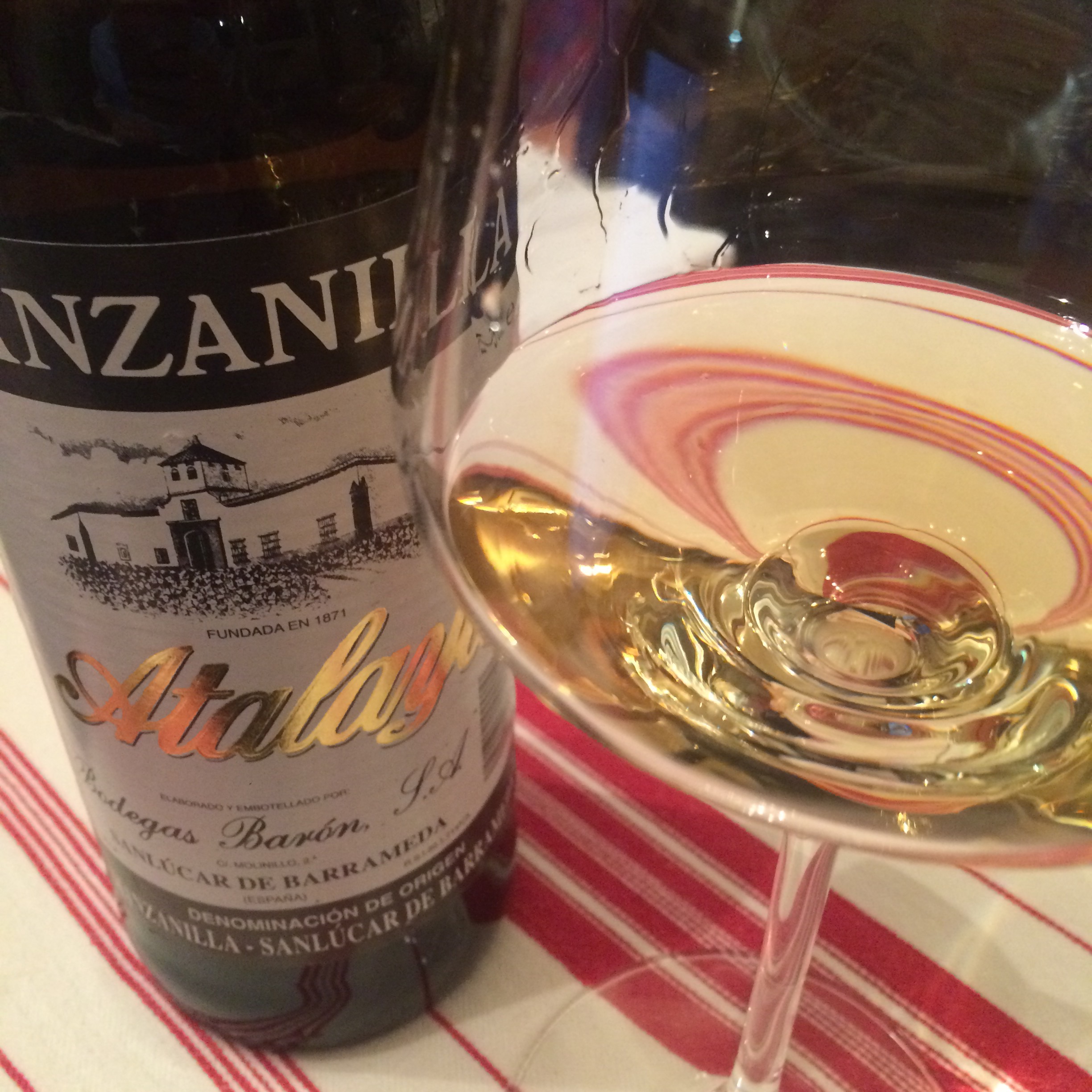
Manzanilla Atalaya


A manzanilla from Bodegas Baron – a brand that has survived the recent makeover but this one has the older label.

It has a richer colour than some manzanillas and is very herbal indeed – well beyond chamomile tea and towards spinachy weeds, even a bit of curry. Quite salty and more than anything else, it is incredibly mineral – it reminds me a bit of a Loire white (don’t ask me which) with that whiff of empty fish tank/wet gravel.

Salty on the palate too – salty and juicy. One of the bigger manzanillas and it definitely has the taste of must. When i first opened this a few days ago I thought it had been a few years too many in the bottle but maybe I was being a little harsh – there is a little bit of oxidation there but on a second drinking I am enjoying it more/finding it more harmonious.

A very nice drop in fact – very interesting nose indeed.

Homecoming Part III

  
This time, to my second home and feeding station of choice: La Chula de Chamberi. And what better way to start a new academic year than with veal sweetbread and El Tresillo Amontillado Fino (a lightly chilled, freshly opened bottle no less).

It is a great combination – the sweetbread is intensely salty, savoury and buttery and the Tresillo is all of that and another notch above with spicey, smokey zing and mellow burnt fruit.

It really is good – if I didn’t have so much work this glass could easily turn into a bottle (and bring me the rest of the cow while we are at it).

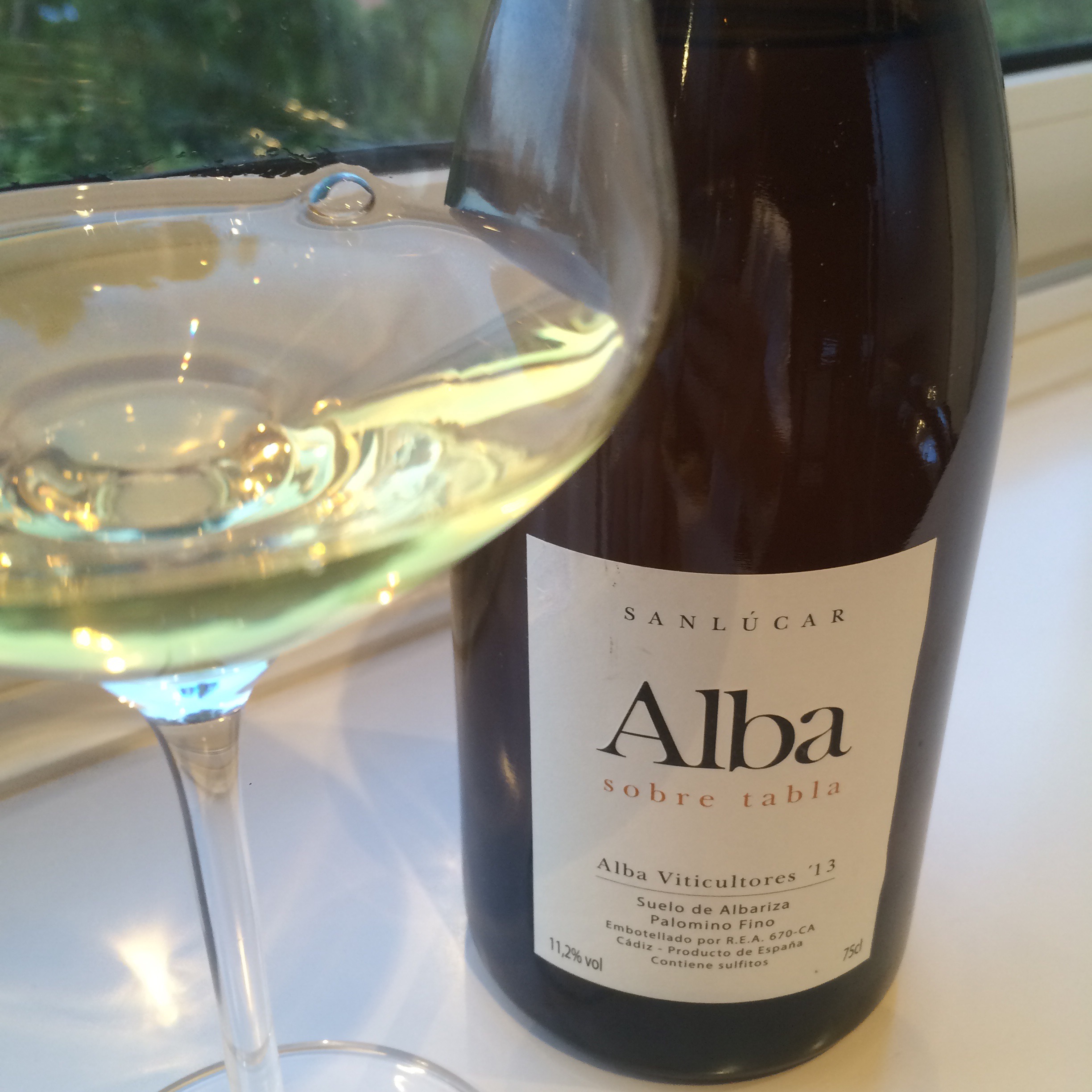
Alba Sobre Tabla 2013 – Lot I 

This is wine from palomino that I bought as a wine of the week from the discerning chaps at Coalla Gourmet.

Frankly there is a lot I could say about it if I were a proper journalist. It is made by four real live wires who probably deserve a post themselves (like this one by Paz Ivison) it is from Sanlucar, and its name refers to the “sobretablas” – the stage in the production of sherry at which the must is tried and its fate is determined (fino to the left, oloroso to the right, etc). I love comparing the way wines are labeled and here we have a pretty straightforward one, but I find it interesting that they mention on the label the “Albariza soil” which is characteristic of the sherry triangle – when you see that you wonder what they are trying to tell you about the wine. Another feature of the bottle markings is also nice – this is a wine made in two lots, and the bottles are marked “I” and “II” on the base with what appears to be albariza soil.

Anyway, I am not a real journalist so on with my drinking.

First, it is a beautiful colour – a light yellow gold – and the nose is delicious. It has aromas of juicy sweet apples but also tropical fruit like pineapple and even banana – reminds me of a very fine daiginjo sake.

On the palate it doesn’t quite live up to the awesome nose. It is softer than a lot of the palomino white wines and has that nice fruit but seems a bit undercooked/jammy/mushy almost like a natural cider from the North of Spain(nothing at all like a strumpy or anything you would get in a pub in the UK, I hasten to add). I find it a little on the gentle side acidity wise – it comes but it comes late. As a result I find it just a touch heavy.

Love the nose and real potential here just lacks a bit of structure.

El Tresillo Amontillado Fino

A friend just sent me this writeup by Julia Harding MW on the Jancis Robinson site. I think it is a fantastic piece which I recommend reading in its entirety.

Here are two snippets:

“But then I tasted it again, with more time and in solitude, from a lightly chilled and freshly opened bottle, and it wasn’t good, it was staggeringly good, so complex and distinctive that I found it hard to describe. …

This is without doubt one of the most stunningly complex and beautiful sherries I have ever smelt or tasted, and it is worth every penny, especially when you consider the time it has taken for nature to make it.” 

My thoughts exactly.

Two amontillados

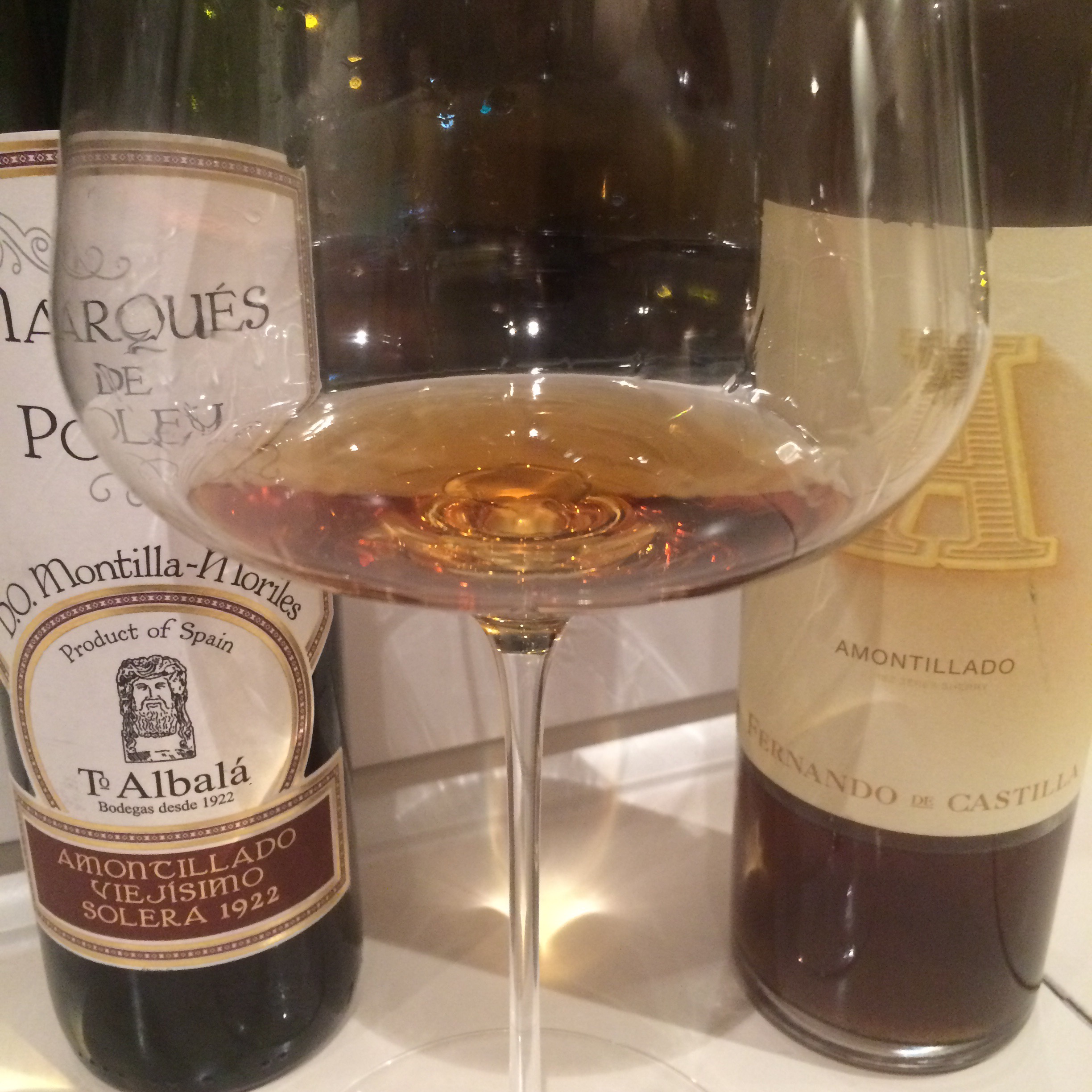
On the right, Fernando de Castilla Antique Amontillado: palomino fino, unfiltered, dusty dry and old in name, spirit and feel. On the left, the Marques de Poley amontillado viejisimo: pedro ximenez, nearly sweet, rich and juicy. Two totally distinct examples of what an amontillado can be.

Tasted separately I really appreciated the breadth of flavours and aromas in the Antique Amontillado and missed it in the viejisimo, but tasting them together one notices how much more compact the Poley is, and how drinkable as a result. It is as if the palomino allows the aromas and flavours to drift apart like a frayed rug while the px keeps them tight.

It seems to me to be a good example of the two contrasting challenges in the creation of a really great sherry – how to achieve that diversity of aromas but hold them together in an elegant structure. (And at a given level of aroma and body the elegance, for me, is most important – it is not for nothing that the very name of fino means “fine”.)

Oloroso Tradicion  


This is a very highly rated oloroso by a label – Bodegas Tradicion -that is paradoxically newer than most of its wines and which has done as much as anyone to bring high quality sherries to market (and sell them)(for good money).

I love the information on the label – this is bottle number 1136/4200 from the first saca of 2014.  On the back it mentions that this has been aged in casks/botas “very” soaked in wine – and it has been in there a good good long while.

In colour it is at the orange/yellow end of the scale of browns and very clear. On the nose it has very pronounced caramel, baked citrus and a little alcohol – I don’t find it the most expressive nose for an oloroso.

On the palate it is balanced and zingy, full of burnt caramel flavours maybe not as big as expected but eternally long. On its label it talks about a concentration of aromas. I buy the concentration but I don’t pick out a lot of different things. On the other hand, it is superbly drinkable – a really elegant oloroso with no rough edges.

Very, very, good.

Sanchez Romate Fino Perdido 1/2015 

  
I am struggling, frankly, to get to grips with the week so far, and needing a lunchtime boost I have come to Taberna Verdejo, temple of great cooking and lovely sherries.

Starting with a favourite here – the fino perdido from Sanchez Romate. It is a beautiful dark gold colour and  super clear. On the nose it is home made apple pie – pastry and baked apples. It looks and smells delicious. 

Not quite as light on the palate you might say – intense salty, yeasty flavour melting away to a long mellow finish – again baked apples spring to mind but more like apple sauce than apple pie. 

I like this more and more – excellent.