Don PX Convento Selección 1955

Wine number 3 of the tasting at the Taberna Palo Cortado was this absolute beauty. Another single vintage wine, now 61 years old, and showing sensational integration.

A deeper black brown in colour, like crude oil, this had the most amazing, surprizing, nose. Yes it had raisins and maybe chocolate, but it was for all the world like an overripe Chateauneuf du Pape with jammy fruit and spices, again oranges, but now mouldy orange peel from the back of the bin.

Then on the palate this came across as lighter, with nice acidity and sweeter spices, no astringency and much less mineral than the 1965. It again had a bittersweetness to it but rather than savoury it was the bitterness of marmalade, with acid and bitter citrus  – your man from Toro Albala came up with a great descriptor: the bitterness of orangey hands after peeling an orange. After that bitterness there was a different kind of sweetness, concentrated and dense, like black treachle and which just seemed to last forever.

Really out of the top drawer – an epic wine.

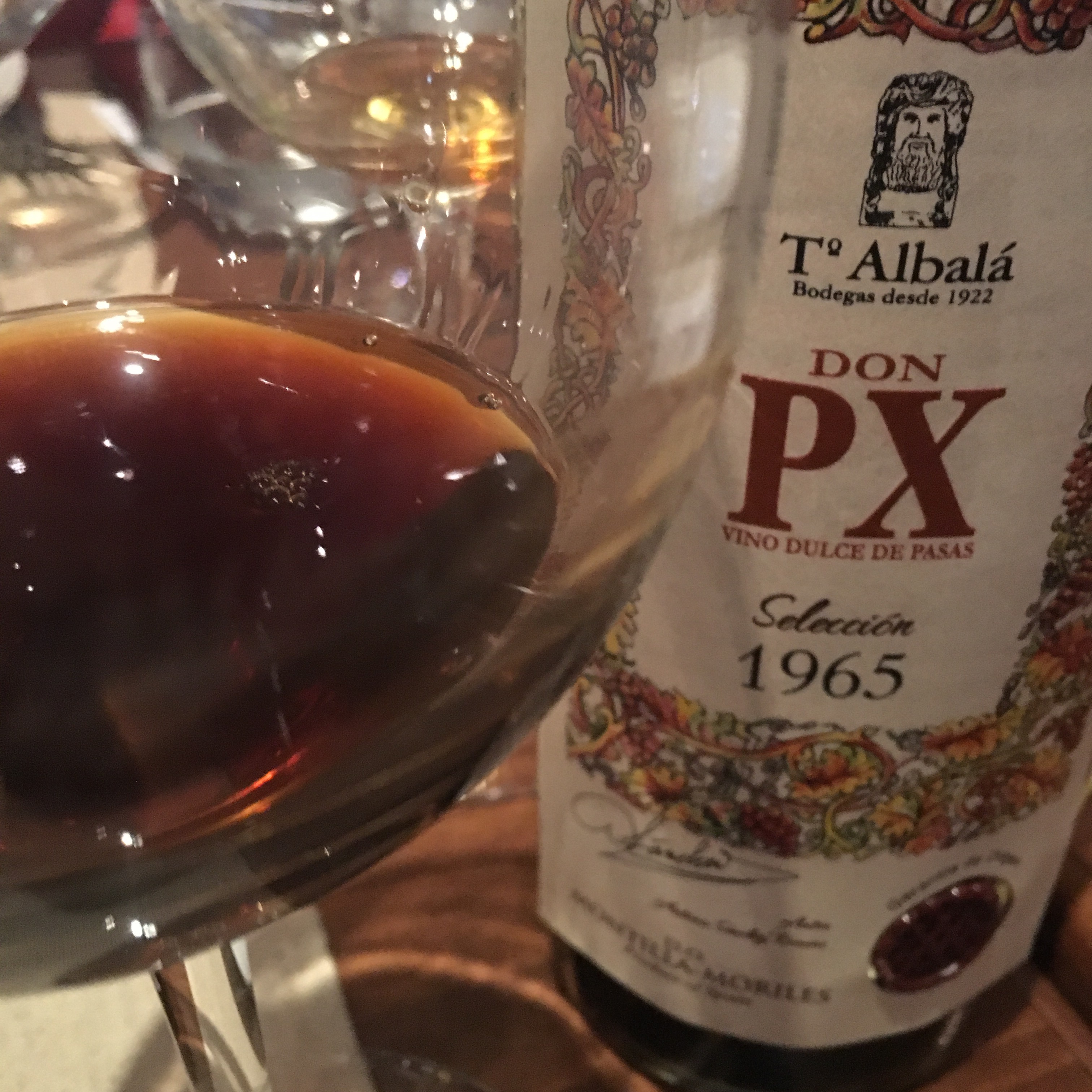
Don PX Selección 1965

Second wine of a fantastic tasting was this 1965 Don PX Selección. Again a single añada wine, again 100% pedro ximenez, but this time a sweet wine with I can’t imagine how much sugar per litre. And of course it was a mere 51 years old (I now realize I didn’t take note of when these were bottled).

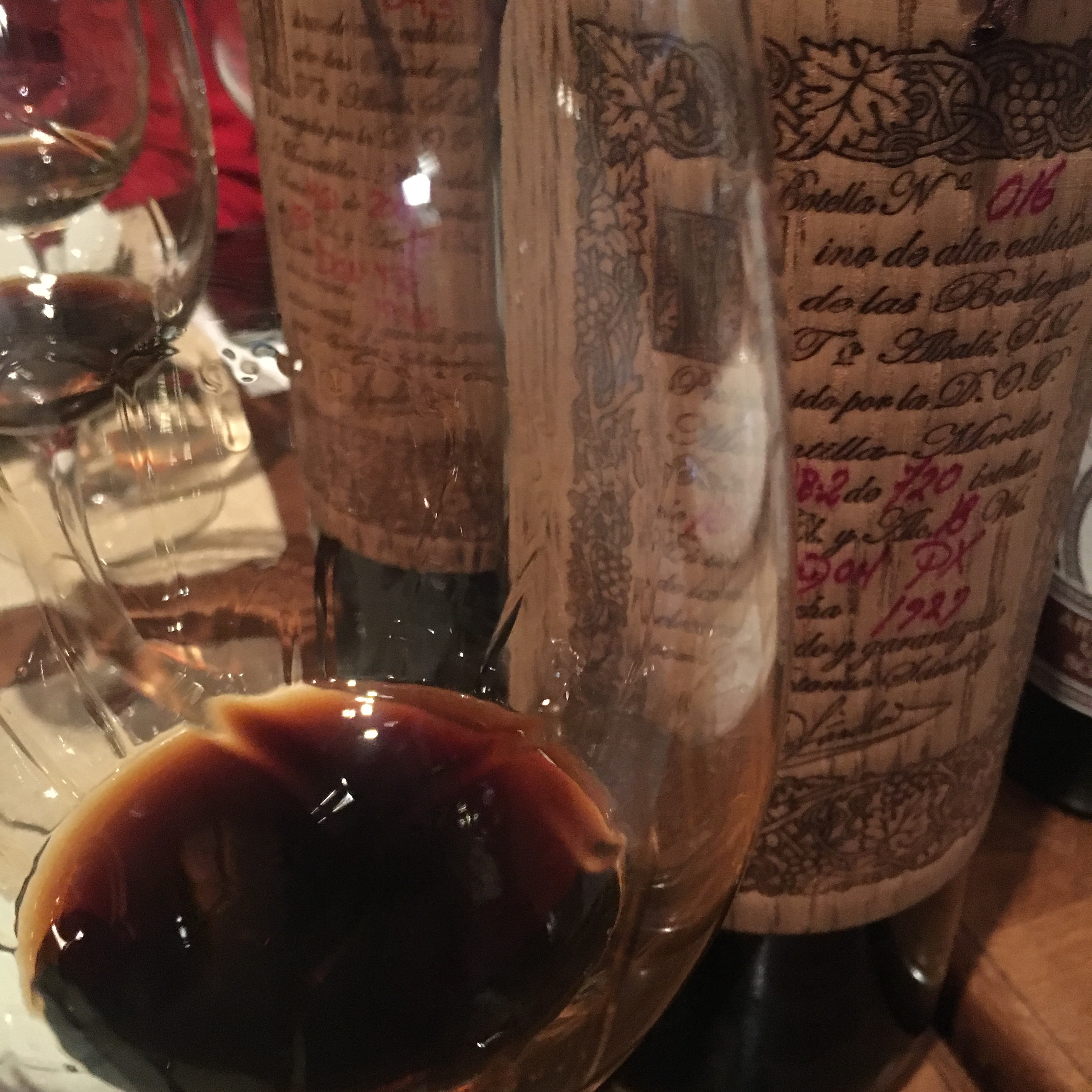
I am really going to struggle to describe the colours of these because I can only think of so many words for brown. Anyway, on this occasion there is a pretty good photo. There was a bit of chat about curry but someone called a far better descriptor: the fried tomato preparation they sell around here (with maybe a bit of cloves)and of course raisin. The palate was pretty amazing. The cloves were there again with orange peel, an almost tangible acidity, pepper, and really evident minerals. It also had a fantastic savoury zing and chalkiness to it – real saltiness that made for a refreshing finish.

Another fantastic, memorable wine.


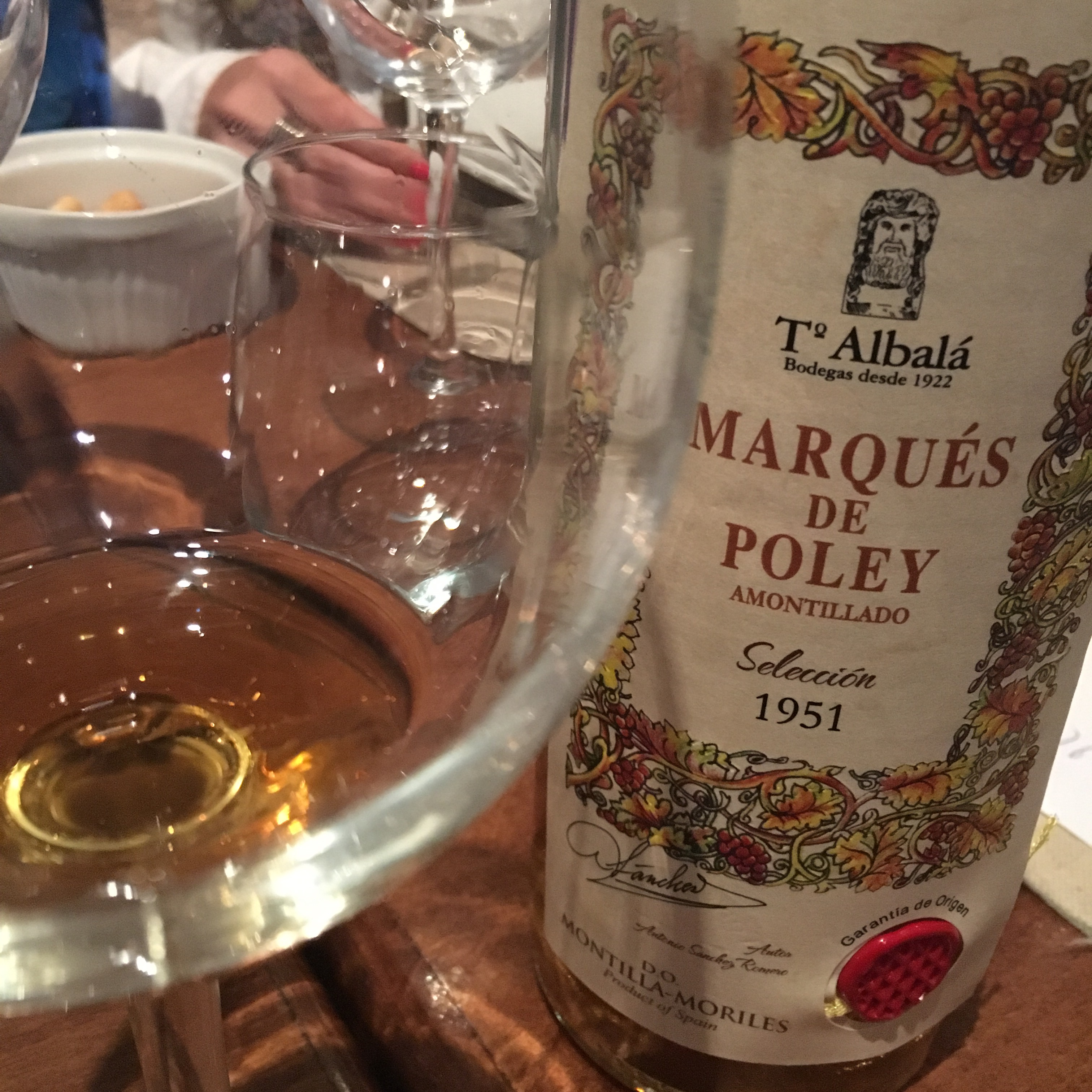
Marqués de Poley Amontillado Selección 1951 

A fantastic night at Taberna Palo Cortado started with this 1951 Marques de Poley Amontillado. All of the wines were single vintage “añada” wines but not “statically” aged – the “merma” or evaporation of the wines had been replaced by wines from the same añada (and it wasn’t clear whether the wines had been “moved” between barrels in addition to that).

Anyway, moved or not, this is a 65 year old dry amontillado (Montilla amontillado, as Antonio Barbadillo pointed out) that is 100 pedro ximenez but unbelievably fine and light. I have written in the past about how elegant single vintage wines seem to remain, but this one was really amazingly excellent given its age and cepage.

You can’t really see the colour above because I didn’t get hold of the bottle until the glass was nearly gone, but it was crystal clear and a really lovely amber colour,  extremely appetising. The nose had a spirit quality that was nearer to brandy than petrol fumes, a really fine nose of caramel and alcohol. Then on the palate it had a combination of acidity and zing, that didn’t so much burn as freshen, followed by notes of caramel then quickly tobacco and leather, before a long, long bitter almond finish.

A really exceptional wine. One of the best 65 year old wines I have drunk, without doubt. (Seriously, one of the wines of an exceptional night – and what a start.)

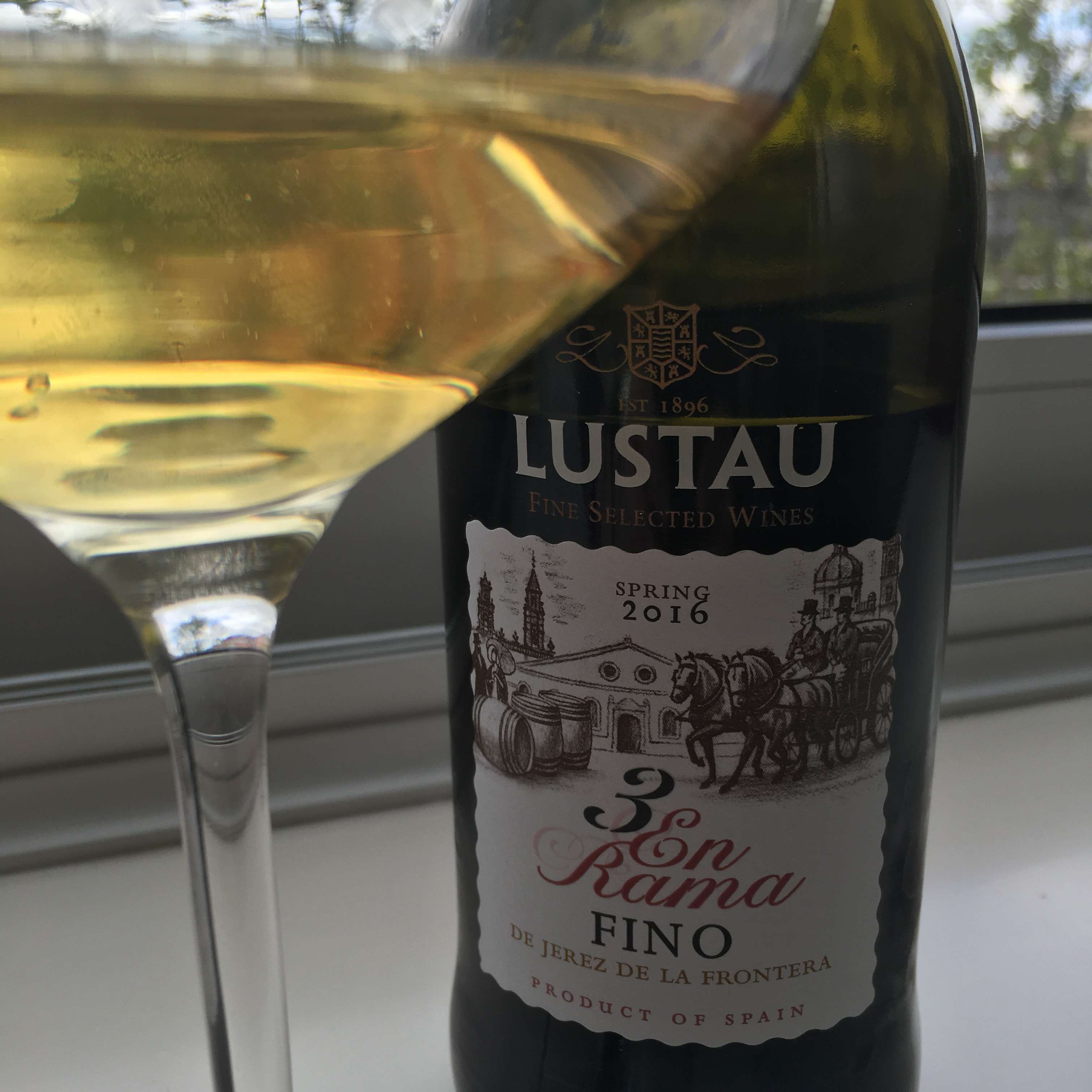
Fino 3 en rama de Jerez de la Frontera 

Not a great day outside but always a good moment for a spot of fino and the second leg of the Spring 2016 3 en rama. In fact, a bit of controversy over the order – Carlos from Lustau here in Madrid would go Manzanilla, Fino del Puerto, Fino (which does makes sense in that the Manzanilla and Fino del Puerto share those seaside influences), whereas I prefer the Manzanilla, Fino, Fino del Puerto order because I think the flavours of the latter are a touch more intense than those of the Fino. Anyway whoever is right, this is what I am drinking right now.

This is another selection from a solera – this time in Jerez de la Frontera – and the wine has spent an average of five years under flor (compared to four for the Manzanilla and five for the Fino del Puerto).

In colour it is a pale goldish yellow – maybe a little less of the green tinge that the manzanilla had. On the nose, there are again some notes of green apple but less grass and more yeast and undergrowth. Then on the palate you get that yeasty flavour with a suggestion of apple at first, followed by punchy undergrowth and salinity, and then quite a long yeasty and sapid finish – maybe a little longer than the manzanilla.

A very pleasant fino -compared to the manzanilla it doesn’t scream freshness at you but it is certainly at the lighter, fresher end of the scale, with just a little heft to it.


Y not


Have learned a lot over the last few days and it will take a while to digest some of it.

I can share one item immediately, however: the chaps at Valdespino confirm that the first letter above is a fancy “I” and not, as many people seem to think, a “Y”. Looking at that label you can certainly understand y, so it is an innocent mistake etc.

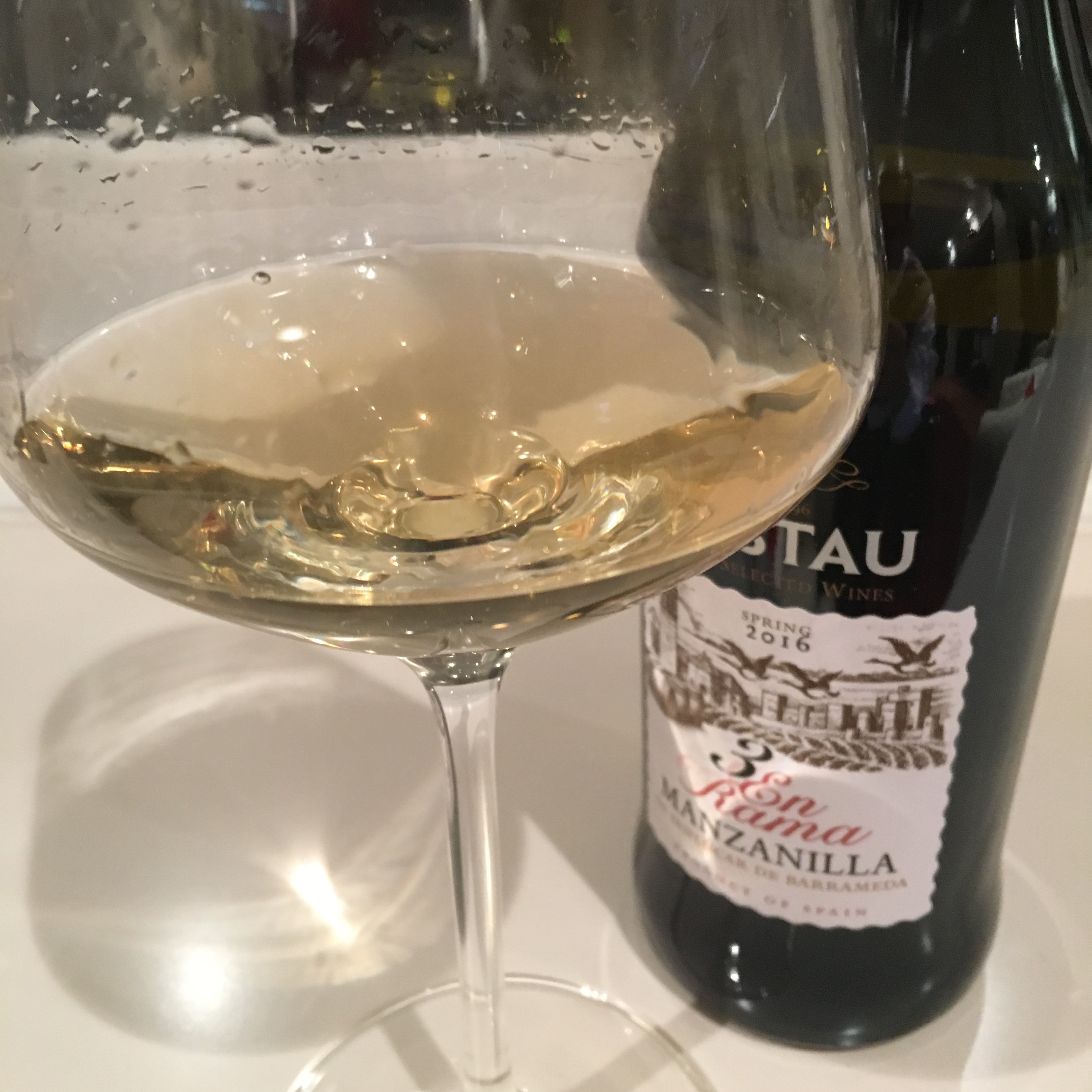
Manzanilla 3 en rama – Spring 2016

The first of this year’s Lustau 3 en rama that is getting written up (after they very kindly sent me a set this week) is this lovely fresh manzanilla, the lightest of the three and fresh from bottling only a few weeks ago.

Although it has had the same four years under flor, in the same bodega, these are selected botas and it seems to me to have a sweeter, lighter touch than the 2015 edition, which I tasted in January (and which had at that stage 9 months in the bottle).

I really like it – the first impression on the nose was of sweet fresh green apples and apple blossoms, with slight touches of yeast and sea air in the background. As the bottle opened out the yeast and grassy aromas began to predominate but that first impression was very vivid. On the palate it also comes across as nicely defined: a sweet, floral and gentle start, then some zingy, intense salty grass-like flavours, and then a fresh, mineral finish, with faint traces of those apples.

I really like the freshness and the clarity of it – it is not big, intense or highly complex but I get the impression it is not intended to be. I also think I like it much more at 5 weeks old than I did at nine months – maybe I should drink it all right away!

El salon de los vinos generosos

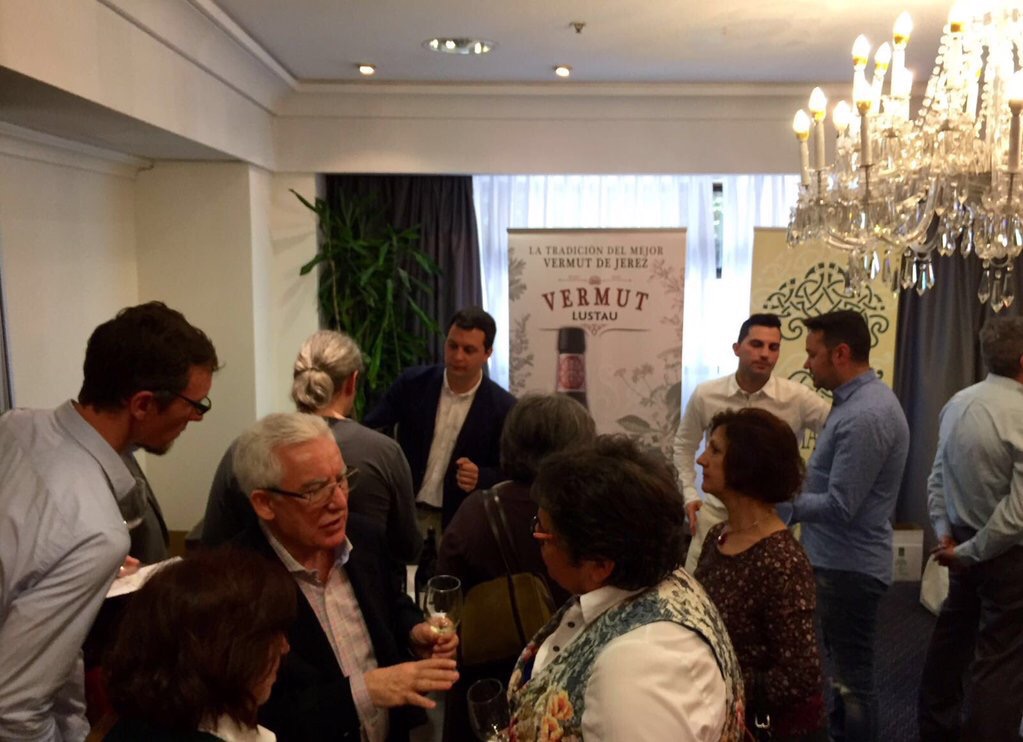
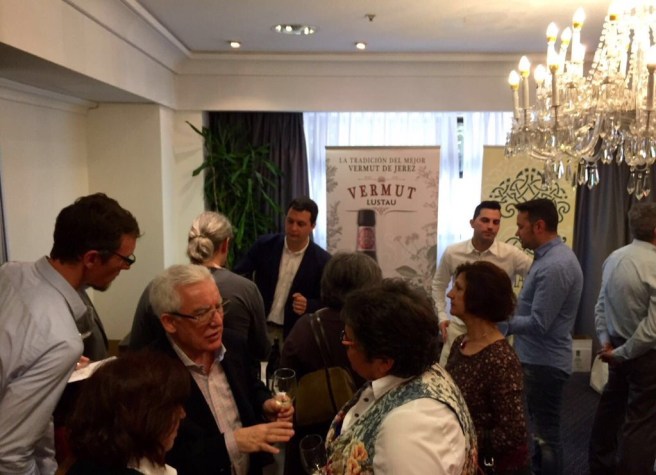
In the many hours that I was there yesterday I completely failed to take a picture of the Salon, the wall to wall stands of top class bodegas, the throngs of happy, thirsty professionals and “semi professionals” or the many fellow bloggers, tweeters and enthusiasts I finally had the pleasure of meeting in the flesh. I never claimed to be any good at this but, really, not a single photo. Neither did I manage, having scrawled down several pages of increasingly unintelligible notes, to bring said notes home. No clue what happened to them, none at all. It is an astonishing new blogging low. (Above graphic aid sent over by the helpful chaps at Lustau – many thanks guys.)

You see (not that it is an excuse or an attempt at one) for large parts of yesterday’s brilliant event in Madrid  I had what is known as a “bit of a buzz on”. (At one stage I (jokingly) offered to defend the honour of the Lustau Fino del Puerto via a fist fight in the carpark.) I did in fact spit out a fair few of the glasses of wine that I was offered. In a couple of particularly egregious cases I even tipped them straight into the spittoon. But these things do not come naturally to me and by far the majority of a very large number of glasses found their way into my bloodstream. It is my great weakness and one I am acutely conscious of.

In my defense, it was a fantastic, convivial occasion and the wines on offer were brilliant, far to good for spitting out. Of the wines that were new to me the standouts were the latest sacas of Sacristia AB Manzanilla and Oloroso; the new version of the Fino Capataz and the Abuelo Diego Palo Cortado from Alvear; the 2001 Historic Vintage Oloroso from Williams & Humbert;  the unbelievably high quality 1955 Solera Cincuentanaria series by Perez Barquero – especially the Amontillado-; Valdespino’s “Coliseo”; and the Sanchez Romate Old & Plus Oloroso, to name just a few. And those are just the novelties. Amongst the top class wines I consider old friends there were: Gonzalez Byass’ Tio Pepe en rama (3 weeks after bottling), the Cuatro Palmas and the 1987 Palo Cortado de Añada; the new saca of Goya XL by Delgado Zuleta; the majestic Fino del Puerto and Fino del Puerto en rama by Lustau;  the Toro Albala 1931 Convent Selección; the Barbadillo Pastora and Solear en Rama; the Tradicion Fino … Frankly,  the list could go on and on and on.

A lot of fantastic wines – too many and too good, really. And I say that because great fun and top class as it was, one of the abiding memories of the salon (other than the sneaking suspicion that once again I made a spectacle of myself), is of the senses being utterly overwhelmed.

At the outset I made a concerted attempt to try the manzanillas and finos against each other, retreating to the centre of the dance floor to take notes and sip in peace, and that comparison was extremely revealing. But after a little while the structured approach broke down under the sheer variety of tempting wines, the competing temptation to try wines across the range of a bodega (like Barbadillo’s trio of Solear, En Rama and Pastora, and Valdespino’s wines from Macharnudo Alto), and the kindness and attention of the people from the bodegas (too many to name here, but I am grateful to all of them). Add to that the chance encounters with acquaintances of every kind and the desire to share a glass with them and chaos ensues. As a result over the course of the day I probably tried in excess of a hundred and fifty different wines of every different style in an increasingly haphazard order: at one point I think I went from a fifty year old PX to a fino, to a vermouth, and then another fino – bonkers.

In addition to the chaotic approach, I honestly think it is unfair on wines of this quality and these qualities to taste such large numbers at a time. Even with an unfortified wine I believe you need to take time to appreciate it – look at it, enjoy the aroma, swirl it around, savour it, think hard about the different stages of its journey across the tongue, past the tonsils and down the neck. With the exceptionally complex wines of Jerez and Sanlucar I think you need even more time to appreciate them: you are stretching your taste buds and memories to the limits in every direction, and if you do it too quickly you can do yourself mischief. In fact on reflection, even with my notes I would struggle to make a sensible write up with more than impressions of the majority. And if I could I am not sure how fair it would be: how can I realistically compare a fino I have tried after an 80 year old amontillado?

But even if the salon was not the ideal location for appreciating these wines it was an absolutely priceless opportunity to try them, to witness the burgeoning interest in them, to meet some real experts and more importantly even, see old and new friends from all over. Twitter, the blog, and all the rest are really miraculous things but you cannot beat actually meeting people and offering to fight them in person … (hangs head in shame).

So bravo to the organizers of the Salon – Calduch Comunicación – and bravo to the bodegas for turning out in such numbers and with such fantastic wines. It really was a pleasure.


Sherry flavours: orange hands 


At a tasting of very old pedro ximenez this week there was an interesting discussion of the citrus aromas and flavours of some of the wines and someone came up with this brilliant comparison: the concentrated, bitter but orangey smell of your hands after peeling an orange. Have just peeled an orange and the descriptor is spot on (from memory at least, I am short of 80 year old PX to compare it with).

The orange is delicious too.


Cata de Toro Albala in Taberna Palo Cortado

It has been quite a week and tonight was special – a chance to try some really great wines from Toro Albala, side by side, in really knowledgeable company and in sherry headquarters here in Madrid. Frankly amazing wines – 1951 Marques de Poley Amontillado, 1965 Don PX Selección, and the Don PX Convento from 1955, 1931 and 1929.

It was an awesome group of wines and the variation was really intriguing. Probably the two most memorable aspects were the minerals and zing of the 1965 – real salt and pepper – and the big contrast with the 1955 that followed it – nose like a jammy Chateauneuf du Pape and a lighter, citrus and sweetness palate.

And I mentioned knowledgeable company – none other than Antonio Barbadillo of Sacristia AB, amongst others. Made for a very entertaining and educational evening – some of the things we discussed are stilling buzzing around in the noggin and may one day appear as blog posts.

There were, however, two jarring notes. First, the central role played by “Parker Points” in much of the commentary. This is a bodega that prints the points on the label, of course, but even so it was very odd to focus on the numerical values so often and to such an extent. Second, there was a bit too much blarney for my tastes: too much of the old “I wear this one as aftershave” and general references to tears and sighs and the like. It is a shame because the technical skill and biological wonder behind wines that have aged between 51 and 87 years got left out somewhat. (Don’t get me wrong, it was very entertaining.)

Once we finished these really big beasts we tucked into some fantastic pintxos, cheese plates, pates and the like – top drawer – accompanied by the Dos Claveles, an unfortified pedro ximenez white wine from Toro Albala, and the Fino Electrico (named afer the electricity substation net to the bodega, by all accounts). Again very nice stuff – but it was a difficult transition after the wines that had gone before, to say the least (although if we had stayed on the other wines I might have ended up staying all night).

A wonderful night that was over all too quickly.

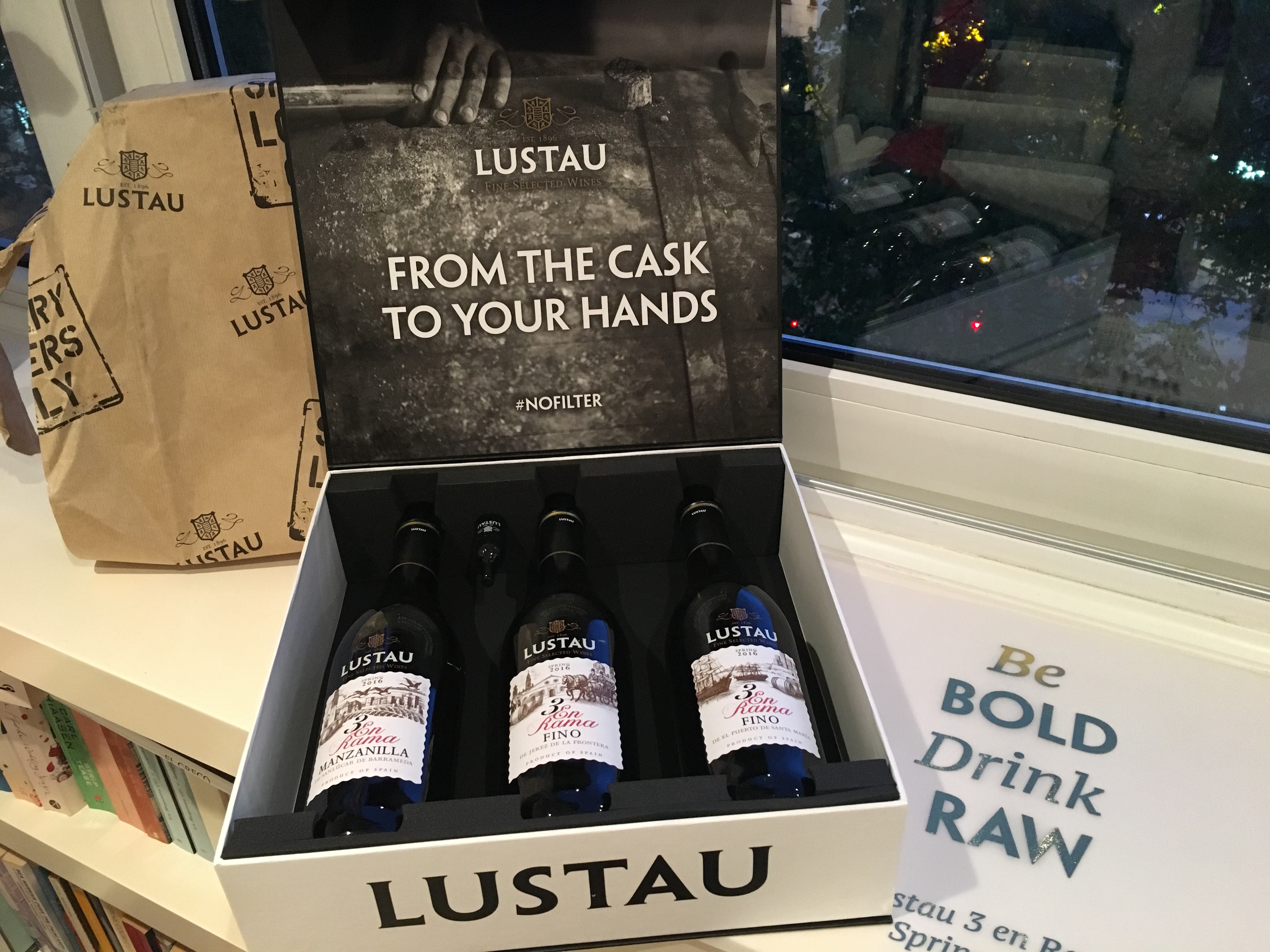
Lustau 3 en rama – Spring 2016

You have to say that is a fantastic presentation – and there is a little bottle shaped memory stick in there with promotional videos, tasting notes, press release, photos and pamphlet – a proper blogger could go to town with all this stuff. All I can try to do is express my gratitude to the chaps at Lustau who very generously sent this to me and congratulate them once again on three cracking wines.

The 3 en rama collection is, like the Almacenista collection, another great idea by Lustau and a concept with a lot of personality. They are selected en rama wines that have been aged in bodegas located in each of the three centres of el marco: Sanlucar (manzanilla), Jerez de la Frontera (Fino), and El Puerto de Santa Maria (Fino del Puerto). The wines are distinct and, in my limited experience, a good example of the characteristics of the three centres. As such they are a great introduction to the concept of the “other terroir”.

I couldn’t wait to get at them and they didn’t disappoint. All three are clean, fresh and defined. However good these wines may get with time in the bottle they certainly sing in these first few weeks (these were only bottled and released in April so we are a maximum of five weeks from the saca) and they all seem to have a brilliant curve of sweet notes to spicey saltiness.

  • The Manzanilla de Sanlucar de Barremeda starts highest and sweetest – the freshness of the green apples on the nose and at the beginning are really quite something, then there is a real zing and almost drying saltiness in the middle and at the end a fresh, tasty sweet finish with a residual tang of that green apple.
  • The Fino de Jerez de la Frontera has more of a vegetable, fresh celery semi-sweetness and a more intense, peppery zing. It seems to have more umami, more volume and a lower register, with an earthier nose and finish.
  • The Fino del Puerto de Santa Maria was my favourite of the three last year and yet again it stands out. It has a fascinating ozone, sea weed and sweet herb nose and is just as complex on the palate – with sweetness, herbal menace and a really salty bite at the end, but then the freshest finish. Really a top, top class fino.

In summary three cracking good wines – and covering all bases. A light approachable manzanilla, a heftier but still elegant fino and a really top class fino del puerto.

The wines are also a poignant testament to the great skill of the late, lamented Manuel Lozano. He was some winemaker and will be greatly missed.