Oloroso Tradición

Not everything that is interesting is new. This is not a vintage wine or a recovered variety. It isn’t even vineyard specific, but it is a classic in every sense of the word. An oloroso from the old school – a VORS in fact – with over thirty years in the butt, but beautifully made. No fruit or biology here: all acidity and intensity, but beautifully polished and compact for all that.

In colour it is an amber yellow/brown and clear as a bell. On the nose you have nice woody cigar box and treacle toffee aromas, very appetising indeed. Then on the palate it has that compactness – zingy acidity up front  to open you up then a broadside of caramel and woody flavours. Real intensity there and then a spicey, acidic finish but a clean one with no astringency.

Another beauty from Tradición.


#4GWFEST2018 – Part 3 – Corta y Raspa Vol II: the Mayeteria Sanluqueña strike again

It was at the Cuatrogatos Wine Fest last year that I first met the Mayetería Sanluqueña and it was great to see the three lads again and try the new vintages.

The mayetería are mayetos (the small scale owner/growers who traditionally supply fruit to the cooperatives and other producers) that instead of selling all their production are making and selling their own wines under the brand “Corta y Raspa” (“Cut and Scrape” – there is more explanation in last year’s post).

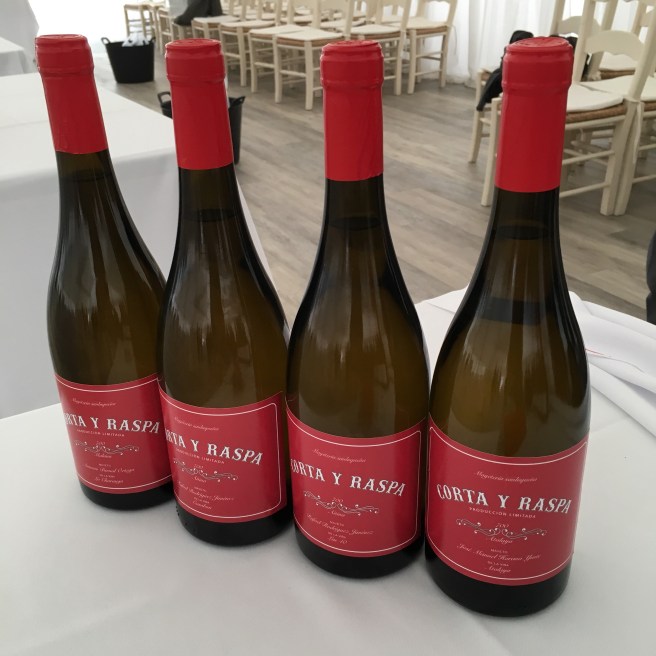
It was great stuff last year and this year’s vintages, bedecked in red, confirm the potential. There are four wines, one from Atalaya (a vineyard and pago with coastal influence near Sanlúcar) by Jose Manuel “Manu” Harana Yuste, that is all freshness and minerals, Casabon (Pago Añina) by Rafael Rodriguez Jimenez – which had a much more appley nose and a similar freshness, Los 40 (Pago Añina), also by Rafael Rodriguez Jimenez, again with apples on the nose and a touch more structure and bitterness on the palate, and last but by no means least La Charanga (Pago de Maína) by Antonio Bernal Ortega, which if not the best was certainly the most expressive, with a sea-air and apple bakewell on the nose, a touch more zip to start with and peppery spiced almond in between.

Four little gems that are once again well worth hunting out.


#4GWFEST2018 – Part 2 – Primitivo Collantes and the king of grapes

Another of the wines on my wishlist at the Cuatrogatos Wine Fest this weekend is in the almost unmarked bottle on the right above: a white wine from Uva Rey planted and grown by the great, criminally unheralded, Primitivo Collantes.

A lot of good things are happening down in Andalucia these days and whatever good things are happening Primi isn’t far away from the action. His vineyard, called Finca Matalian, is situated in Chiclana de la Frontera at the Southernmost end of the region, just 7km from the sea but 100m above sea level and lashed by strong Atlantic landward and seaward breezes. It must I first came across his wines as a result of Volume I of the Pitijopo: the Chiclana pitijopo was my favourite on the night, and stood out for its range of fruit and mineral flavours. I was so impressed that I set out to track down the wines from Finca Matalian, from the Arroyuelo Fino en Rama to the Fossi Amontillado, Viña Matalian and then Socaire, the unfortified but fino-barrel-tempered white wine that has quickly attained cult status (the wine that brought you “Socairismo“).

But he hasn’t stopped there, or with the top class Cuartillos moscatel (or the sweet version of Viña Matalian which I must admit I have not tried yet). On the contrary, the guy is probably the leading producer of Uva Rey wines in Chiclana. Uva Rey (aka Mantuo Pilas) is one of the 119 varieties (autoctonous or otherwise) that made up the pre-phylloxeric vineyards of the region and that the signatories of the so-called Manifesto 119 are seeking to recognize and recover.

This is not the first Uva Rey I have tasted (the pre-phylloxeric palo cortado “Encrucijado” wines have had a decent dose) but it is the first 100% Uva Rey and it was one I was curious to try. Primitivo had told us at a tasting in Madrid a while back about how resistent the grapes were (and specifically that two days of sun drying didn’t seem to have any visible effect whatsoever).

And it didn’t disappoint. This is the first harvest, the 2014, fermented in demijon and straight in the bottle (no wood, no innox) where it had been the three years since. I cleverly failed to take a picture of the wine in the glass or note down what it looked like – which probably means that it wasn’t very distinctive looking, but it certainly had a distinctive nose : tyre rubber reminiscent of a riesling, with citrus and esparto grass underneath. On the palate it had a more abrupt start than you expect from a palomino – maybe a touch more acidic and a lot of body and structure, with flavours that were again between citrus and dry grasses.

Exciting stuff: the body it has hints at a lot of potential, and this is only the first vintage.


Vinos de España, una pasión – 2018

Another one of my favourite events coming up – Vinos de España, the annual event organized by my mate Juan Manuel Hidalgo, this year on March 22 in Bodegas Campos in la Juderia Cordobesa (Cordoba) from 11:30 til 19:30. Full details are on the website here.

As always, a full list of absolutely top bodegas from all around Spain (best of the lot being Emilio Hidalgo of course). I have missed out the last couple of years – weekdays are not easy to take off – but this time it is a stone’s throw from Madrid so I really hope to be there.

#4GWFEST2018 – Part 1 – The return of Antonio de la Riva

Some of the wines I was most looking forward to trying at the Cuatrogatos Wine Fest last weekend were new (and old) wines from an old name: Antonio de la Riva. It is the name of a maker established in the 19th Century, absorbed by Domecq in the late 20th Century and which disappeared as a label not long afterwards, but whose bottles are highly prized by collectors and fans of the older wines. I am neither a collector (except to the extent that winemakers persuade me their wine will improve in the bottle) or particularly big on the bottle aged wines, but even so I was excited about these, because the famous old brand – together with some regal old butts and a supply from some handy soleras and vineyards – has recently been revived under new ownership.  And you have to say it could not be in better hands: the Sobrinos de Haurie themselves, Ramiro Ibañez and Willy Perez.

The wines, which up to this weekend had only been tried by a select few, are expected to be released soon. They include a white wine, from pago Macharnudo (and specifically, the corner of the Majuelo vineyard known as “El Notario”), a fino from wines sourced from Balbaína Alta, and two very senior citizens in the form of a very old oloroso and a very very old moscatel. On the day the lads had brought the fino, the oloroso and the moscatel and given the tiny quantities that were available their presentation in public was discreet – as the photographs above show.

The good news is that the wines are absolute belters.

First, the fino is a classic “Jerez” style (I have written “Jerezano twice in my notes”), with a very mineral, compact structure and sapidity. The nose is stoney and weedy, not big and aromatic haybales but more like the overgrown wall of a churchyard. Then it has a sharp zing to it broadening out into a decent mouthful of slightly bitter almonds before a fresh finish. Closer in style to a Camborio than an Inocente but in that same neighbourhood in terms of class with a good ten years under flor.

After the fino, the oloroso, which according to my notes is from Balbaina Baja and is spectacular (double underlined in the original text). Sawdust and alcoholic sweetness on the nose (I have hazelnut vinegar written here), then all the right kind of woody flavours across the palate: walnut and cedar cigar boxes, bitter chocolate and extremely black, salty and peppery coffee. And an unbelievable concentration and acidity – holding even a small sip in your mouth the heat is incredible.

And then the moscatel, which is another absolute beast. More of the same only possibly even more so. Incredibly dense and dark to look at – took an eternity for the drop above to make its way to the tasting receptacle – but just amazing on the nose and the palate, full of ginger and spices, nuts, chocolate and coffee. Enough acidity to keep it honest and balance up its sweetness and incredibly long. Sensational, and being honest, well beyond my powers of description even if I had taken decent notes.

Remember the name: Antonio de la Riva.

Amontillado Williams Coleccion Añadas, 2003

When we discuss bottle ageing we tend to be talking about the effects of between a few and a good few years in the bottle: legendary finos from the 1950s that have held it together miraculously and brutal old amontillados that have mellowed over decades. I probably don’t have enough patience (or storage) to really study on those kinds of timeframes but I think it is equally interesting at times to see the effects of even a short time – a few weeks or a year or so – in the bottle. The impact on some wines – especially the more aromatic biological ones – can be significant,

Here is a good example, the 2003 Amontillado from the Williams Colección Añadas, which I enjoyed during a cracking lunch at Taberna Verdejo. At least from my memory of it at previous tastings, this has sharpened up, on the nose and the palate, after just 18 months in the bottle and 12 months since I first tasted it (admittedly, that was the february saca).

I remember it being a spirity nosed, rounded and mellow wine, and maybe that is why I am surprized today by how zingy, sharp and acidic it is. The hazelnut that I associate with the Williams Colección Añadas is there on the nose but also there are notes of alcohol like a sweet, nutty vinegar. There is not a lot of haybale (or esparto grass) in evidence and it is not as spirity as it was. On the palate too there is nice acidity upfront and salinity at the back, and altogether it seems more vertical than this time last year.

More defined and even more elegant, but maybe a little less wild than it was last year.


The Cuatrogatos Wine Fest 2018

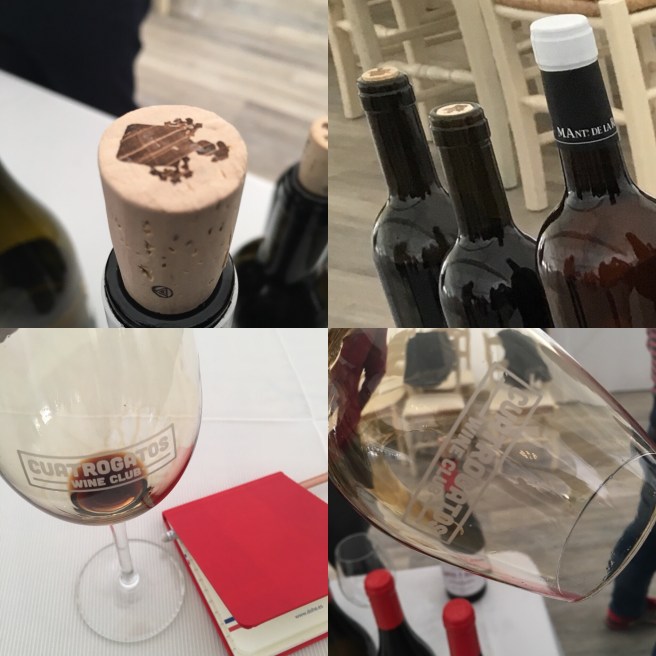
I am on the train to Madrid after a fun and inspiring weekend with winemakers from every corner of Spain, brought together by my friend and top man Federico Ferrer.

There were a few exciting new wines from el marco de Jerez and I will be writing up the notes as soon as I can, but for the time being I wanted to post my thanks to Fede, Marta and all the winemakers for a really fantastic event and a lot of laughs.

Wines do not make themselves. They do not occur in nature. They do not grow or emerge from the soil, however famous the vineyard. They are made by people and making them is bloody hard work. (And if you think making them is hard, try selling them.) I am a little in awe of anyone who can make wine, an awe that only increases when you spend time with them and see just how much of their life they pour into that work.

I really feel privileged and grateful to have been there this weekend. Long live the winemakers, and long live the Cuatrogatos Wine Club!

Barajuela Finos again

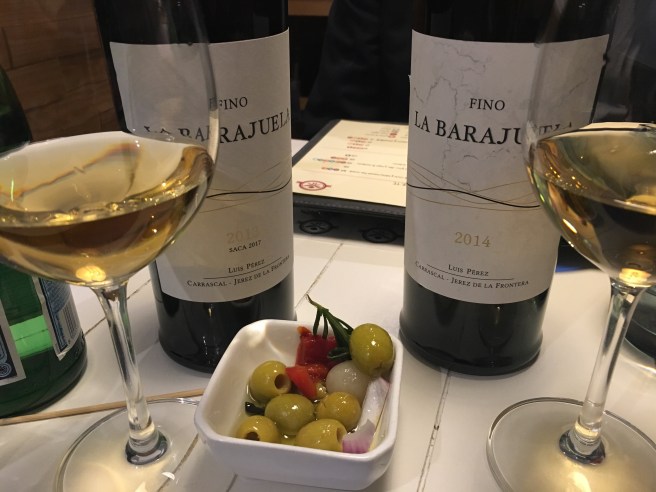
The boys down in Jerez tease me for the amount of these Barajuela wines I am able to find but to be honest most of the time they seem to find me. I am honestly trying to hold back, and now only order it if I can share it with at least one newcomer to the breed. This was one of those occasions – a lunch at Bache with an old colleague-, and yet again I can confirm that the people love it.

What I love about these wines is how much fruit is there, how the fruit seems to reach down the savoury registers into salinity making a massive iceberg of a wine: as much or more below the surface as above it. On that score, the 2014 Fino has the same white blossom and white fruit nose and top end of the palate as the 2013 Fino (saca of February 2017), but more of the savoury, sapid mountain. It also has less time under flor – isn’t quite as sharp or mineral – but has an even bigger, fuller frame. On the other had, while it is not strongly biological on the nose the 2013 – particularly this second saca – has, if not quite haybales, then at least a little bit more dry herb in the nose and again that sharper profile.

More importantly, both are brilliant white wines for sherry lovers, sherries for wine lovers, just brilliant wines.

Palo Cortado Lagar Blanco

The other place in full effect. This was one of the wines that Borja at Bache gave us the other day during yet another enjoyable lunch. I don’t know much about it and didn’t have much time to study (what with all the eating and socializing that was going on) but it was very nice stuff.

Palo cortado is not a category that was historically associated with Montilla Moriles although you see more and more of them since the recent resurgence of the category. I do not know the legal definition up there (“is there anything he does know?”, you might well ask) but judging by the bottle and what it says here  it seems to be along the same lines as in Jerez: a wine that has the nose of an amontillado and the body of an oloroso. Nowadays wines with those characteristics can be achieved in various ways: a bit of biological here, a bit of free run juice there, or even by pure selection. Judging by the nose and the information provided I guess that this one falls into the latter two categories.

However it was made or selected it is a very nice wine. I am always on the lookout for heaviness when PX is involved but this one is very fine, nice and sharp at both ends with acidity and salinity and nutty and a little bit woody in the middle (and the finish). Not overdone at all and a nice age – I would have guessed 20 years or so and I would have been right.