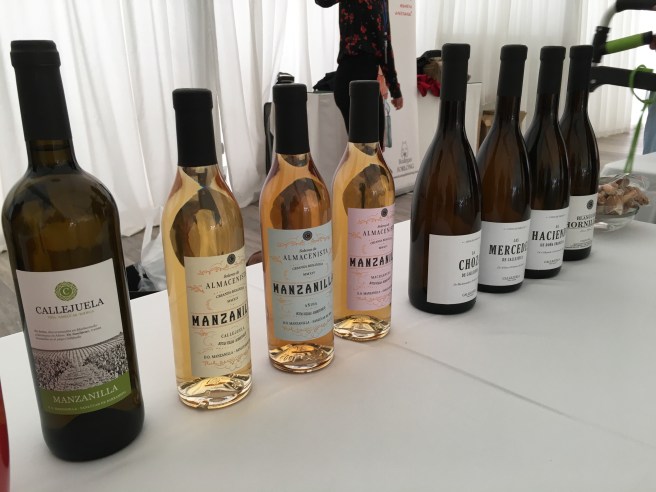
#4GWFEST2018 – Part 4 – the Callejuela single vineyard manzanillas

There is just so much to like about Bodegas la Callejuela. It is hard to think of a more likeable couple of blokes than these big, friendly guys, and although at first glance they don’t look like the kind of hipsters you would imagine revolutionizing the scene in Jerez I can tell you noone is doing more than they are.

To start with they have a quality bodega with a really solid range of wines, from the unfortified blanco de hornillos via the manzanilla fina, manzanilla madura, manzanilla en rama, amontillado, and oloroso all the way up to the outstanding older wines, Blanquito, La Casilla and the unbelievable El Cerro (and the PX). But they are a lot more than a bodega with a good range. They are the source of the wine which, with the help of a touch of Ramiro Ibañez magic, has become one of the truly iconic projects of the new Jerez – the Manzanilla de Añada 2012 -, they were involved in the Manifesto 119 and have since launched a range of unfortified vineyard specific white wines that for me are really pitch perfect. These guys really get it.

I have already had the chance to write about their latest releases – first at the bar of the late, beloved Territorio Era, and later at an excellent event organized by Montenegro vinos. They are single vineyard manzanillas, and in fact they are also single vintage wines – from 2014-, although they are not able to market them as such since not all “i”s were dotted and “t”s crossed, so at the time I first wrote about them I called them something different. Anyway here they are, resplendent at the Cuatrogatos Wine Fest with their clear bottles (which I personally think is a quality touch), classy new labels and their official title of “manzanilla” (a reminder once again that although two of the three are from Jerez vineyards, what counts is where they are made into wine for these purposes).

And three quality wines too. The Callejuela (vineyard) is the most biological of the three with haybales on the nose, a touch more zing and a sharper profile. The Macharnudo is absolute class, with that aromatic and metallic mineral quality and an elegant, compact shape, while the Añina is even visibly more evolved, slightly oxidated, smooth but nevertheless fresh.

I find it very hard to choose between the three of them, I must admit. Perhaps I need to try them again!



Oloroso Tradición

Not everything that is interesting is new. This is not a vintage wine or a recovered variety. It isn’t even vineyard specific, but it is a classic in every sense of the word. An oloroso from the old school – a VORS in fact – with over thirty years in the butt, but beautifully made. No fruit or biology here: all acidity and intensity, but beautifully polished and compact for all that.

In colour it is an amber yellow/brown and clear as a bell. On the nose you have nice woody cigar box and treacle toffee aromas, very appetising indeed. Then on the palate it has that compactness – zingy acidity up front  to open you up then a broadside of caramel and woody flavours. Real intensity there and then a spicey, acidic finish but a clean one with no astringency.

Another beauty from Tradición.


#4GWFEST2018 – Part 3 – Corta y Raspa Vol II: the Mayeteria Sanluqueña strike again

It was at the Cuatrogatos Wine Fest last year that I first met the Mayetería Sanluqueña and it was great to see the three lads again and try the new vintages.

The mayetería are mayetos (the small scale owner/growers who traditionally supply fruit to the cooperatives and other producers) that instead of selling all their production are making and selling their own wines under the brand “Corta y Raspa” (“Cut and Scrape” – there is more explanation in last year’s post).

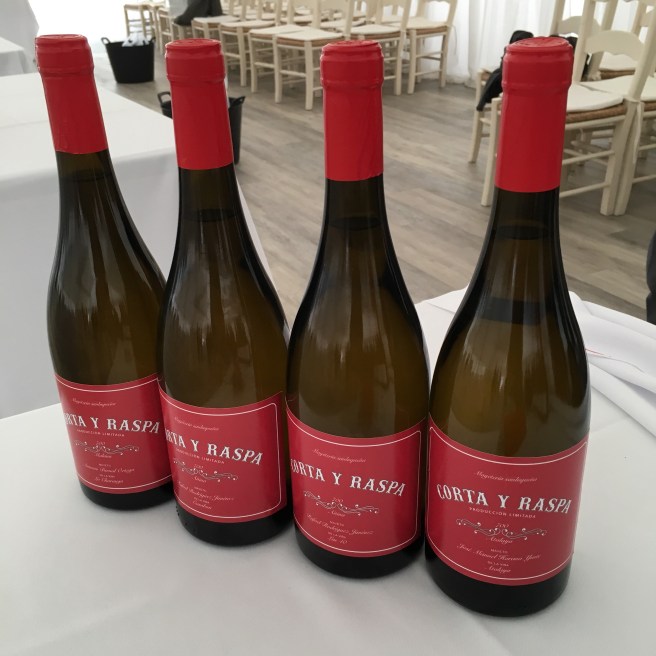
It was great stuff last year and this year’s vintages, bedecked in red, confirm the potential. There are four wines, one from Atalaya (a vineyard and pago with coastal influence near Sanlúcar) by Jose Manuel “Manu” Harana Yuste, that is all freshness and minerals, Casabon (Pago Añina) by Rafael Rodriguez Jimenez – which had a much more appley nose and a similar freshness, Los 40 (Pago Añina), also by Rafael Rodriguez Jimenez, again with apples on the nose and a touch more structure and bitterness on the palate, and last but by no means least La Charanga (Pago de Maína) by Antonio Bernal Ortega, which if not the best was certainly the most expressive, with a sea-air and apple bakewell on the nose, a touch more zip to start with and peppery spiced almond in between.

Four little gems that are once again well worth hunting out.


#4GWFEST2018 – Part 2 – Primitivo Collantes and the king of grapes

Another of the wines on my wishlist at the Cuatrogatos Wine Fest this weekend is in the almost unmarked bottle on the right above: a white wine from Uva Rey planted and grown by the great, criminally unheralded, Primitivo Collantes.

A lot of good things are happening down in Andalucia these days and whatever good things are happening Primi isn’t far away from the action. His vineyard, called Finca Matalian, is situated in Chiclana de la Frontera at the Southernmost end of the region, just 7km from the sea but 100m above sea level and lashed by strong Atlantic landward and seaward breezes. It must I first came across his wines as a result of Volume I of the Pitijopo: the Chiclana pitijopo was my favourite on the night, and stood out for its range of fruit and mineral flavours. I was so impressed that I set out to track down the wines from Finca Matalian, from the Arroyuelo Fino en Rama to the Fossi Amontillado, Viña Matalian and then Socaire, the unfortified but fino-barrel-tempered white wine that has quickly attained cult status (the wine that brought you “Socairismo“).

But he hasn’t stopped there, or with the top class Cuartillos moscatel (or the sweet version of Viña Matalian which I must admit I have not tried yet). On the contrary, the guy is probably the leading producer of Uva Rey wines in Chiclana. Uva Rey (aka Mantuo Pilas) is one of the 119 varieties (autoctonous or otherwise) that made up the pre-phylloxeric vineyards of the region and that the signatories of the so-called Manifesto 119 are seeking to recognize and recover.

This is not the first Uva Rey I have tasted (the pre-phylloxeric palo cortado “Encrucijado” wines have had a decent dose) but it is the first 100% Uva Rey and it was one I was curious to try. Primitivo had told us at a tasting in Madrid a while back about how resistent the grapes were (and specifically that two days of sun drying didn’t seem to have any visible effect whatsoever).

And it didn’t disappoint. This is the first harvest, the 2014, fermented in demijon and straight in the bottle (no wood, no innox) where it had been the three years since. I cleverly failed to take a picture of the wine in the glass or note down what it looked like – which probably means that it wasn’t very distinctive looking, but it certainly had a distinctive nose : tyre rubber reminiscent of a riesling, with citrus and esparto grass underneath. On the palate it had a more abrupt start than you expect from a palomino – maybe a touch more acidic and a lot of body and structure, with flavours that were again between citrus and dry grasses.

Exciting stuff: the body it has hints at a lot of potential, and this is only the first vintage.