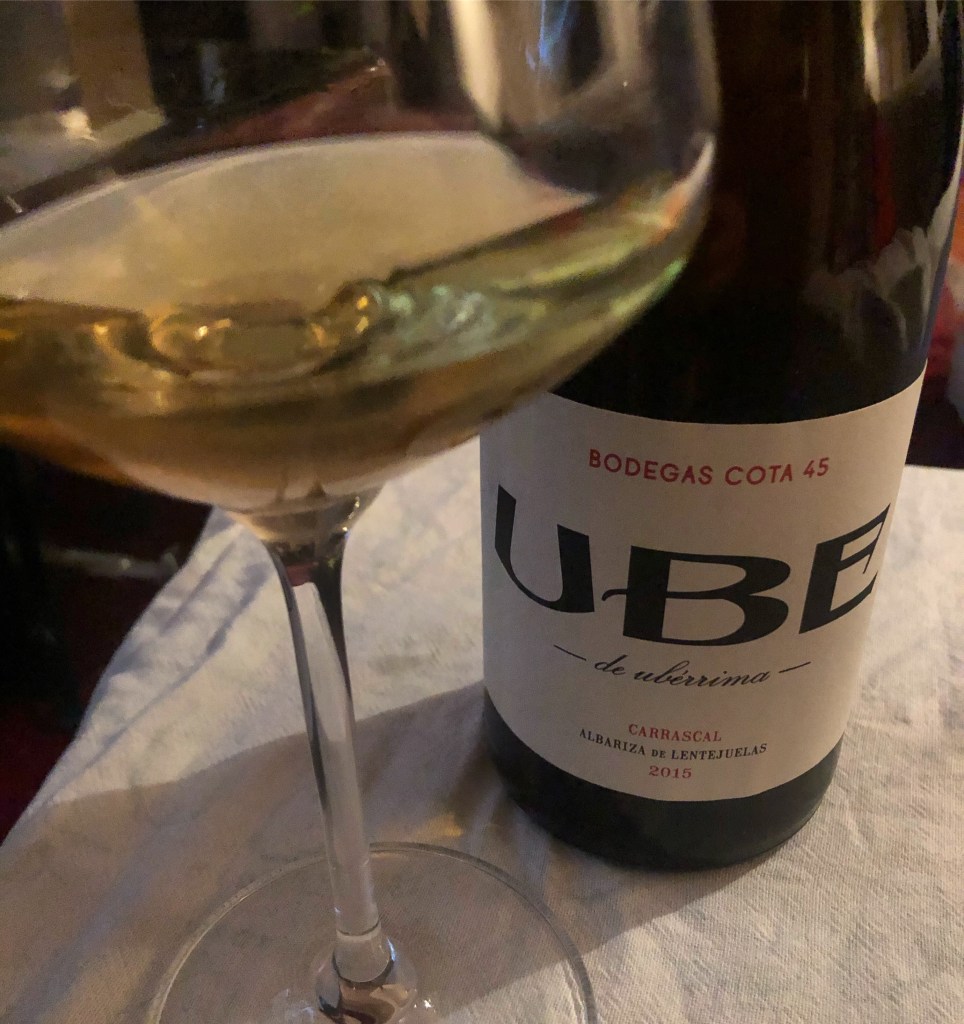
This was the original UBE and still my favourite overall. From Carrascal de Sanlucar, the freshest and most vertical of the great pagos in el marco, but from old vines and a low yielding vineyard that produces wines of relative potency and concentration.
It is of course 100% palomino (although with Ramiro other options are available), from three different clones – palomino fino, palomino de jerez and palomino pelusón (which intriguingly translates as big hairy palomino). It is fermented in bota and then spends another 20 months there, without flor, after which this one has been another three and a half years in the bottle.
That period in the bottle has really brought it on – as I so often find with palomino white wines – and the result is a highly enjoyable, fresh but flavourful white wine.
As you can see, it has taken on a very attractive old gold colour, clearly darker in shade than I remember it, and it has a very distinctive nose, chalky interlaced with lemon but with a hint of stewy herbs in the background. In fact those herbs come through more and more as the wine opens up. Really interesting balance of mineral, fruit and savoury. Then on the palate more of the same, the effect of the chalk, the fresh start and a nice, generous mouthful of citrus and herbal fruit before slipping away in a long fresh finish.
Plenty to enjoy here, a really excellent wine, and that savoury character makes it a great wine for one of the cheeky lunches I have missed so much …
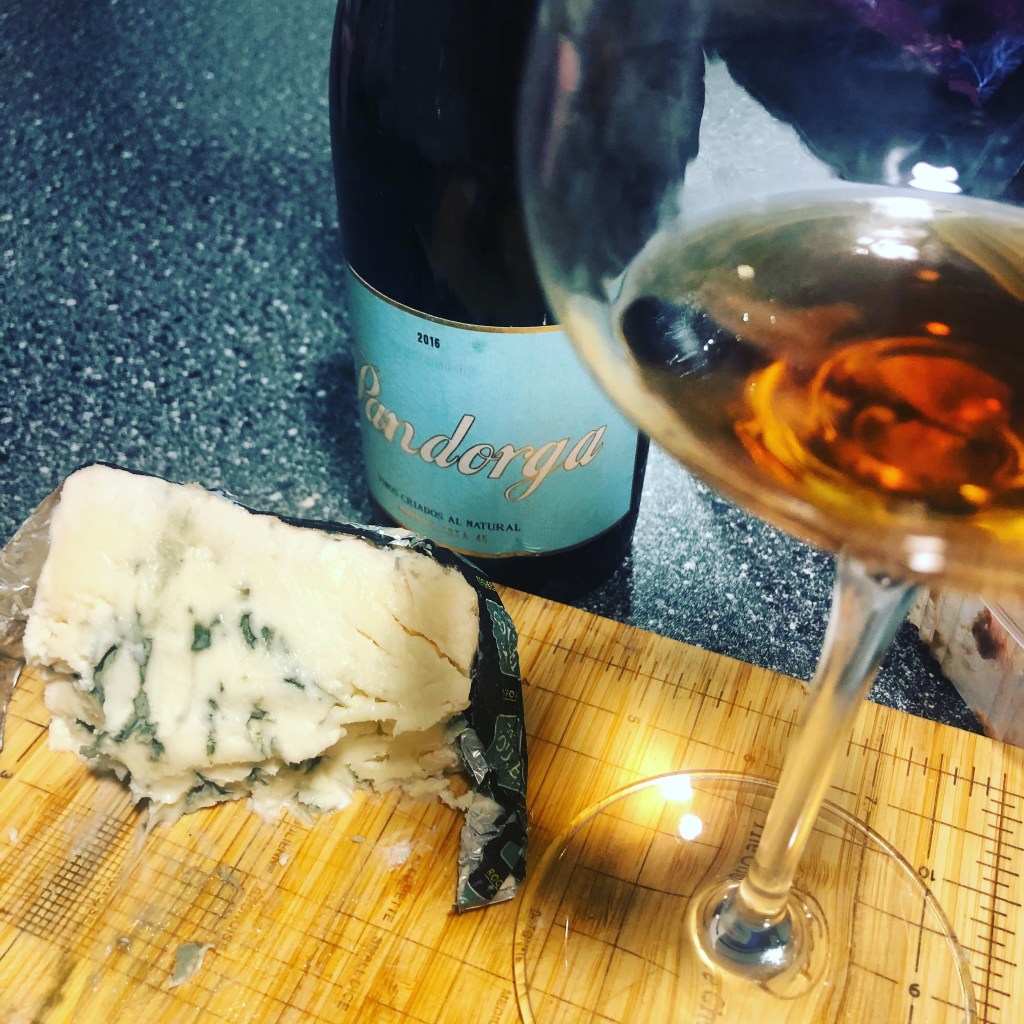
A clash in trading names means a change of moniker for this historic wine and it is a real shame. Historic because it is made using varieties that had long fallen out of favour, and because it was one of the first “new wines” from el marco. It was certainly the first that I tried, what seems a long time ago now in September 2015. That was the 2012 – the MMXII – and this is the 2016.
Over the years the wine has wound its neck in a bit. Back then there were five or six varieties involved, as the idea was to try and replicate the almost random selection of the pre-phylloxeric vineyards. But it was never meant to be an experiment, it was meant to be a wine, and as a wine it has grown and grown in stature even as the varieties dwindled. Now it has just three varieties: palomino fino, uva rey and perruno. (Still two more than your average blanco de albariza.)
From the start it was a lovely wine, but it just seems to get better and this strikes me as good as any that I have tried. It has that bit of extra girth of flavour, more buttery, more melon, but this one also has a lovely elegant profile and fresh finish. And from memory it seems to have improved a lot with a year in the bottle too.
One worth hunting out and savouring – the history of the wines and varieties of Jerez, and a lovely wine while you are at it.
This summer I had one of the top pairings of this cracking pedro ximenez by Cota 45 – with a roasted and caramelized peach in Bagá, Jaen. It was sensational, with the apricot flavours and sweetness of the pedro ximenez combining and contrasting superbly with the similar but higher register sweetness of the peach.
But this one above wasn’t far behind either – a completely different pairing, with a creamy, salty roquefort balancing the acidity and sweetness of the wine, and the two sharing a wonderfully rich texture. You don’t want crackers here – a nice soft white bread, good butter and a do not disturb sign.
Unquestionably the wine of a pretty good summer. In fact Mrs Undertheflor even asked me earlier this evening, knowing we had bagged a few unicorns over the course of the vacations, and it was gratifying that there was at least some interest in my opinion on this occasion so I thought I might share it more widely.
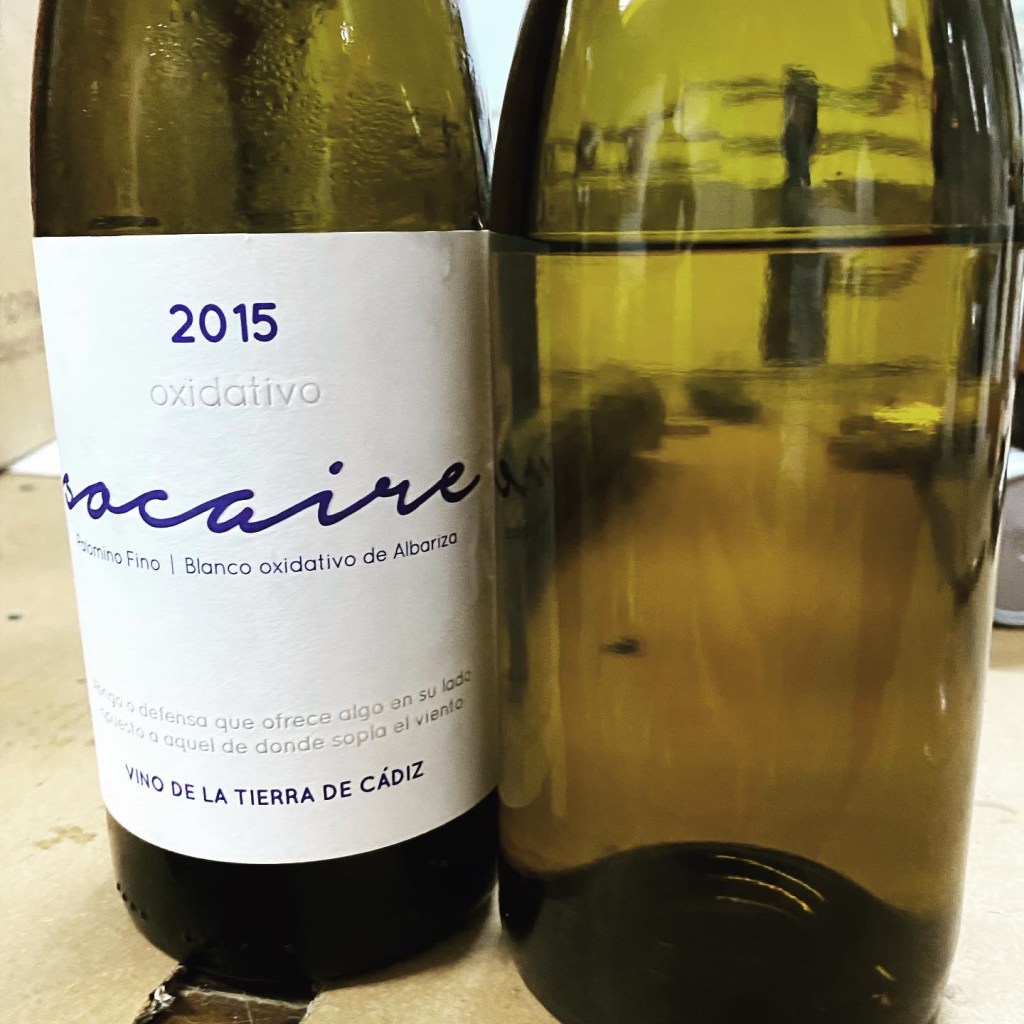
You see I knew Socaire Oxidativo 2015 was excellent but last week I had one of those rare opportunities to explore the wine from every angle – and it was one of those even rarer moments when a wine thus explored got better the more I explored.
I was fortunate enough to be in Chiclana for my holidays – beautiful beaches and climate, some really top class restaurants -, even more fortunate in that Primitivo Collantes himself was kind enough to show myself and some good friends around his vineyards and bodega, and even even more fortunate that he was generous enough to let us taste the oxidativos from 2019, 2018, 2017, 2016 and 2015 (and of course the other Socaire, the Arroyuelo en Rama and the Fossi, not to mention the new sensation, “Tivo”).
Now Primitivo Collantes SA is one of the few bodegas I have actually visited, and probably a principal cause of my recommendation to anyone really interested in a wine to go and visit the makers. It is a special organization lead by a special individual. It is the only bodega in Chiclana – aside from the coop – to grow and harvest grapes in Chiclana and make its own wine, and the last survivor of a once very proud tradition in these parts. And it plays its part in that tradition too, withe some venerable wines and styles: Arroyuelo is a great fino, Fossi a superb amontillado.
But its great wines, for me, are those that go by name of Socaire. The first Socaire was revolutionary in its day – a barrel fermented, bota aged unfortified palomino from the sheer white soils of Finca Matalian that blazed with zest and expression in its first vintage, and subsequently has shown with power, complexity, elegance and every combination thereof year after year. Really one of the great modern wines from the region.
And now this. The difference between the two is one of age – this is what happens when Socaire gets more than two years of bota age, and starts to show its fondness for the oxygen that surrounds us.
And what a transformation that time brings. The 2019 was a refined mosto – fuzzy and rampant, for all that it had nearly 11 months in the bota. The 2018 was finer, a real wine now, but still spiky and up for it. 2017 was finer and more elegant, losing those spikes and almost holding itself in. And then 2016 had grown again: aromatic, full of flavour and character, a butterfly emerging from its chrysalis. In terms of barrel tasting (well, not really, 2016 was going into the bottle already) it was as good as I have experienced – a real anatomy of the creation of a wine. And then of course we tasted it next to the 2015, with its year in the bottle and its polish.
It was an outstanding introduction to the wine, and was soon followed by the horizontal dimension, as we tasted it next to the other wines from the same exceptional vineyard (Finca Matalian, now you ask), including the upstart “Tivo” from the traditional Chiclana Uva Rey. If the vertical gave us an anatomy of a wine in the making the horizontal gave us its geography – it was like looking at old family portraits of a dear friend and spotting all the familiar features of sisters and brothers.
And those features are the features of an outstanding white wine. Lower in register than some of those appearing further North, this is mountain flowers and sweet herbs on the nose, aromatic and rich, then a lovely elegant profile delivering those same flavours on a steely frame of salinity, which leaves your mouth watering as you finish.
An outstanding wine from an excellent producer, a beautiful place and thoroughly good family. My wine of the summer 2020 is Socaire Oxidativo!
I only have two bottles of this (vintage) left but couldn’t resist it.
I don’t know what it is about Ube but every time I have a bottle another one soon follows, and after that, well, one thing generally leads to another.
It is a class old vine palomino from a typically vertical, Atlantic Sanlucar, and this one from a warm year has a touch more fruit heft to balance the savoury, stewy herbs.
One of the newer labels in Jerez but an old school wine. A compact, solid fino with a lot of time in the barrel.
It comes from a compact, solid project with 16 hectares of vines on Pago de Añina in three vineyards: San Cristobal, El Aljibe and San José. Under new ownership but with old vines, a lot of varieties and clones in each vineyard but also a lot of new thinking. They have had them in ownership since 2015 and have produced wine since 2016. Those wines are used to rociar acquired soleras with a long history.
The fino is from a solera with four criaderas and the 2500 or so bottles a year have had an average of 8 years under flor. The result is that compact, solid fino I mentioned earlier. Almond, yeasty dough and haybale aromatics and then a solid palate with a nice zingy start, bitter almond and slightly undercooked bread and then a mineral finish.
And it has a solidity to it that makes you feel like it is one of those unbeatable finos. The spanish have a frankly mystifying word: impepinable. Literally it means “uncucumberable” but after eighteen years in Spain it seems to me that it means you can’t fault it.
We are all locked in, but I don’t have anywhere better to go. This is an exceptional, world class white wine.
It shows all the qualities of its variety, time and place. The white fruit and herbs of the best palominos, the concentration of an (even) hotter season and the salinity and verticality of its birthplace in Carrascal de Sanlucar.
That combination of concentrated fruit, herbs, salinity and freshness make for an incredibly complex white wine, which was perfect with dinner but is even better on its own.
A brand new bottle of this marvellous wine, the pinnacle of bottle ageing. A full 15 years under the flor (on average, a lot longer in the case of some of its contents) and after six weeks or so in the bottle as fresh as a daisy.
The archetypal fino with a nose full of nuts, yeast and minerals and a superb full, solid palate – like a great opera tenor no woolly vibrato here. Full in flavour but elegant in profile – a really fantastic wine.
And in the background maestro David Villalon selecting cheeses from the unequalled board at Angelita Madrid. Two legends in one lunchtime.
This was a gift given to me by wonderful friends and I am mortified that I have opened it without being able to share it with them.
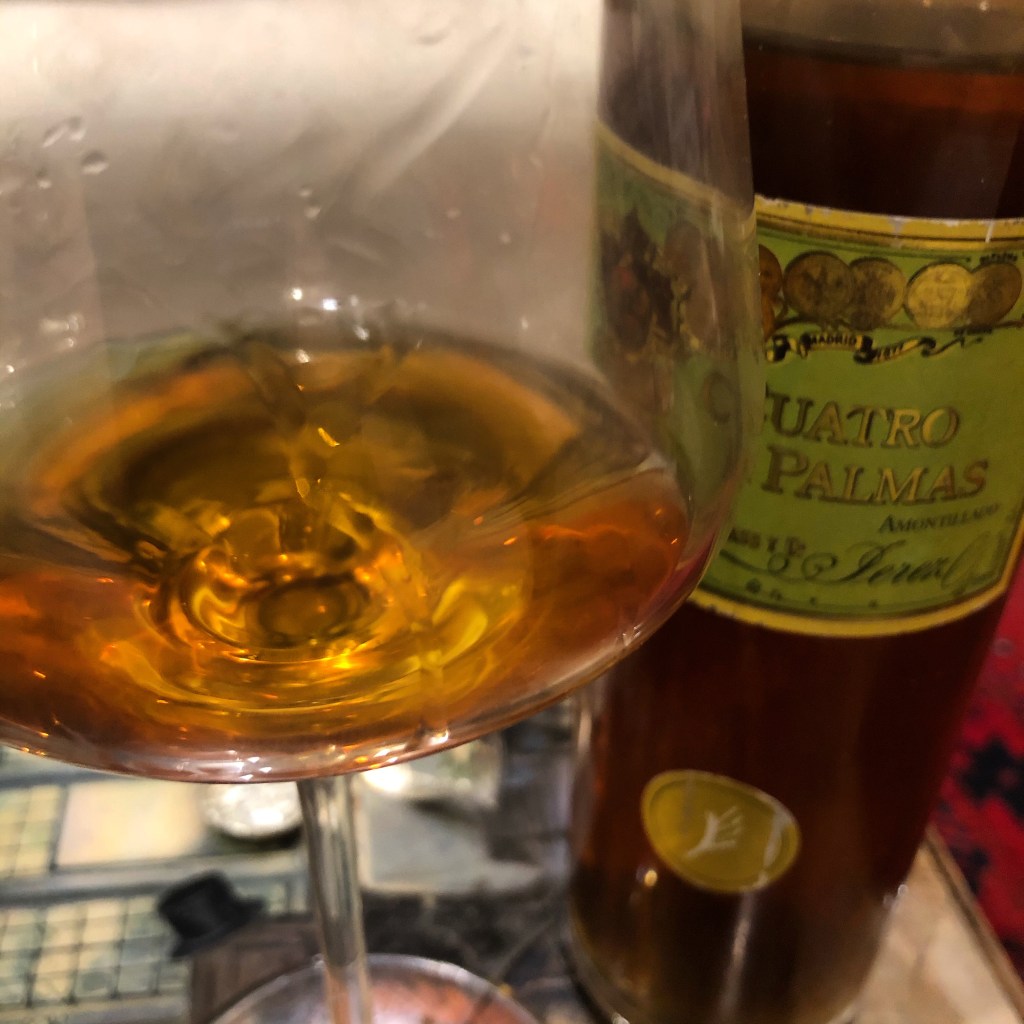
But on the other hand I have them in mind as I drink this excellent wine. A superb example of an old amontillado, this is so fine on the nose, so saline and sharp, and so elegant of profile, with maybe just a fanned out tail like a fiery saline shuttlecock.
Beautiful work from Antonio Flores and the team at Gonzalez Byass back in 2012. Which I now remember is the year I met my friends – and my woe is compounded.
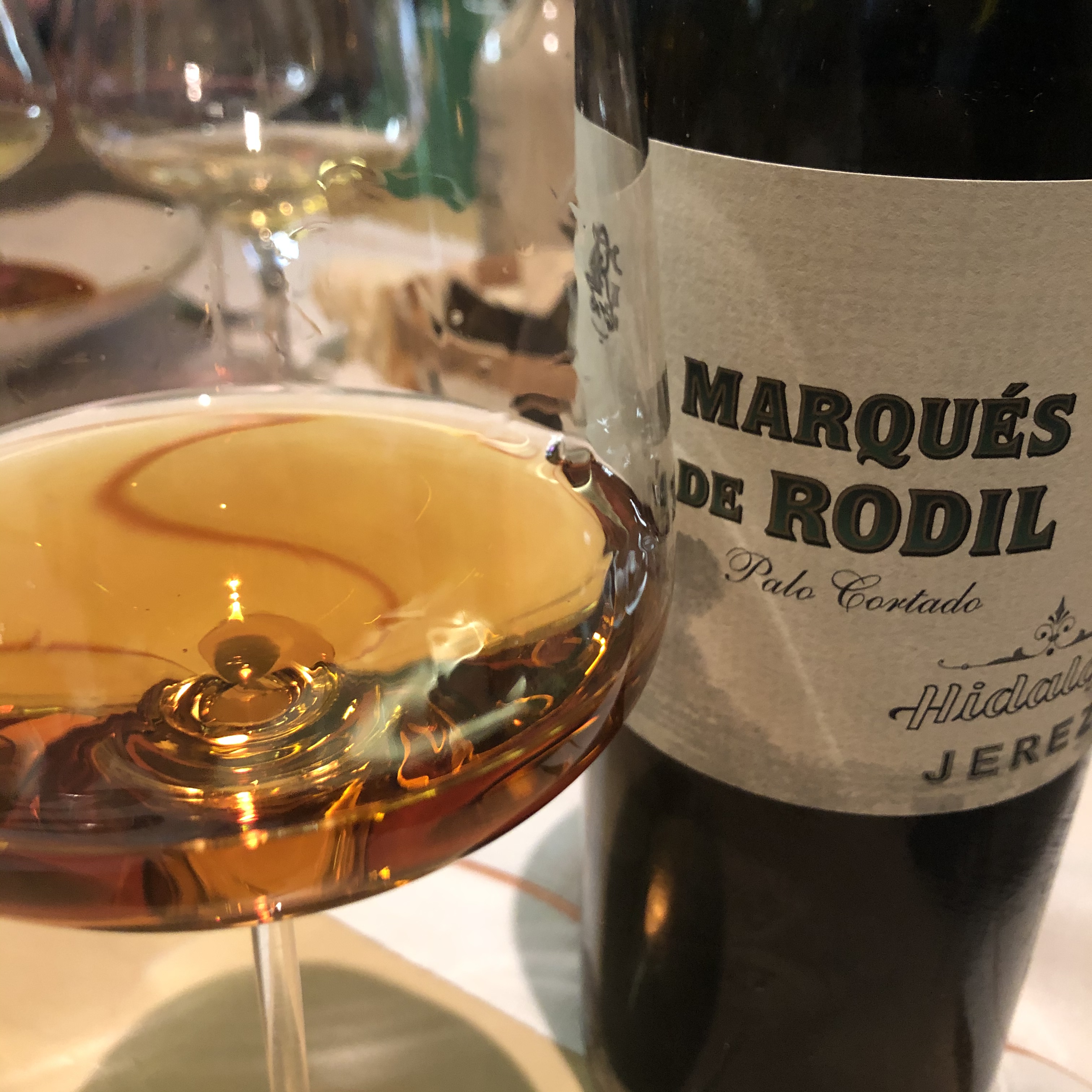
I wrote a few days ago about my discovery of the Huerto de Carabaña bistro in Madrid. Not one of Madrid’s fanciest locales but very enjoyable, in particular the wine service, and in particular when the wine service includes a wine like this.
Marqués de Rodil is sold as a palo cortado, probably the most “commercial” category of sherry around and if you want to know where your wine comes from one of the trickiest. Some makers profess to being mystified as to how it is made (which tells you everything you need to know about the veracity of the marketing involved). In reality, you most often find it is an oloroso made from first press, fine mostos, or base wine that had a fair bit of biological ageing to begin with (something which is more common than you may think) or even just an oloroso that tasted especially “fine” in the casks.
Be that as it may, palo cortados can indeed be absolutely cracking wines. Full in flavour but light on their feet, they can combine the best of all worlds, with a little more elegance than an oloroso and a little more spark than an amontillado.
This one certainly does, it is a beautiful wine. Clear as a bell in consistency and with a lovely copper/gold colour to it. This one was from a freshly opened bottle and had a lovely fragrant nose: nutty toffee steeped in brandy. Then on the palate it was sharp to start, a dry, serious palate of toffee, nuts and heat and a long, flavourful finish.
Really enjoyable wine and no wonder they are big sellers.




 undertheflor.com