Descubrir el Jerez with Los Generosos in La Canibal (aforo completo)

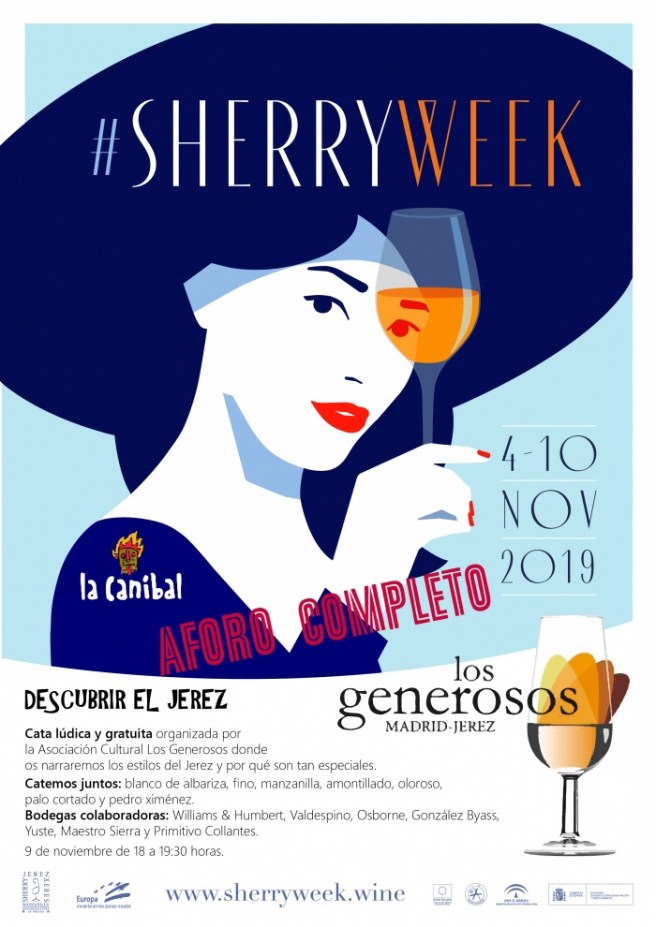
This blog often gets pelters for focussing on small production wines that are unavailable to 99% of readers, but to celebrate this year’s sherry week I am branching out into publishing events that you won’t be able to participate in either.

It is a pity because it is a cracking event, aimed at introducing the wines of Jerez to a wider audience, featuring a really nice selection of the different styles provided by the producers and Consejo Regulador, each of which will be spoken to by one of the Generosos, a club dedicated to drinking and the exaltation of drinking sherry wines of which I am proud to be a member, and in the convivial surroundings of La Canibal.

Such a good event, in fact, that it was already full (50+ signups) even before we had the poster ready. If by any chance you have already signed up I look forward to seeing you there!

Pandorga 2016

Apricots on the nose, bright acidity and a palate of pure apricot jam with a rich, sugary finish.

Pandorga, by Cota 45, is a single vineyard, vintage 100% pedro ximenez from Jerez that is unlike most pedro ximenez you may have tasted. Young and fresh, the grapes have had some sun-drying but not to the point of becoming raisins and the resulting wine is more opulent in fruit on the one hand and (slightly) less loaded with sugar on the other.

And like many of the wines from Cota 45 there is some fascinating wine making going on beneath the surface. Whereas many pedro ximenez wines are made in a way that minimizes the difference between vintages (more sun-drying in cooler vintages, less in warm ones), this wine is prepared in a “procyclical” way. As such, the relatively cool 2014 was given less sub drying, the much warmer 2015 much more, and this something in between. As a result you get three very different wines: just as an indication the 2014 had 12 degrees of alcohol, the 2015 had so little -5% – it couldn’t legally be called a wine, and this one has 11,5%.

Wines that express the varietal and shout out the vintage. And superb wines too!

Socaire 2017

One of the great Cadiz wines, this, a palomino with a touch of class about it, with as much silk as steel and as much flavour as aromatics. Coming back to it once again after a while without (probably last seen at Easter) what strikes me is how balanced it is – how the fruit, bota effects and saline sizzle combine so nicely that you can hardly make out the gaps. A top class wine, no question.

La Fleur 2015 in Zalamero Taberna

It has been a very intense time at work in recent weeks and the first casualties of the tight deadlines are the restaurants that are farthest from the office. As a result I haven’t been to Zalamero nearly as much as I would like. Good food, good wine, good people, nice hatstand, it is one of my very favourite spots.

So it was a double pleasure to get there for a Sunday supper a couple of weekends ago with my esteemed colleague Ruben of SherryNotes (and WhiskyNotes). We had a really cracking dinner, featuring really excellent roast chicken croquettes, mackerel, squid and lamb chops. And we had a really cracking wine too.

La Fleur is a 100% palomino from the folks (Rocio and Alejandro) at Forlong – a young couple of proper winemakers that make a full range of subtly different palominos (and the occasional interloper), all of them class wines and all of them showing off the many qualities of this tragically overlooked grape.

La Fleur is a case in point – has just a touch of flor, and maybe as a result seems a little more floral and sweeter on the nose than many palominos – in some ways bringing it closer to the wines from Jura. Like any palomino it is fresh and juicy on the palate, but again the fruits you find there are more exotic than you might expect – I really associate this wine with sweet apple pies and pastries, and those aromas were still there in this bottle, but over time notes of pineapple came through. And then the back end has plenty of oomph, with a saline finish – a kind of reverse mullet that is party at the front and business at the back.

A lovely wine and perfect for a lovely dinner and occasion.

Elkano

Felt obliged to write something about what was nearly a religious experience this summer up on the basque coast near Sebastian: Elkano in Getaria.

On the night we didn’t even have any sherry, preferring to stick to more local brews, but they had a superb list – including the De la Riva blanco macharnudo and many others, so sherry lovers should feel no qualms about going. And indeed even if they didn’t and whatever qualms you may have you should go anyway.

You may have heard or read about Elkano and its famous rodaballo (turbot), grilled on the coals outside the restaurant. You may even, given the appearance recently of ever fancier grill restaurants all over Spain and further afield, have had other exceptional rodaballos or similar fishes that have been mentioned in the same breath. In my case I had even been to Cataria, Elkano’s sister restaurant down in Cadiz, where I had had the best fish that I had ever been served in my life.

But even then I honestly never imagined how absolutely superb this meal was going to turn out to be. Everything was good – the lobster cooked two ways, the hake cheeks three, and the other little fish that came and went – but the turbot was just out of this world. What was staggering was not simply how rich, how juicy, and how perfectly white and fluffy/flakey the fish was, but the sheer range of flavours and consistencies, all of them expertly pointed out by the resident genius Aitor Arregi.

I can still remember how the guys down in Cataria were full of life, literally bouncing around in their excitement as they explained the fish to us. By comparison, Aitor was a man of few words but maximum information. A priest in the temple of the turbot rather than a ringmaster, no frills added and none needed.

Really exceptional and one of those very rare meals you will remember for your whole life. Turbots never tasted that like before and may never do so again.

Marqués de Rodil in Huerto de Carabaña

I wrote a few days ago about my discovery of the Huerto de Carabaña bistro in Madrid. Not one of Madrid’s fanciest locales but very enjoyable, in particular the wine service, and in particular when the wine service includes a wine like this.

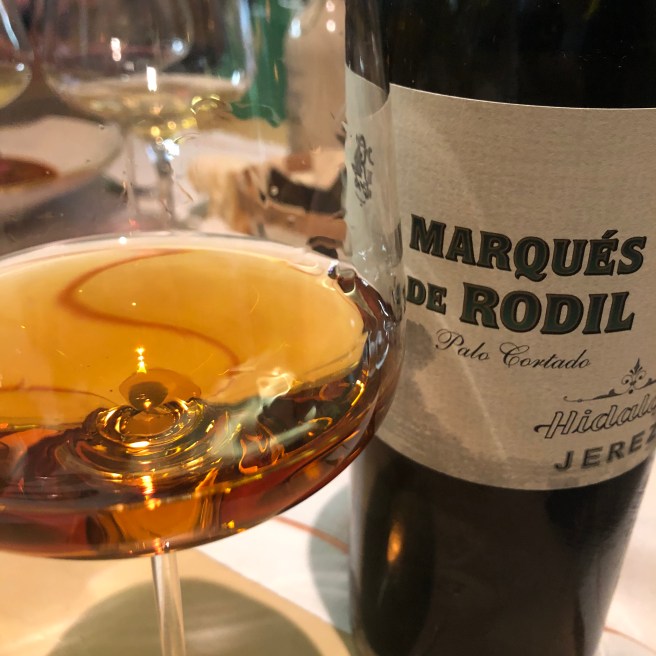
Marqués de Rodil is sold as a palo cortado, probably the most “commercial” category of sherry around and if you want to know where your wine comes from one of the trickiest. Some makers profess to being mystified as to how it is made (which tells you everything you need to know about the veracity of the marketing involved). In reality, you most often find it is an oloroso made from first press, fine mostos, or base wine that had a fair bit of biological ageing to begin with (something which is more common than you may think) or even just an oloroso that tasted especially “fine” in the casks.

Be that as it may, palo cortados can indeed be absolutely cracking wines. Full in flavour but light on their feet, they can combine the best of all worlds, with a little more elegance than an oloroso and a little more spark than an amontillado.

This one certainly does, it is a beautiful wine.  Clear as a bell in consistency and with a lovely copper/gold colour to it. This one was from a freshly opened bottle and had a lovely fragrant nose: nutty toffee steeped in brandy. Then on the palate it was sharp to start, a dry, serious palate of toffee, nuts and heat and a long, flavourful finish.

Really enjoyable wine and no wonder they are big sellers.

La Buena Vida

La Buena Vida is a really top class little bistro run by really nice people with top class cooking (including world class cheesecake) and an excellent winelist, including more than enough sherries for even the most obsessive palominohead.

True to its name, it is one of those places where you can try the things that make life worth living: simple or flamboyant cooking (in truffle season oyoyoy) and wines from every corner of the world and right across the spectrum.

A colleague and I had a relatively simple lunch by la Buena Vida standards – níscalos (saffron cap mushrooms) with potatoes, mallard and that quite splendid cheesecake, washed down pretty liberally with Fino Innocente (not as easy to find as it should be) and the majestic Tradición Amontillado.

The good life indeed!

A 2017 manzanilla La Jaca in Taberna Verdejo

Whereas I tend to pull faces when I get given really old wines I have no problem with the occasional manzanilla with a couple of years in the bottle. They get that touch of oxidation but remain very fine – no inclination towards the potency of a manzanilla pasada but a little bit of the flavour.

This one, a half bottle of La Jaca that had been filled in June 2017, was no exception to the rule. Still fragrant on the nose, but a little bit of old fruit in there with the chamomile, like one of those fruit teas, but wheras the fruit teas always smell better than they taste, this was just fine on the palate. Still fresh and zingy, had a nice dry, nutty palate and if not quite a hint of toffee maybe just a suggestion of nougat.

Very nice little wine, and absolutely at home in what is surely the loveliest little tavern in town.

El Huerto de Carabaña

A moment to reflect on a cracking lunch yesterday at the Bistro of el Huerto de Carabaña.

The bistro is not much to look at. The restaurant section around the corer is fancier, but the bistro is an old school neighbourhood eatery with lighting you would call discreet, smallish tables with even smaller tablecloths, tiled walls, a glass front at one end and the kitchen widen open to view at the other. And given that it is smack in the middle of a neighbourhood full of restaurants at the very top end of whatever interior decoration ranking there may be (and getting higher every week) this is not the place fashionistas in the neighborhood would pick.

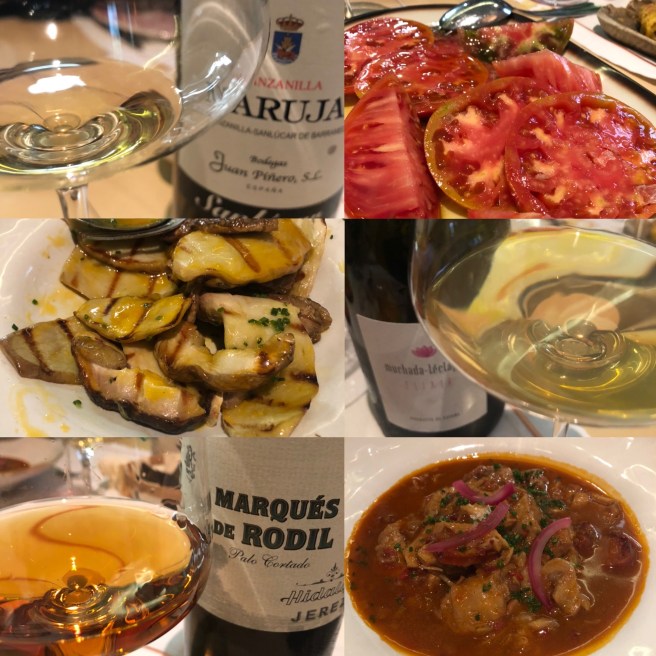
And neither was there anything fancy about the food: tomatoes, boletus and callos (and cheesecake). But there is absolutely nothing wrong with tomatoes, boletus and callos. The place is named for a garden and the motif is rustic: a menu full of grilled and fresh vegetables. Good quality, country cooking. In fact the only “but” I would attach to the solids was that the callos seemed to have a little too much of the garden about them – warm, rich and savoury rather than sharp and spicey.

But the best thing about the lunch was the wine, and everything about the wine. First, no sooner than I sat down than I had a glass of la Maruja in my hand – a really excellent one too from a bottle filled in August (so this has not been sat on a shelf waiting its turn) and served in a Gabriel glass.

Even better was to come. Instead of a wine list, what these guys have is a walk-in wine cellar where you can go and have a look, it is around the corner in the restaurant, and the way to get there is a Goodfellas-style shortcut through the kitchen. Now not everyone would be up for it, but if you don’t love walk-in wine cellars then I wonder why you are reading this blog, and you will have to believe me when I tell you there were some exciting wines in there – a wine loving truffle pig would have a field day.

A sherry loving truffle pig too. They had some quality wines by Tradición and Emilio Hidalgo, including some you don’t see every day, and some classics from the bigger bodegas too, all of them very fairly priced by the glass.

For winelovers they also had some of the rarer, newer wines from Jerez, and we didn’t even have to hunt them out. The sommelier, whose name I didn’t catch but I wish I had, saw our enthusiasm for the Maruja and the Marques de Rodil and proceeded to fish out a bottle of Muchada Leclapart that he had coravined (that cork was not needed any further and a bit of argon was released into the atmosphere).

It all added up to a great lunch, with some terrific wine – from the singing Maruja to an absolutely class, elegant Marques de Rodil – without breaking anyone’s bank and with the minimum of fuss. You may not have noticed the Huerto de Carabaña before, but if you get the chance you should definitely stick your neck in there.
 

UBE Paganilla 2018 in Angelita

Here is a sharp, fresh, fruitful palomino for the doubters if there are any left. The latest UBE, and one of the latest new creations of Ramiro Ibañez is a chip off the old block.

As you can see from the label, it is from a vineyard in the pago Paganilla where the soil is a mix of barajuelas and tosca cerrada, and it may be the power of suggestion but to me those barajuelas come through in the form of white fruit on the nose, more intense, concentrated roast pineapple on the way in and just a hint of grapefruit on the finish.

Excellent stuff and I can feel another outbreak of UBE coming on …