Blind tastings and the many wonders of the sherry triangle

I have written elsewhere on this blog about the excellent Spanish website elmundovino as a great place to find high quality wine writing. In particular I find its historic archive of blind tastings an excellent resource. This week, though, their tasting of sherry wines (Jerez y mas allá – in english, “Jerez and beyond”) was a touch controversial.

For what it is worth, I didn’t agree with the assessment and scoring of several of the wines in the tasting, and I was surprised in particular by some of the tasting notes since they didn’t correspond to my own experiences and recollections (I had to go back and read my own to make sure). More importantly, some actual real experts took to twitter to express their difference of opinion, giving rise to a lively correspondence, some frank exchanges of views and some interesting philosophical contemplation (my favourite contribution was this great post by the guys at enoarquia).

More heat than light was shed overall. Understandably, there was quite a bit of steam being let off. However, some good points were made that set my sluggish neurons into a slow shuffle towards what I euphemistically describe as “thoughts”.

One issue that came up for debate was the old chestnut of blind tasting vs, non-blind tasting (fully sighted tasting? labels out? not sure what the term is). On this I think most agree that blind tasting is preferable, but I think it is also widely accepted that when wines are very different in character it is necessary to have at least some kind of sorting so that an opinion can be formed in context. This seems especially important point for the wines of the sherry triangle, which produces a greater variety of styles than any other region I can think of.

In fact the controversial tasting this week pushed the envelope even by these standards: there were wines of every kind including fortified and unfortified, red and white, still and sparkling and among the fortified wines manzanillas, manzanilla pasadas, fino, amontillado fino, cream and moscatel. I am not suggesting that the panel weren’t able to distinguish them, and I am certain that every care was taken in relation to the order of tasting, but I can’t believe that such a mixed bag provides the best context in which to evaluate a given type of wine. I myself have found that some excellent wines come across very differently in different formats, with some wines (in particular Equipo Navazos’ superb little palo cortados, for example) doing way better in “catas” when tasted against their similar peers.

Another issue that came up is the issue of the “unfortunate bottle”: the concern that in a blind tasting, the taster may not realize that the bottle he or she has tasted is not in condition since they do not know what to expect. Again, I think this can be a critical issue for sherry wines, and in particular in the case of some of the unfiltered or lightly filtered wines that featured in the tasting (I hesitate to use the word “natural” wines, but these are the product of miraculous biological processes that to my ignorant mind simply must be more fragile than your standard grape juice). Simply put, sherry wines are not as other wines and even at the very high end, some bottles come out better than others: I recently had a bottle of La Panesa that was notably more alive and exciting than most I have had. (Of course that could be a result of the saca, but an interesting blog piece by criadera highlighted the enormous differences in evolution of several bottles of an identical wine.)

Finally, and on the tasting notes I always remember a gem of a quote in a post by Jamie Goode on Wineanorak.com – “‘Writing about music is like dancing about architecture” – which I think very neatly sums up the issue. When we look at the case in point, that difficulty is made worse, once again, by the sheer variety of styles in the tasting. To extend the analogy, writing punchy little tasting notes for such a variety of wines must be like discussing different styles of architecture, engineering and geography using only tap shoes.

All in all, I believe the panel gave themselves an impossible task here and as a result got some scores and notes wrong. I for one hope that these wines get another chance – tasted blind by all means, but against comparable wines.

Sex scenes and tasting notes

A mate of a mate is a successful novelist – goes by the name of Marcus Sakey (which is, in fact, his name). His books are really good. I read the first one on recommendation but for the rest needed no encouragement – really good characters, really good stories, cracking writing – you read through the night until you finish. Absolutely top class.

Then I met the chap and he turns out to be a really good lad as well. Sort of chap you could drink beers and whisky with and have a well above average amount of fun. Comes from a stable of good lads over in Michigan and has not let them down – absolute diamond.

But since I met him I have read another of his books and this time, without labouring a point, I now notice the sex scenes.

Before, they were there I suppose. Sex is, after all, a beautiful part of life, even in paperback thrillers, But before I barely noticed.

Now, when I read these descriptions (far from OTT – just beyond banter level in fact) I feel a little bit embarassed and fail to stay in the moment. Imagine one of your mates in the pub describing two other people making love and you will have an idea of the discomfort. The books are still cracking – and I realise I am compounding the issue because if you read one now you will be imagining my discomfort, which may be discomforting – but it is at times like watching a Bond movie with your parents.

Which is why I try to hold back in the drafting of the old tasting notes. I wouldn’t want to come across like Meg Ryan in that deli with that bearded chap even if – occasionally – I feel that way.

The Magic Numbers

img_4924

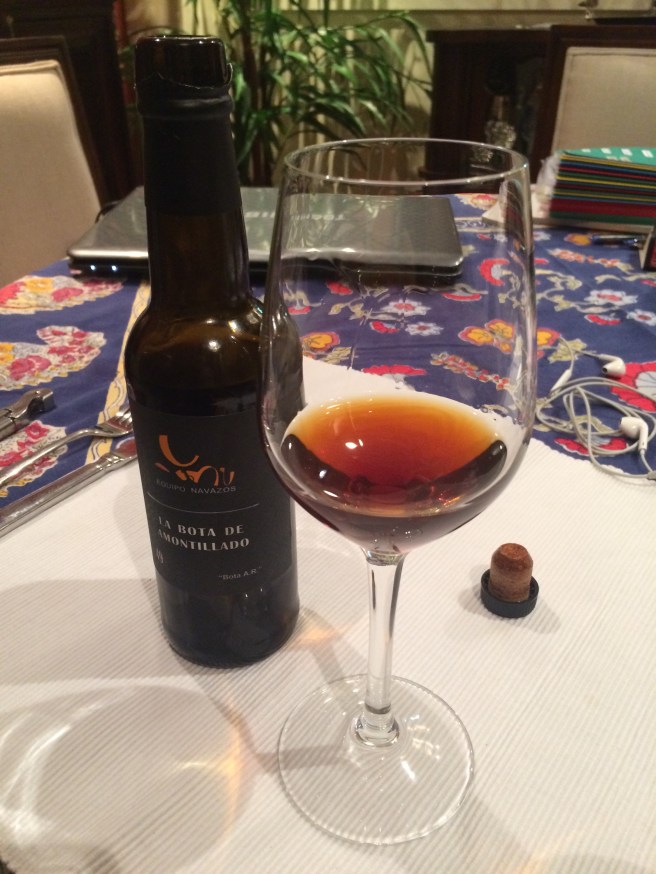
Only recently I mentioned on this blog that I had never tried the Bota de Palo Cortado 41 by Equipo Navazos and providence, in the form of an agile wine merchant, has provided. A bottle of said beverage is now on its way to me – and this is not, it must be said, purely an act of altruistic generosity on the part of the merchant involved: a largeish amount of coinage has already travelled in the opposite direction.

I must admit to certain misgivings. First, this number 41 is a “brother” or “cousin” of Botas 47, 48 and 51, wines of which I have had mixed experiences. Second, I have a growing worry that this blog may be turning into an Equipo Navazos fan page (albeit written by a grumpy, demanding fanboy). There are a lot of sherries out there, why do I keep spending my hard earned wodge on these?

There are of course a number of reasons. All their wines are high quality and some are amongst the best I have ever tasted. They cover a wide range of styles too. Since I started this blog I have cracked open palo cortados, manzanillas, a manzanilla pasada, a fino, a white wine and two amontillados that I can remember, before that I have had olorosos of every stripe, I have a PX in the fridge as we speak and indeed they even have created some new categories – “fino que va para amontillado” and “florpower”. They are also cleverly marketed by genuine enthusiasts – they come with a story behind them which lends them interest and piques your curiosity.

But most of all, there is the magic of the numbers. All of the Equipo Navazos releases are given a number (e.g., the palo cortados mentioned above – releases number 41, 47, 48 and 51) and are strictly limited editions. They may in future release another palo cortado from the same bota, but it will be a different wine with different characteristics, and will get a different number accordingly (witness the manzanilla pasadas – at least the 30 and 40 are from the same bota and the 40 is in a class of its own).

These numbers give the wine something that many of the superb wines from Jerez and around do not have – uniqueness and scarcity. In my view (and this is an area where I know many of my friends in Jerez disagree) that uniqueness is something that all makers should try to achieve. Maybe not by numbering releases necessarily – but by dating the releases, identifying the vineyards and even the special botas involved.

First, because as I mentioned before, you pique the curiosity: sherry fans will want to try every one of your releases to compare them. Even the guys in Jerez that disagree with the idea of identifiable releases will admit that their wines differ from saca to saca, and even if they didn’t, it is fun to check it for yourself and to compare how the same wine evolves over time, for instance.

Second, because a certain kind of wine lover will want to collect them. I am not in this camp with the Equipo Navazos – I try them all and only attempt to stockpile my favourites, but there is one wine I have started collecting every release of – the brilliant Solear en ramas with birds on the labels (I am also a bad birdwatcher, which may explain that).

Third, by differentiating your releases you get a little of the buzz that accompanies the vintages of the wines of other regions – the guys at Gonzalez Byass in particular are very adept at generating buzz around their en rama releases each year, and it is noticeable that they are also leading the field with the single vintage palo cortados (albeit in a slightly more diffuse way – I reckon they could do more with a more disciplined, focussed approach).

Fourth, and this is an important point, you give wine writers and reviewers a reason to regularly review and write about your wines – give them new scores every year (scores which generally drift upwards naturally, it has always seemed to me) – and you give the new generations of writers and reviewers a reason to write about you. Every high score adds to your prestige and generates buzz, and the low scores are soon forgiven or forgotten – the more horses you enter, the better your chances of winning the race.

Of course there is a downside: when I started to hunt around for the last few bottles of my personal favourite, the Bota de Palo Cortado 34, I found that a wine I had first acquired for €36 a bottle might now cost me several multiples (fear not, I hunted around and obtained a reasonable stock for limited damage). I also feel this can be overdone: a specific release is fair enough, but I am not sure it is worth individually numbered bottles and botas.

I also recognize that people who are far, far, more entitled to an opinion than I disagree with me on this entirely. (I wish I could explain to you their reasoning but I generally only get to discuss it after quite a quantity of quaffing.) It is easy to see that this approach would significantly complicate the business of selling sherry – and that a large amount of the added value may end up in the hands of retailers.

On the whole though, I am in favour of limited and dated releases, of identifiable vintages and vineyards, and of doing anything at all that might help the bodegas of jerez make truly unique wines or, at the very least, bring the superb wines they do make back to the front of the mind of the world’s wine writers and drinkers.

What is the score?

The keen eyed amongst the half dozen readers of this blog will have spotted that two of the wines from an epic dinner of last week – the Toneles and the AR – are from the select band of wines blessed with a “score” of 100 points by the famous Mr Parker (or in Spain, the great Mr Gutierrez).


It was a pretty good dinner alright – and also an excellent demonstration of just how difficult this scoring business is – in particular, imho, in the world of sherry.

Because the Toneles was just out of this world – something completely unique and amazing, for which 150 points would not have been too many and 100 points totally failed to tell the story. By comparison, the AR, while still unique and amazing in its own way, was left a little bit exposed.

A lot of this would have been a result of the vast differences between the wines, and maybe it was unfair to compare. Indeed, colleagues (who had kindly contributed some stellar bottles themselves) explained to me that the points scale is not intended to provide for comparisons across genres.

Still, it makes you realize how shockingly hard scoring wines really is. Tasted in a line up of other aged amontillados and palo cortados I am sure the AR would have impressed due to its power and range of flavours, but on its own it was a bit eye watering and didn’t seem balanced at all. On the other hand, how can you hope to make sense of the subtle differences of similar wines other than by tasting flights together?

A number of friends have suggested I start putting scores on here for the wines I taste. Last week confirmed my suspicion that it is not nearly as easy as it seems.

How to be a bad sherry blogger

At least in part this blog – and in fact my interest in wine in general – was inspired by Simon Barnes’ terrific book How to be a Bad Birdwatcher.

The thesis of the book (subtitled “To the Greater Glory of Life”) is really that life is enriched by the mere act of lifting up your eyes and enjoying the things that are all around us, and that the more you learn about them, the more you enjoy.

If I remember right, the first piece of advice is simply that the next time you see some birds fly by, you should look at them and observe how amazing they are. The second, that you should enhance your pleasure by learning something about them. After that, you will find that the knowledge enables you to identify those birds and discover new birds, seek out information on the new ones, and so on. The knowledge then accumulates and the more you know, the more you enjoy, and then at some point I think you start hiding under blankets in fields with long lenses.

It is fantastic and I can’t recommend the book too highly. After reading it I really did start birdwatching – and even got into some amusing situations with binoculars in public parks – but I soon realized that the same rules apply in other fields.

Specifically, I noticed how much more you get out of wine when you really try and observe it – when instead of glugging it down you take a moment to look at it in the glass, smell the aroma and splash it around your tongue and tonsils. Then you start learning little odds and ends – winery visits are great for this – and, before you know it, you feel like you are beginning to understand things, and really enjoying it.

In my case, I have found that the blog adds to the fun. It has given me an excuse/a prod to drink a few different sherries already (and I have some real goodies lined up), has forced me to try and observe them and even to try and put my observations into words. The latter part is a lot more difficult than I expected (I frankly admit some of the descriptions are based more on inspiration than information) but it is also highly enjoyable – once your imagination starts telling you a sherry  tastes of caramel, or nuts, or herbs, or bread, then it doesn’t take much more.

And there is also some cracking bird watching around Jerez, or so I am told.

Table wines?

There is a belief that top class sherry needs to break out of its “aperitif/digestif” typecasting and take its place at the center of the dinner table.

It can certainly do it – olorosos or palo cortados in particular lend themself to the task with their dry acidity and mellow/spicy flavours and are superb with meaty roasts and even spicey stews (if you havent tried oloroso with callos a la madrilena you really should). Lighter finos and manzanillas stand up well with seafood and tastier fishes, and dry, full bodied finos (like the Panesa or Tradicion) and amontillados really complement creamy sauces. In fact, there are many foods – very green greens like artichokes, asparragus, or rocket, or pickles and vinagrettes – that really cry out for a sherry.

On the other hand, the dinner table is not short of pretenders – the entire world of wine, not to put too fine a point on it – and one does wonder whether this is the right battle in strategic terms. There is nothing lost by trying, of course, but it may be a mistake to limit options.

At the end of the day there is nothing wrong with being an aperitif – I would rather have a glass of sherry than many beers and wines, proseccos and pink spritzers. Of course, to an extent it depends where you want to be in the supermarket – the company you want to keep etc. – and the price bracket you want to be in. Sherry as the new champagne?

Equipo Navazos

Equipo Navazos (Team Navazos) originated as a group of enthusiasts who would visit bodegas in search of the “special” soleras and even individual botas and has evolved into a label that has played a huge role in bringing fine sherry wines to the attention of the wine drinking public worldwide.

They still sniff out prize “botas” from classic bodegas but now they release them for sale in numbered bottlings – they are now in the high 50s – some of which are cracking wines – like this little beauty. (In fact the first wine that really made me sit up and take notice of sherry was an Equipo Navazos Palo Cortado.)

It is a gem of a formula. They have released a wide variety of different wines across every category (even inventing new ones, if you believe everything you hear) and with a clear emphasis on characteristics and quality. By numbering the releases, they also create vintages/scarcity – explicitly recognizing that wines do evolve differently over time, permitting comparisons of development through bottle ageing and, lets face it, appealing to the trainspotter/collectionist type of wine buff.

There is, of course, a downside. If every bodega were to separate the prize barrels, the rump would inevitably decline, while the major beneficiaries of the scarcity may not be the makers but rather the stockists: already bottles of low number Navazos wines can be obtained from opportunists at greatly inflated prices. In their exuberance they can also, maybe, get it slightly wrong: some of the releases are more interesting than enjoyable, while some can be accused of being “test tube wines”, ideal for blind tastings but a little over the top for a dinner party.

There is no doubt, though, that Navazos have made a great contribution to promoting interest in fine sherry wines in critics and winelovers worldwide and in leading the charge towards distinctive, select bottlings. Their heart is in the right place and their work is of a very high quality. If you find some, buy it!