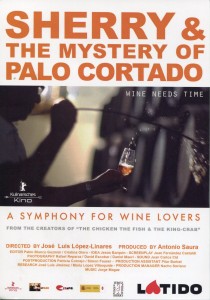
It has been a long time coming – I was originally asked to go to an early showing of this in Madrid (I believed the premiere but can’t be sure). I didn’t make it and since then one opportunity after another has passed me by. Now, once again thanks to the good offices of the unequalable Ruben at Sherry Notes (who already wrote about this back in January and February) I have had a chance to have a look and thought it would be rude not to share my views.
It has been received rapturously by some and not so much by others (this review in Variety is a good example). I have to admit I had had my doubts about it. I really dislike the blarney that sometimes surrounds palo cortado – the supposedly mysterious, magical wine that is “born” rather than “made”; and when I saw the title of this I feared the worst.
So I finally sit down to watch it and must say I enjoyed it. Frankly, it is a better documentary than the title made me expect.
To start with, there are a lot of heroes (and even friends) in here. If you love these wines you should take a look to have a chance to listen to the people that make them, write about them and serve them to you. From memory: the guys behind Equipo Navazos (Eduardo Ojeda and Jesus Barquin), Paola Medina (Williams & Humbert), Jan Pettersen (Fernando de Castilla), José Ramon Esteve (Esteve, evidently), Antonio Flores (GB), Pilar Pla Pechovierto and Ana Cabastrero (Maestro Sierra), Alvaro Giron Sierra, Paz Ivison, my man Guillermo Cruz, the Sherry Women, Cesar Saldaña, Beltran Domecq, Pitu Roca, Andoni Luis Aduriz, even David Muñoz pops up (and has a pop) — the list goes on. In particular it was great to see the Equipo Navazos guys at work – am a big if slightly grumpy fan of their wines and it was nice to put a face to all that endeavour.
Second, it has a wider reach than just palo cortado. It really is more of a general sherry documentary and covers a lot of good ground – not too much explanation of the basics, and it manages to touch on a lot of good stuff: the importance of terroir and harvest, the skills of the cellarmen, the characters of the different wines.
Third, it is beautiful to look at. There are some beautiful images of countryside, bodegas, vineyards, the town of Jerez, restaurants, bars, stews, not to mention the pimped up gaffs of some of the big families (the expression “decent drum” doesn’t cover it). There is nice archive footage of harvests, wine making, the criadera system, and flamenco singing. There are some touching stories of multiple generational involvement, life long fascinations, personal fascinations (the Roca lads were brought up in the “Andalucia town” of Terrat) and struggles (although a potentially moving story from Pilar Pla Pechovierto could have been followed through a little). And of course there are a lot of interviews with the above mentioned luminaries, which are neatly strung together and full of nice nuggets.
And the story being told? Well in the end I find it hard to disagree, although I am sure that a lot of people in the business will do. If I had a criticism it would be that amid all the camerawork and talk of marketing and pairings you can lose track of the fact that we are talking about wines. Yes there is a segment on the pagos, there are snippets (which I loved) on their qualities (the macho macharnudo and the feminine, flowery miraflores) and on the importance of the soil and the vine. Nevertheless, the wine, the wine making, the skills, all get a little lost in the visuals and talking heads. (From some of the snippets I bet there is a lot of this on the floor of the editing suite.)
And the mystery? The mystery is why they called it the mystery of palo cortado. Not only is there no real mystery these days (and here I defer to the great Jesus Barquin), but if there was, the mystery is neither announced or explored at any length – it is announced and immediately shot down! (Yes, there are some frankly vexing references to it being a “rebellious wine” and the like – but nothing too over the top.) in this sense for me the film is summed up by a moment at the end when Cesar Saldaña has time to say “I tend to prefer amontillado … ” but just as he says “but a palo cortado is …” he gets cut off. Classic stuff.
All in all, I am glad to have seen it and think the world would be a better place if more people did likewise. (They are pushing on an open door convincing me that we should all drink more wines from Jerez and Sanlucar.) However, I really feel they slightly missed an opportunity to appeal to a more critical public. There was some good nuggets dispersed through the piece but when it came to the moment for critical argument all we had was (necessary) generality, some affirmation (a 100 year old wine may be history, but why history good? Is it great wine?) a bit of David “Dabiz” Munoz saying it was “brutal” and rock and roll and a little bit of blarney.
Still, bravo, or, more to the point, cheers! I have had a fair few glasses to help pass the time as you may have guessed.


 undertheflor.com